Which Is the Best Way to Invest in Real Estate? Comparing Fractional, REITs & Direct Ownership
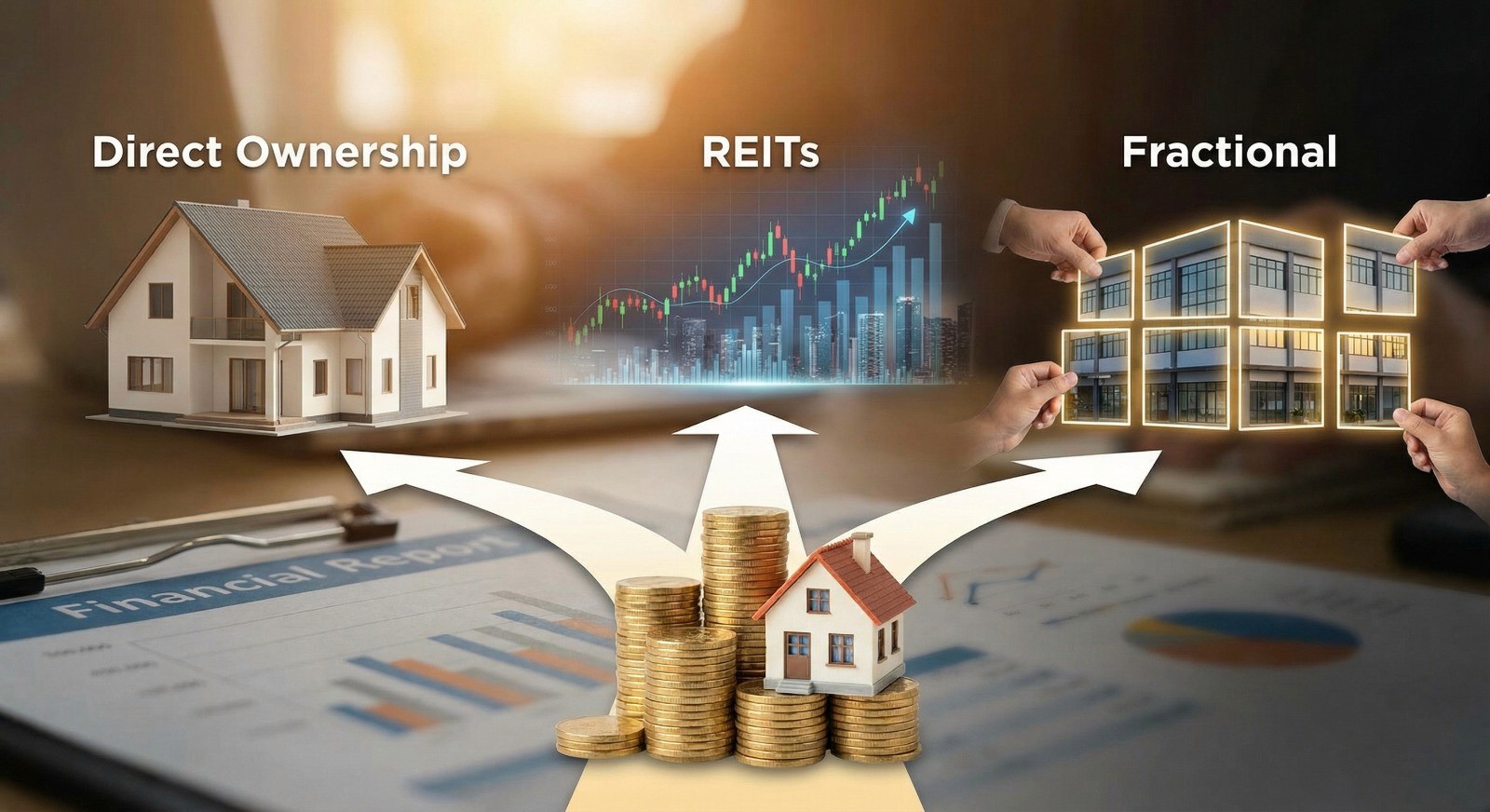
At some point, wealth stops being about “how much you earn” and starts being about what your money is doing for you. That’s usually when real estate enters the frame. Do you lock in one big property, take the market-linked route with REITs, or choose the newer, quieter middle path of fractional investment?
Are you still asking what is best, or have you transitioned to - “Which is best for what I want my money to do in the next 5, 10, 20 years?”
Traditional Real Estate: One Big Bet
Traditional real estate is the classic Indian favourite. A whole property in your name, a loan, and the emotional satisfaction of “owning something real.” The emotional part is excellent. The financials, however, need a closer look.
Scenario: Buying a ₹1.5 crore apartment as an investment
Property price: ₹1.5 crore
Down payment (30%): ₹45 lakh
Loan amount: ₹1.05 crore
Interest rate: assume around 7–8% over time (rates change with markets and lenders)
Tenure: 20 years
At these levels, EMIs on a ₹1 crore loan over 20 years typically sit in the mid-₹80,000s to low-₹90,000s range, depending on the exact interest rate and lender. For a ₹1.05 crore loan, you are broadly looking at a monthly outgo around the ₹90,000 mark.
Now factor in:
Stamp duty and registration: often 5–7% of property value
Maintenance charges and periodic repairs
Possible vacancies if you rent it out
Total cash outflow over 20 years (principal + interest + costs) can end up significantly above the original ₹1.5 crore tag, especially if interest cycles move against you for part of the tenure. On the income side, typical residential rental yields often hover around 2–3% per year on property value.
So, if that same ₹1.5 crore apartment rents for, say, ₹35,000–₹40,000 a month (₹4.2–4.8 lakh a year), your pre-cost yield is roughly in that 2–3% range. Not terrible, but not aggressive either.
What this means in plain terms:
You’re tying up ₹45 lakh of your capital as a down payment.
You’re committing to a significant EMI for 20 years.
Your returns depend heavily on long-term appreciation + modest rent.
When traditional wins:
You want self-use and emotional security.
You’re comfortable with long-term EMIs and concentration in one asset.
You value control over diversification.
REITs: Real Estate with a Market Flavour
REITs (Real Estate Investment Trusts) offer a more straightforward, more liquid approach. You don’t buy property, you buy units that represent a share in a portfolio of income-generating assets (typically Grade-A offices, some retail, etc.).
In India, REITs:
Are listed on stock exchanges.
Are regulated by SEBI.
Distribute a large portion of their rental income to investors.
Recent market data suggests Indian REITs have been delivering distribution yields roughly in the 6–7.5% range, with total returns influenced by both income and price movement.
Scenario: How ₹20 lakh behaves in a REIT:
You invest ₹20 lakh into a listed REIT.
At, say, a 7% annual distribution yield, that’s around ₹1.4 lakh per year in payouts (before tax), plus any capital appreciation over time.
You can exit partially or entirely by selling units on the exchange whenever you want market liquidity.
There’s no EMI, no property-specific risk, and no tenants to manage. But you also:
Don’t choose the exact properties in the portfolio.
Have to live with stock-market-like price volatility along the way.
REITs are great if you see real estate as an income-generating, semi-defensive piece of your portfolio, and you want the convenience and liquidity of listed securities.
When REITs work well:
You want real estate-linked income with stock-like liquidity.
You prefer a regulated, transparent structure.
You’re okay with short-to-mid term price volatility.
Think of REITs as the “mutual fund version” of real estate: diversified, liquid, and professionally managed-but one step removed from the actual bricks and mortar.
Fractional Real Estate: Direct, Flexible, and Focused
Fractional investment is where things get interesting for today’s investor. Instead of buying 100% of a property or taking exposure through a pooled REIT, you co-invest in a specific property along with other investors through a structured vehicle (often an SPV).
FRAX, for instance, focuses on curated retail properties, well-located, income-generating assets that see real, everyday consumer footfall.
Scenario: What it looks like in practice:
Property value: ₹5 crore
Investors come together via an SPV.
Minimum investment: say ₹10–25 lakh per investor.
Rental yield: often in the 7–10% annual range, depending on asset quality, location, and lease structure.
Holding period: commonly 3–5 years, planned around exit strategy and market conditions.
How ₹20 lakh behaves in fractional real estate:
You invest ₹20 lakh into a ₹5 crore retail asset through FRAX platform.
At a 9% annual yield, that’s about ₹1.8 lakh per year in rental income (before tax and fees).
Over a 4–5 year horizon, you also participate in any capital appreciation when the property is sold or exited.
You don’t:
Take on a loan or EMI.
Handle tenant interactions, rent collection, or documentation-that’s managed by the platform and asset manager.
But you do:
Know exactly which asset you are invested in.
See returns tied to that specific property’s performance, not a large, anonymous pool.
Liquidity is not as instant as REITs, but secondary options and planned exits are increasingly part of fractional models.
When fractional shines:
You want direct property exposure without taking on a significant EMI.
You prefer higher income visibility and clarity on the exact asset.
You like the idea of diversifying across multiple properties over time, using smaller tickets.
If traditional real estate is owning the whole restaurant, and REITs are buying shares of a restaurant chain, fractional ownership is like owning a meaningful stake in one prime outlet you’ve carefully selected.
Snapshot
Aspect | Traditional | REIT | Fractional |
Capital Needed | Very high | Low | Medium |
Liquidity | Low | High | Medium |
Asset Linkage | Direct (single asset) | Pooled portfolio | Direct (specific asset) |
Income Visibility | Medium (depends on tenant & EMI) | High (regular distributions) | High (lease-driven) |
Diversification | Low | High | Medium |
Control | High | None | High (asset-level) |
FRAX - Making Fractional Investment Frictionless
FRAX steps in to make fractional investment in retail real estate accessible, structured, and thoughtfully curated. The platform handles asset discovery, due diligence, legal structuring, and ongoing management. It fractionalizes premium real estate so anyone can invest in verified, SEBI-regulated, RERA-compliant assets under the Small and Medium REIT (SM REIT) framework, with as little as ₹10K. No brokers, no hidden fees.
For young investors in their 30s, 40s, and beyond-juggling careers, families, and long-term goals - FRAX offers a practical bridge between capital-heavy traditional investments and market-driven REITs. It lets your money participate in high-quality, premium properties without the usual operational friction. Ready to make your money work smarter? Explore FRAX and see how fractional investment fits your portfolio - no significant commitments required.
Learn more
Discover more from the latest posts.