
Top Indian Cities for Real Estate Investment in 2026
Discover the best Indian cities for real estate investment in 2026. Focus on jobs, infrastructure, and renters for steady returns and growth.
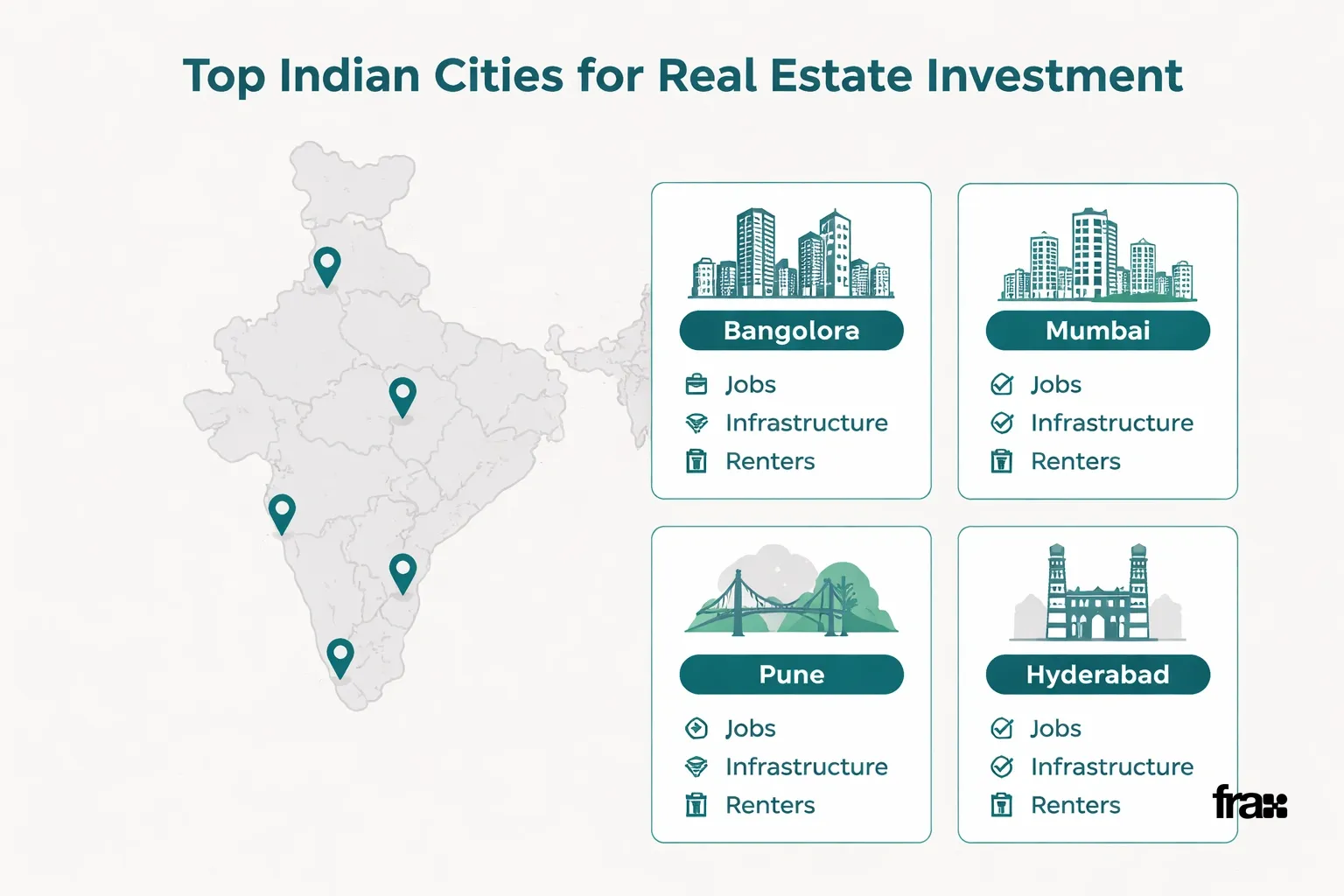
Where should you actually put your money in Indian real estate in 2026? It usually comes down to three things: jobs, infrastructure, and renters. That's why Mumbai, Pune, Bengaluru, Hyderabad, Gurugram, and Chennai keep dominating the conversation. They all have the IT growth, metro expansions, and steady price bumps needed to keep both residential and commercial properties moving.
Honestly, choosing the right city matters just as much as how much cash you're throwing at it. Buy in the wrong place, and your property just sits there eating holding costs. Pick the right micro-market, and you get steady rental income plus decent appreciation. Here is a breakdown of where to look, what to avoid, and how to actually get in the door.
This content is for informational purposes only and does not constitute financial, legal, or investment advice.
What makes a city good for property investment in India
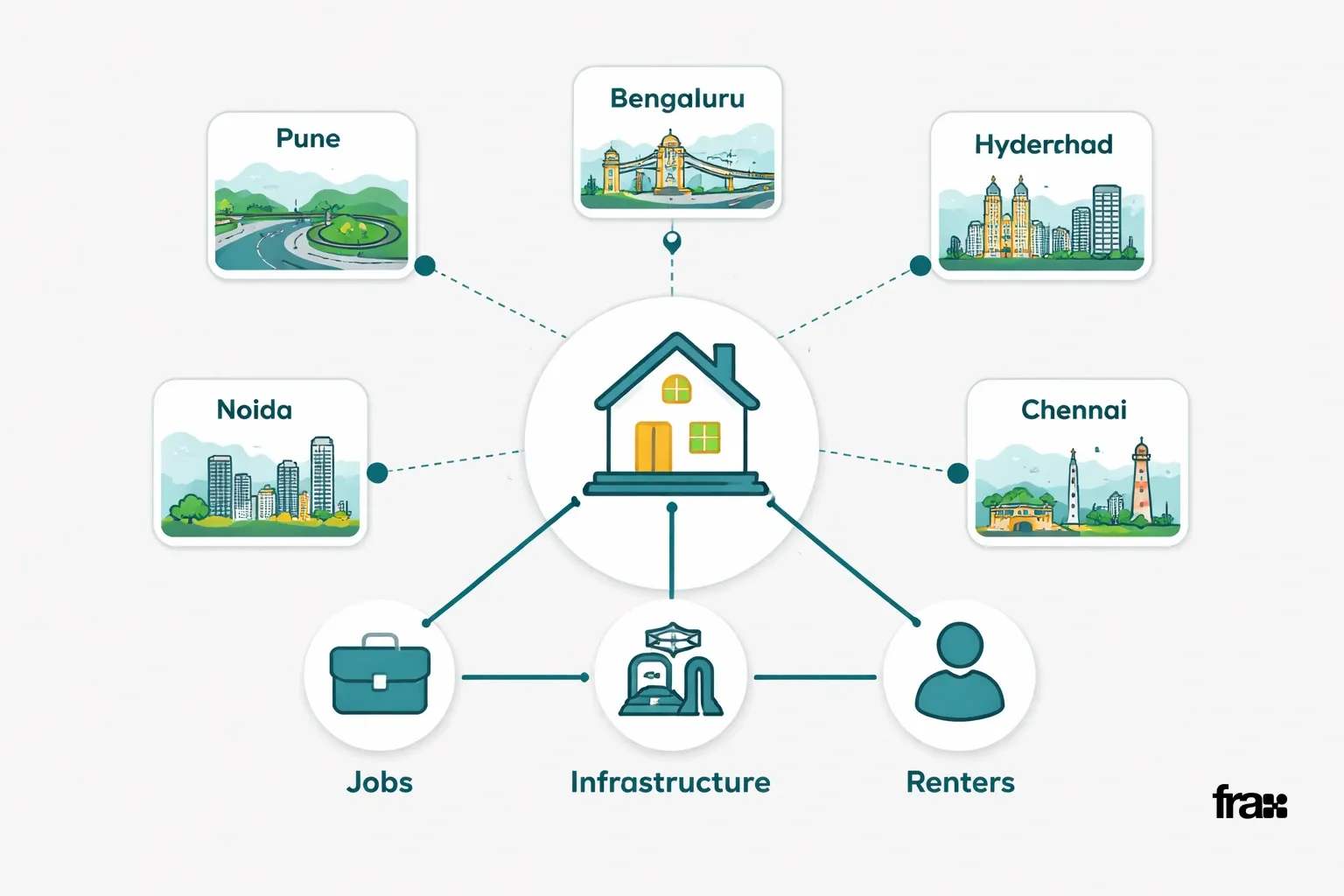
A city makes this list because it actually has jobs, infrastructure, and renters. If those three aren't working together, a cheap entry price is just a trap. You'll end up with a property you can't lease and can't sell.
Big infrastructure builds like new metro lines, expressways, or airports almost always bump up surrounding property values. Look at Pune's Ring Road or Bengaluru's Peripheral Ring Road in 2026. But infrastructure only matters if people have jobs to pay the rent or EMIs.
That's why corporate presence is the glue holding it all together. A city with shiny new roads but no offices will struggle to fill apartments. Hyderabad and Gurugram win here because their IT parks and business districts create a steady pipeline of tenants. You can see exactly how these state-level growth patterns play out in our breakdown of India's state GDP growth and real estate impact.
This content is for informational purposes only and does not constitute financial, legal, or investment advice.
Mumbai and Pune: Western India's property investment hotspots
This content is for informational purposes only and does not constitute financial, legal, or investment advice.
Mumbai is still India's most expensive and most liquid market. Pune has quietly become its affordable, high-growth cousin for investors who want better entry yields.
In Mumbai, the central and western suburbs, including Andheri, Powai, and Thane, keep attracting premium money. But the entry costs are brutal. Retail investors usually need crores to play directly. Pune is a different story. Places like Hinjewadi, Wakad, and Kharadi are riding IT sector growth but at much lower price points.
City | Average Entry Cost | Key Driver | Investor Profile |
|---|---|---|---|
Mumbai | Very High | Financial hub, limited land | High-net-worth, institutional |
Pune | Moderate | IT corridors, affordable housing | Young professionals, first-time investors |
Here's what's interesting: Pune's rental yields often beat Mumbai's on a percentage basis, even if the absolute rent numbers are lower. Past performance and realized XIRR figures are historical and do not guarantee future property returns or rental yields. If you care about cash flow rather than prestige, Pune is incredibly attractive. To see how these two stack up against other emerging markets, check our guide on the top cities for fractional real estate investment in India.
Bengaluru and Hyderabad: Tech hubs driving property investment in India
If Mumbai and Pune are the western hubs, Bengaluru and Hyderabad are driving the commercial story through IT and biotech. Both cities are packed with global tech campuses, which can lead to a steady stream of renters near business districts.
In Bengaluru, Whitefield, Electronic City, and Sarjapur Road remain the go-to spots for residential investments tied to IT jobs. Hyderabad's Gachibowli and HITEC City are playing the exact same game, just with a lower cost of living and faster approval times. I find that Hyderabad is often slightly cheaper per square foot than Bengaluru, yet it pulls in similar rental demand.
Both cities have seen commercial real estate investments surge right alongside residential demand. Grade A office spaces here pull in multinational tenants, which helps support long-term returns. If you want a structured way into these markets, our step-by-step beginner's guide walks through the entire process.
This content is for informational purposes only and does not constitute financial, legal, or investment advice.
Explore Premium Properties Starting at ₹10,000
Delhi NCR and Gurugram: National Capital Region's property investment appeal
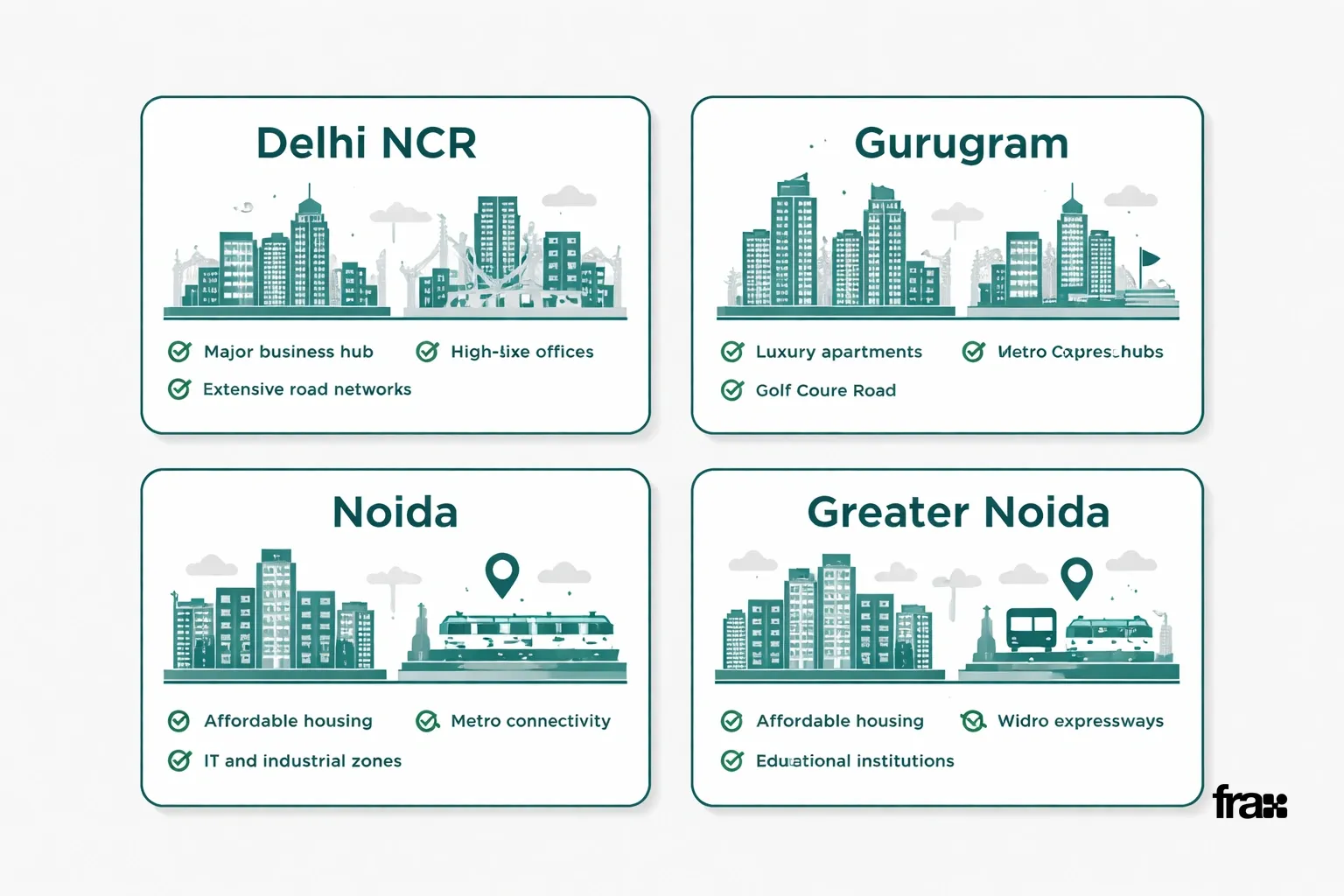
Delhi NCR gives investors access to India's biggest consumer market and a very mature commercial setup. Gurugram, in particular, stands out for corporate real estate and high-end residential demand.
Gurugram's Golf Course Road, Sohna Road, and Dwarka Expressway corridors keep pulling in both domestic and NRI money. The city has Delhi next door, great road connectivity, and a pile of Fortune 500 offices. If you want something cheaper in the same region, Noida and Greater Noida are the usual alternatives.
But NCR is fragmented. Because it crosses state lines, the regulatory environment changes depending on where you buy. You can't treat it as one uniform market: you have to research the specific micro-market. That complexity is exactly why a lot of investors are shifting toward structured, pre-vetted routes into premium NCR properties rather than buying directly.
This content is for informational purposes only and does not constitute financial, legal, or investment advice.
Chennai and Ahmedabad: Emerging property investment destinations
Beyond the usual metro circuit, Chennai and Ahmedabad represent the next wave of property growth. Both combine lower entry costs with rising industrial and IT activity.
Chennai's OMR corridor, basically India's IT Expressway, has been pushing residential demand for over a decade. The city also leans on port-led logistics and automotive manufacturing, so it isn't overly dependent on IT. Ahmedabad, on the other hand, has turned into a massive hub for industrial and logistics real estate thanks to Gujarat's aggressive manufacturing push.
You'll usually see lower price points per square foot in Chennai and Ahmedabad compared to Mumbai or Bengaluru. That makes them great if you want to diversify without dumping all your cash into one expensive market. We cover these emerging spots alongside the established hubs in our analysis of the top 10 best places to invest in India.
This content is for informational purposes only and does not constitute financial, legal, or investment advice.
How to choose the best place for property investment in India
This content is for informational purposes only and does not constitute financial, legal, or investment advice.
Picking a city means balancing infrastructure, rental yield, liquidity, and how long you actually want to hold the property. There's no universal right answer; it really comes down to what you're trying to achieve.
Factor | What to Check | Why It Matters |
|---|---|---|
Infrastructure pipeline | Metro, expressway, airport projects | Drives long-term appreciation |
Rental yield | Current rent versus property price | Determines cash flow quality |
Liquidity | Resale demand, time to exit | Affects how fast you can sell |
Economic diversity | Multiple industries, not just one sector | Reduces concentration risk |
Single-industry cities take a beating during economic slowdowns. We break down how to hedge against that in our piece on India's 2026 economic slowdown and real estate strategies. Also, pay close attention to liquidity. Even in a strong market, traditional real estate can sit on the market for months before you can exit.
Property investment in India without crores: Fractional ownership route
Let's be real: most people don't have crores lying around to buy premium real estate outright. Fractional ownership fixes that, letting you get into property investment in India starting with just ₹10,000.
Platforms like FraX put each property under a dedicated LLP SPV, meaning one property corresponds to one LLP. You hold direct beneficial partnership interests in these SPVs, not direct individual property titles. The money runs through an ICICI Bank escrow account, and Universal Trustees oversees the whole thing independently. It adds a serious layer of financial safety.
What I like about this is that you can spread smaller amounts across different cities instead of tying all your risk to one property. You could take ₹50,000 and split it between Pune, Hyderabad, and Chennai instead of dumping it into a single Mumbai flat. For a full breakdown of how this model works mechanically, read our guide on fractional real estate investing in India.
Start Diversifying Your Property Portfolio Today
If this is completely new to you, our guide on starting fractional real estate in India with ₹10,000 covers four distinct ways to begin. It's worth reading before committing capital to any specific city or property.
Common mistakes to avoid in property investment in India
People lose money in real estate when they chase price appreciation and ignore who is actually going to rent the place. A city's growth story doesn't mean a thing if tenants aren't moving there for jobs.
Over-concentration is another classic mistake. Investors dump everything into one Mumbai flat, and then panic when that specific micro-market cools off. Diversifying across cities and property types takes that risk down significantly.
Do your legal homework, too. Don't skip checking the escrow structures and whether independent trustees are actually watching the money. Our glossary for fractional real estate investment terms can help you understand the vocabulary before signing anything. For a deeper look at balancing risk against reward, our smart investor's guide to fractional real estate breaks down practical frameworks.
This content is for informational purposes only and does not constitute financial, legal, or investment advice. Investors hold direct beneficial partnership interests in dedicated LLP SPVs, not direct individual property titles. Past performance and realized XIRR figures are historical and do not guarantee future property returns or rental yields.
Frequently asked questions
This content is for informational purposes only and does not constitute financial, legal, or investment advice.
Q: Which city is currently best for property investment in India? A: It really depends on what you're optimizing for. Pune and Hyderabad often provide different rental yield profiles at lower entry costs. Mumbai and Bengaluru are more expensive, but they offer higher liquidity if you need to exit fast. Past performance and realized XIRR figures are historical and do not guarantee future property returns or rental yields.
Q: Can I invest in property in multiple Indian cities with a small budget? A: Yes. Fractional ownership platforms let you split smaller amounts (starting at ₹10,000) across different cities. You don't have to tie all your money to one location.
Q: How does infrastructure development affect property investment decisions? A: Better roads and transit mean easier commutes, which pushes property values up over time. A new metro line or expressway usually signals long-term appreciation for the surrounding corridors.
Q: Is Tier 2 property investment in India, like Chennai or Ahmedabad, safer than Tier 1 cities? A: "Safer" depends on the local economy, not the city tier. Both Tier 1 and Tier 2 cities carry risks. It's more important to check if the city has a diversified job market and solid infrastructure pipeline.
Q: What role does rental yield play in choosing a property investment location? A: Rental yield tells you how much income the property spits out compared to its price. If you want cash flow and aren't just holding for appreciation, higher yield locations matter a lot.
Q: Do I need crores of rupees to invest in premium Indian real estate? A: No. Fractional ownership structures, like the ones offered through FraX, let you access premium properties with tickets starting at ₹10,000, spread across dedicated LLP SPVs. Investors hold direct beneficial partnership interests in dedicated LLP SPVs, not direct individual property titles.
Learn more
Discover more from the latest posts.