

5 Modern Ways to Invest in Indian Real Estate Without Crores
Explore 5 modern, low‑barrier ways to invest in Indian real estate-REITs, fractional ownership and more for flexible digital investing.
This content is for informational purposes only and does not constitute financial, legal, or investment advice.
If you're trying to get into Indian real estate, you basically have five paths: buying physical property, REITs, real estate mutual funds, real estate investment companies, and fractional ownership platforms. They all demand completely different amounts of money, patience, and paperwork.
I keep hearing the same thing from younger professionals and NRIs: how do you invest in real estate without a few crores to spare or years to waste on broker negotiations? A decade ago, you just saved up, took a home loan, and bought a flat. That model hasn't disappeared, but it's no longer the only way to get skin in the game.
What Are Property Investment Opportunities in India Today?
This content is for informational purposes only and does not constitute financial, legal, or investment advice.
You can split property investing into two buckets: owning the whole asset yourself, or owning a slice of it through a platform. That second bucket has blown up since 2020 because it removes the biggest barrier to entry, which is upfront capital.
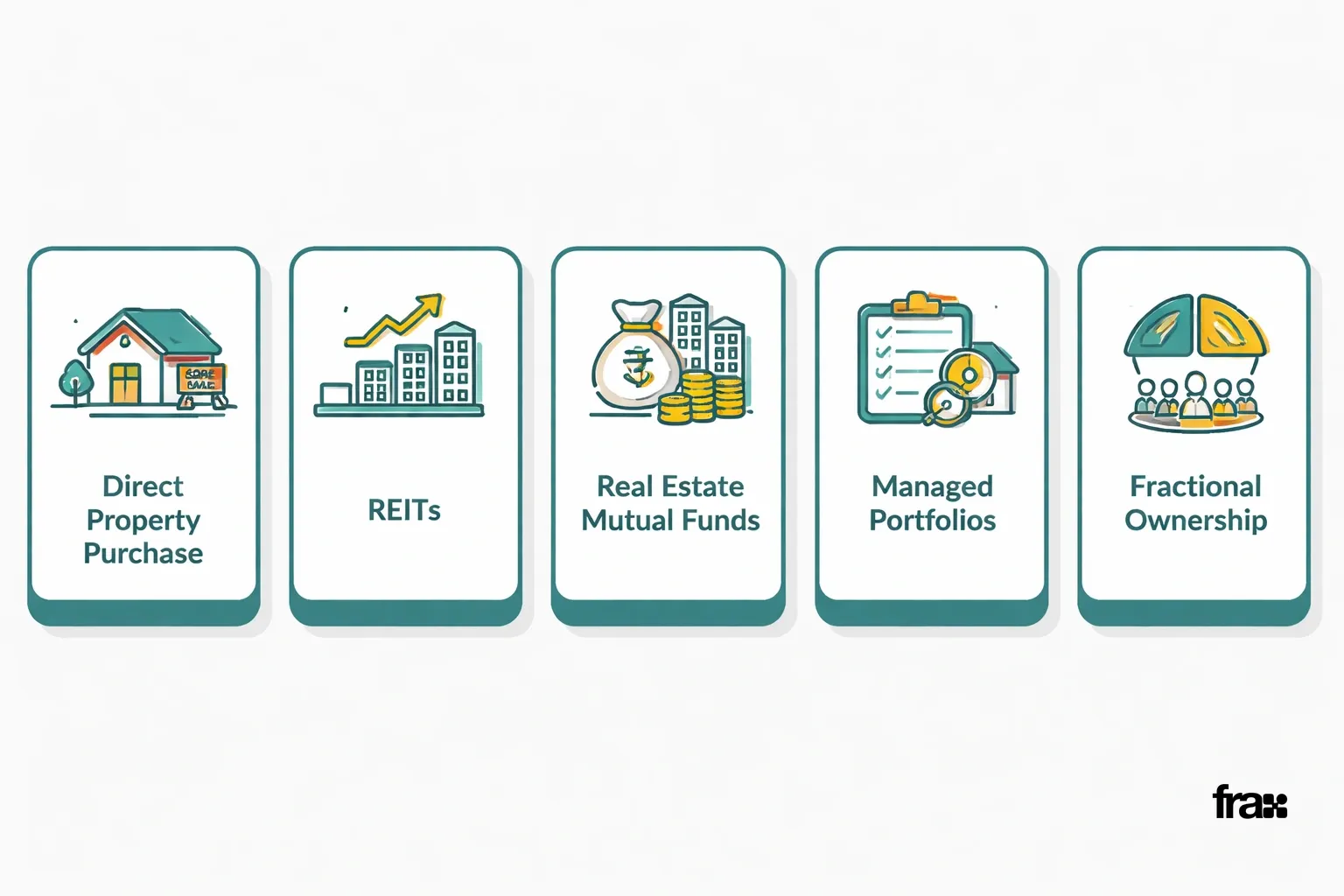
Today, the options look like this:
Buying residential or commercial property directly
Real Estate Investment Trusts (REITs) traded on stock exchanges
Real estate mutual funds and AIFs
Real estate investment companies running managed portfolios
Fractional ownership platforms, where a property sits inside a dedicated Limited Liability Partnership (LLP). Investors hold direct beneficial partnership interests in dedicated LLP SPVs, not direct individual property titles.
Someone with ₹2 crore and patience for paperwork might still prefer direct ownership. Someone with ₹10,000 and a full-time job will probably want an app that handles the legal heavy lifting.
How to Invest in Real Estate: The Traditional Route
This content is for informational purposes only and does not constitute financial, legal, or investment advice.
Direct real estate investment is exactly what it sounds like: buying a physical property in your name, holding the title deed, and taking on full personal liability for its upkeep.
The process is a grind. You find a property and haggle over price, usually through a broker. Then you arrange financing, typically a home loan covering 70-80% of the value. Then comes the legal due diligence: title verification, encumbrance checks. Finally, you register the sale and pay stamp duty.
There are real benefits here. You hold the title. You can renovate, rent, or sell on your own schedule. But for most salaried professionals, the downsides are hard to ignore. You need a lot of cash upfront (often ₹50 lakh or more for decent locations), and it is incredibly illiquid: selling can take months. Your entire net worth is tied up in one building, and you are stuck managing the property, the tenants, and the legal upkeep.
For a deeper look at how traditional ownership compares with newer models, see this breakdown of fractional, REIT, and direct ownership routes: https://getfrax.com/blog/which-is-the-best-way-to-invest-in-real-estate-comparing-fractional-reits-direct-ownership
How to Invest in Real Estate in India: Modern Digital Options
This content is for informational purposes only and does not constitute financial, legal, or investment advice.
Modern real estate investing in India now includes REITs, real estate investment companies, and fractional ownership apps that let you invest online in minutes. These digital options drop the entry ticket from crores to as little as ₹10,000, and they handle the legal structuring on your behalf.
REITs let you buy listed units backed by rent-generating commercial assets. It works similarly to buying a stock. They offer exchange-based trading, though liquidity depends on daily market volumes, and REIT availability is still limited in India. You can read a full beginner's guide to this format here: https://getfrax.com/blog/real-estate-investment-options-reit-investing-guide-india-commercial-real-estate
Fractional ownership platforms work a bit differently. Instead of trading listed units, they structure each property under its own dedicated LLP, and investors hold direct beneficial partnership interests in that LLP. Investors hold direct beneficial partnership interests in dedicated LLP SPVs, not direct individual property titles. It allows multiple investors to co-own a single premium asset.
FraX follows this model. Each property on the platform sits inside its own LLP Special Purpose Vehicle, meaning one property equals one LLP. This keeps each asset's finances and liabilities ring-fenced from every other property on the platform.
If you want to understand how fractional real estate investing actually works step by step, this resource covers the mechanics in detail: https://getfrax.com/blog/real-estate-investment-options-fractional-real-estate-investing-in-india-how-it-works
Explore Property Investment Opportunities on FraX
Property Investment Opportunities Compared: A Quick Table
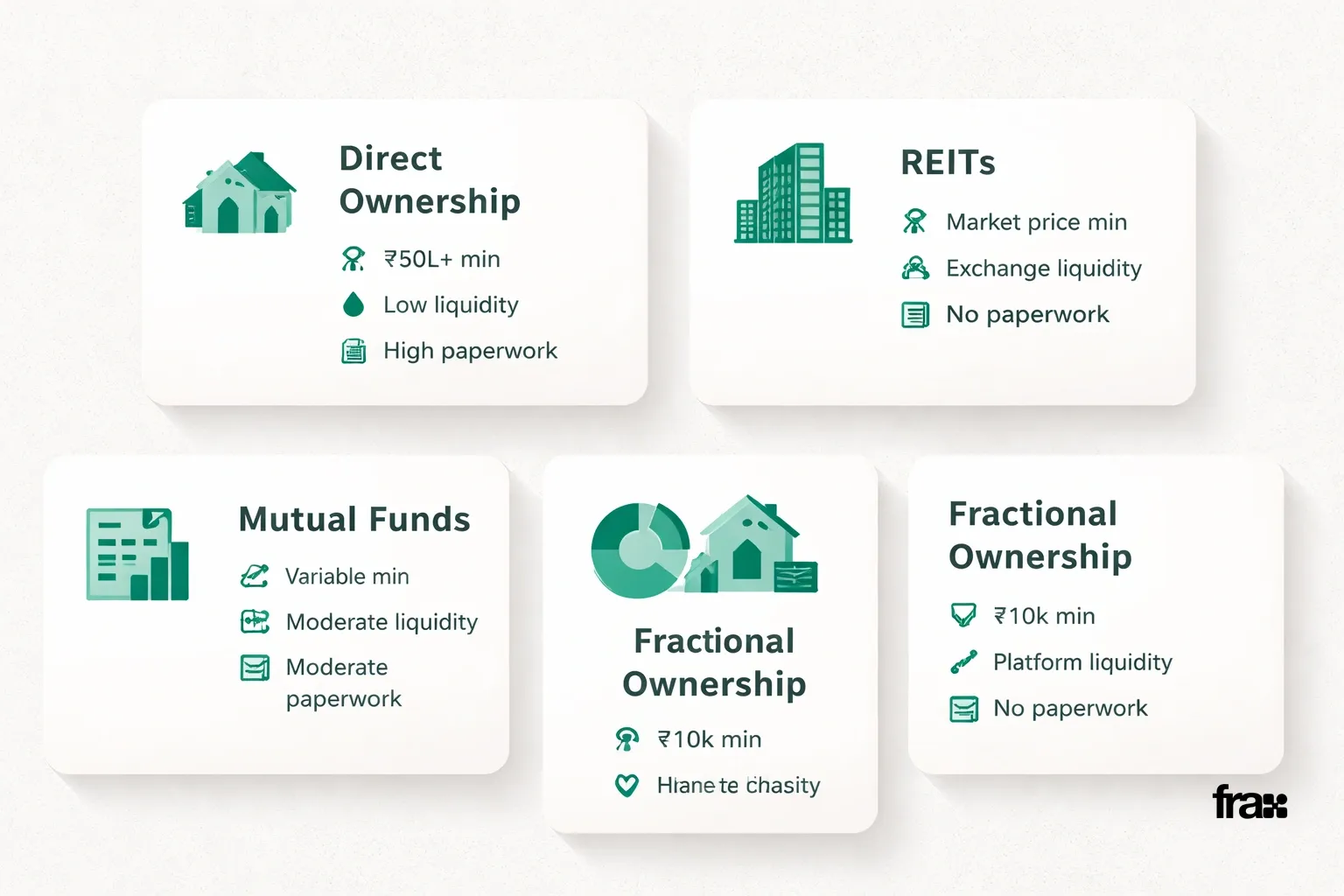
Comparing investment routes side by side makes the tradeoffs clear. Ticket size, liquidity, and management effort vary sharply between direct ownership, REITs, and fractional platforms, so the right choice depends on your capital and time horizon.
Route | Typical Minimum | Liquidity | Paperwork | Management |
|---|---|---|---|---|
Direct ownership | ₹50 lakh+ | Low, months to sell | High | High, ongoing |
REITs | Market price per unit | Exchange-dependent | Low | None |
Real estate mutual funds / AIFs | Varies, often high | Low to moderate | Moderate | None |
Fractional ownership (FraX) | ₹10,000 | Platform-based, no lock-in | Low | None |
This table is a starting point, not an exhaustive comparison. Every route carries its own risks, and none of them eliminates market risk entirely. For a broader view of how fractional investing fits into a diversified portfolio, see: https://getfrax.com/blog/portfolio-stability-made-easy-how-fractional-real-estate-reduces-volatility
This content is for informational purposes only and does not constitute financial, legal, or investment advice.
Real Estate Investment Companies: What to Look For
Real estate investment companies vary widely in structure, transparency, and investor protections. This content is for informational purposes only and does not constitute financial, legal, or investment advice. Before committing capital, check how the company structures ownership, who holds the escrow, and whether legal documentation backs every asset on the platform. Investors hold direct beneficial partnership interests in dedicated LLP SPVs, not direct individual property titles.
A few practical checkpoints matter more than marketing claims. Does each property sit in a separate entity to limit cross-liability? Is investor money held by a regulated bank with an independent trustee overseeing it? How much capital has the platform actually deployed, and are they upfront about buy and sell fees?
FraX, operated by FraX Digital Private Limited, was founded in November 2025 by Prabhav Tanay (CEO) and Tushar Chaudhary, both IIT-BHU alumni. The platform has crossed 40,000+ app downloads with a 4.8 star rating across the App Store and Play Store. Past performance and realized XIRR figures are historical and do not guarantee future property returns or rental yields. As of now, it has deployed over ₹3 crore in cumulative investor capital across its listed properties.
Transactions on FraX run through an ICICI Bank escrow account, overseen by Universal Trustees as an independent trustee. This structure is designed to separate investor funds from platform operations. For a closer look at how this safeguarding works in practice, read: https://getfrax.com/blog/not-just-returns-how-frax-safeguards-investor-money-at-every-stage
You can also browse other real estate investment companies and models operating in India here: https://getfrax.com/blog/real-estate-investment-options-top-investment-companies-india-fractional-real-estate
Invest in Real Estate Online: Step-by-Step with FraX
Investing in real estate online through FraX is pretty straightforward: sign up, browse vetted properties, invest from ₹10,000, and exit anytime without a lock-in period. The entire process happens inside the app, skipping the brokers and physical paperwork.
First, you download the app, create an account, and do your KYC digitally. From there, you can browse the listings. Each one shows the LLP structure, documentation, and historical performance data. When you're ready, you choose an amount starting at ₹10,000 and fund it through the ICICI Bank escrow account. If you want out, you can sell your position through the platform whenever you choose, since FraX doesn't impose lock-in periods.
FraX charges a 1% buy fee and a 1% sell fee on transactions. These fees fund platform operations, legal structuring, and property vetting. There is no guarantee of returns, and past performance figures shown on the platform are historical rather than predictive of future outcomes.
If you are investing for the first time, this beginner's walkthrough covers the entire process in more depth: https://getfrax.com/blog/your-first-fractional-real-estate-investment-a-step-by-step-beginner-s-guide
Start Investing in Real Estate Online Today
Property Investment in India: Who Should Consider What
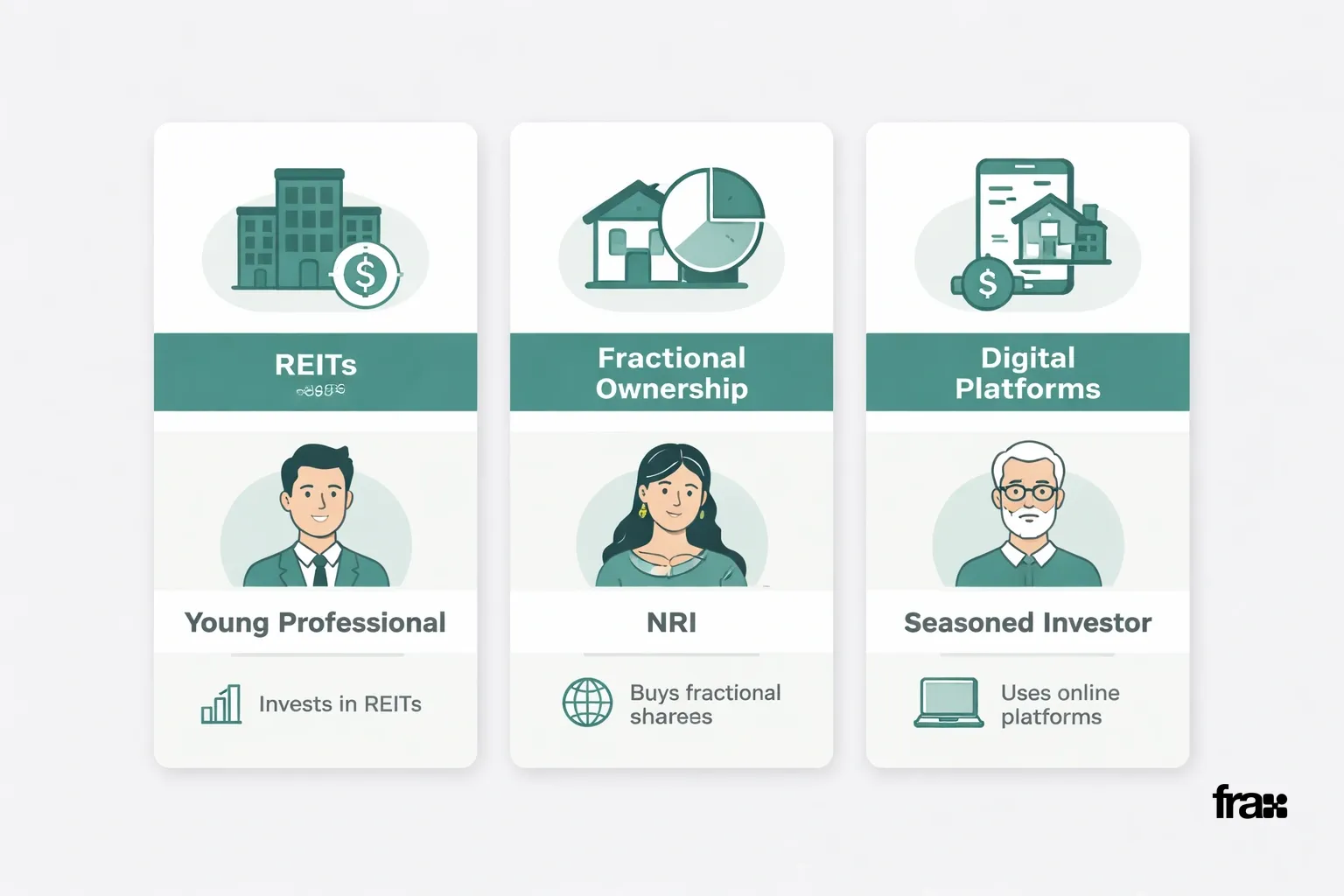
Property investment in India suits different people differently. Salaried professionals earning ₹15-20 lakh often lack the capital for direct ownership but can still access premium assets through fractional platforms starting at ₹10,000. Investors hold direct beneficial partnership interests in dedicated LLP SPVs, not direct individual property titles.
Think about the typical profiles here. A salaried young professional has limited capital and no time for property management, so they want exposure without a 20-year loan commitment. An NRI wants exposure to Indian real estate without the nightmare of managing physical property remotely. A seasoned investor might already own property directly but wants diversification across cities and asset types. And then there is the first-time investor, who just wants to learn the asset class before committing large sums.
Reports suggest that 80% of FraX users fall under the age of 35, reflecting a broader shift toward accessible, app-based investing among younger Indians. This demographic typically values liquidity and transparency over the status of holding a physical deed. For more on how this age group is approaching premium real estate, read: https://getfrax.com/blog/how-young-professionals-earning-%E2%82%B915-20-lakhs-can-finally-access-premium-real-estate-in-india
NRIs exploring fractional models should also review the specific exit and risk considerations covered here: https://getfrax.com/blog/FraX-fractional-real-estate-exit-risk-nri-guide-2026
This content is for informational purposes only and does not constitute financial, legal, or investment advice.
Risks and Realities of Property Investment Opportunities
This content is for informational purposes only and does not constitute financial, legal, or investment advice.
Every property investment opportunity carries risk, regardless of structure or ticket size. Market cycles, tenant vacancy, regulatory changes, and liquidity constraints can all affect outcomes, and no platform or route removes these factors entirely.
It helps to separate marketing language from mechanics. A platform may offer "buy and sell anytime" functionality, but that does not mean instant liquidity the way a listed stock trade works. Selling depends on finding a counterpart buyer through the platform's mechanism.
Similarly, fractional ownership through an LLP SPV structure means investors hold direct beneficial partnership interests in dedicated LLP SPVs, not direct individual property titles. This is an important distinction from traditional direct ownership, and it is worth understanding fully before investing.
You have to weigh the risk factors. Real estate values can fall as well as rise over any holding period. Rental income, where applicable, is not fixed or guaranteed. Legal and regulatory frameworks around fractional ownership are still evolving in India, and platform-based liquidity depends on buyer demand, not a stock exchange order book.
A beginner's glossary of terms used across fractional platforms can help clarify this landscape further: https://getfrax.com/blog/fractional-real-estate-investment-india-a-beginner-s-glossary
Building a Diversified Real Estate Portfolio
A diversified real estate portfolio spreads capital across multiple properties, cities, and asset types rather than concentrating risk in one physical purchase. Fractional investing makes this achievable even with modest capital, since ₹1 lakh can be split across five or more properties instead of one.
Diversification does not eliminate risk, but it can reduce the impact of any single asset underperforming. Investors who previously could only afford one property in one city can now spread exposure across different micro-markets, residential versus commercial asset types, and properties at different stages of their holding cycle.
This approach mirrors how equity investors diversify across stocks and sectors. Younger investors, in particular, are embracing this shift as a way to treat real estate like a flexible portfolio asset rather than a single, illiquid, lifetime purchase. For more on how fractional ownership is reshaping access for this generation, read: https://getfrax.com/blog/fractional-real-estate-for-young-investors-5-ways-it%E2%80%99s-changing-the-game
You can also browse the full range of articles and updates on the FraX blog: https://getfrax.com/blog
This content is for informational purposes only and does not constitute financial, legal, or investment advice. Investors hold direct beneficial partnership interests in dedicated LLP SPVs, not direct individual property titles. Past performance and realized XIRR figures are historical and do not guarantee future property returns or rental yields.
Frequently Asked Questions
This content is for informational purposes only and does not constitute financial, legal, or investment advice.
What is the minimum amount needed to start investing in real estate in India? Through traditional direct ownership, minimums often run into tens of lakhs or more. Fractional ownership platforms like FraX lower this to ₹10,000 per investment.
How is fractional real estate different from owning a physical property title? Fractional investors hold direct beneficial partnership interests in a dedicated LLP SPV created for each property, rather than holding a physical title deed in their own name. Investors hold direct beneficial partnership interests in dedicated LLP SPVs, not direct individual property titles.
Can I sell my fractional real estate investment anytime? FraX operates on a buy and sell anytime model with no fixed lock-in period, though actual sale timing depends on the platform's mechanism and is not identical to instant stock exchange trading.
Are returns from fractional real estate investments guaranteed? No. Real estate values and any associated income can fluctuate, and past performance figures are historical rather than a guarantee of future outcomes. Past performance and realized XIRR figures are historical and do not guarantee future property returns or rental yields.
How does FraX protect investor money during transactions? Transactions run through an ICICI Bank escrow account, overseen by Universal Trustees as an independent trustee, separating investor funds from platform operations.
Who typically invests through platforms like FraX? Reports show that around 80% of FraX users are under 35, including salaried professionals earning ₹15-20 lakh who want exposure to premium real estate without large upfront capital.
Learn more
Discover more from the latest posts.


