
Start Fractional Real Estate in India with ₹10,000-4 Ways
Explore 4 property investment routes in India: direct ownership, REITs, fractional ownership, and pooled funds. Start with as little as ₹10,000.
Property investment in India has opened up. You're no longer stuck with just the old "buy a flat with a loan" model. Now, you've got four main routes: direct purchase, REITs, fractional ownership, or pooled investment funds. They all have different price tags and different levels of headache. Fractional ownership is the one getting the most attention lately, mostly because it lets you start with ₹10,000 instead of needing crores in the bank.
Real estate has always been the go-to for building wealth in India. The problem was, for a long time, it was a closed club. If you were a working professional, you were mostly locked out. That’s changed. Digital platforms have reshaped who gets a seat at the table.
This content is for informational purposes only and does not constitute financial, legal, or investment advice.
What counts as a property investment now?
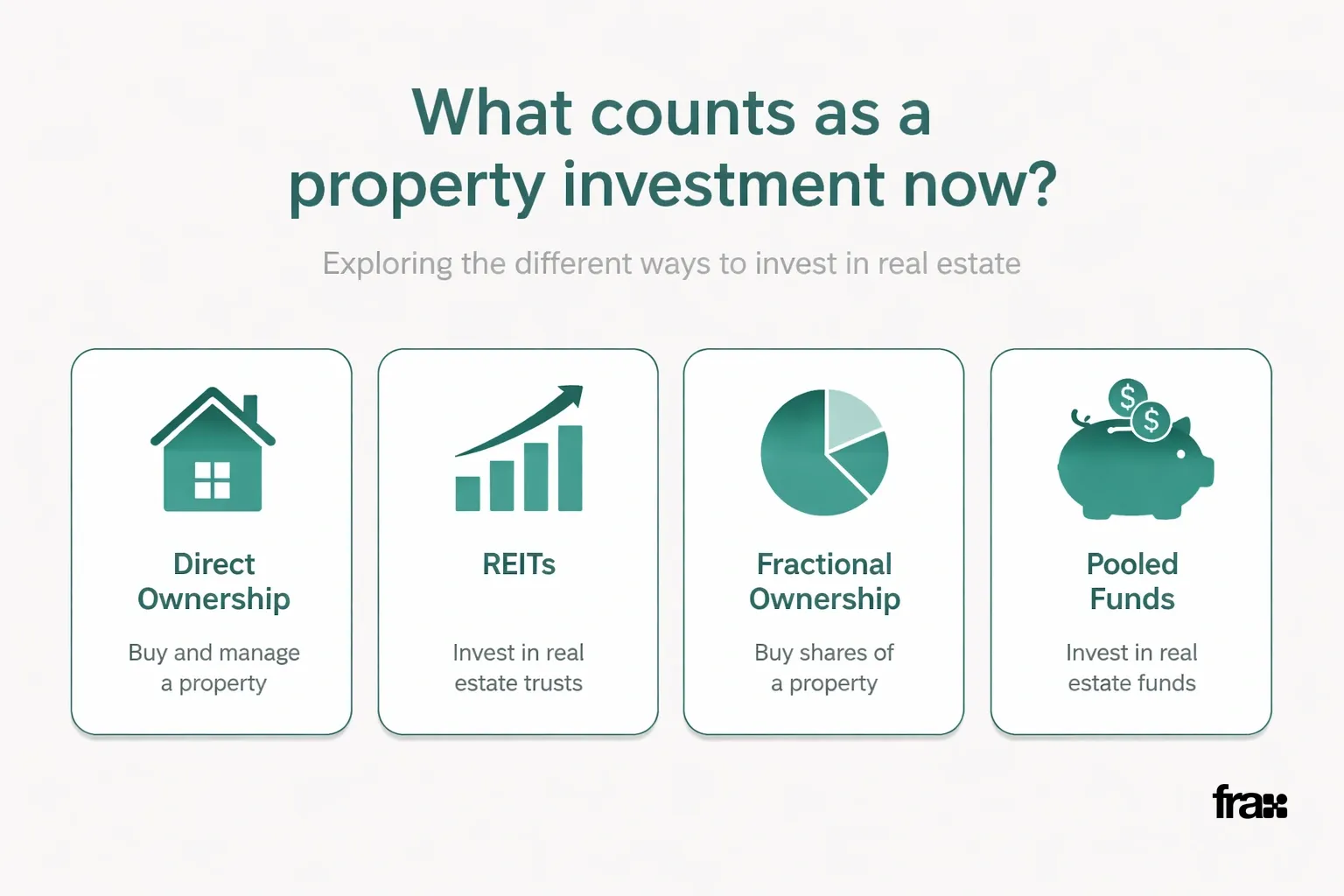
It used to mean signing a deed. Now, "investing in property" means any setup where you earn from real estate without necessarily buying the whole building yourself. That could mean owning a flat, holding units in a listed trust (REITs), co-owning a share of a specific asset (fractional), or putting money into a fund that manages the whole thing.
Ten years ago, the path was narrow: pick a location, get a loan, sign papers. That option is still there, but now there are alternatives designed to solve specific problems, mostly the high cost of entry and the fact that selling property takes forever.
Direct ownership: You buy the unit or plot.
REITs: You buy units on the stock exchange; the trust holds the buildings.
Fractional ownership: You co-own a share of a specific property through a legal entity. Investors hold direct beneficial partnership interests in dedicated LLP SPVs, not direct individual property titles.
Real estate investment companies: Platforms or funds that pool your capital and manage it.
This content is for informational purposes only and does not constitute financial, legal, or investment advice.
The three ways in
This content is for informational purposes only and does not constitute financial, legal, or investment advice.
If you want exposure to real estate, you generally choose between three structures: full ownership, market-traded instruments, or fractional models. It comes down to how much cash you have, how fast you need to get it back, and how much control you want.
Full ownership is the classic route. It costs a lot, tens of lakhs or crores for anything decent in a metro. REITs trade like stocks, so they are liquid, but you do not pick the buildings. Fractional ownership splits a single property among multiple investors. Investors hold direct beneficial partnership interests in dedicated LLP SPVs, not direct individual property titles.
Here is the math on what each usually asks for:
Method | Typical Entry Cost | Control Level | Liquidity |
|---|---|---|---|
Direct ownership | ₹20 lakh+ | Full | Low (selling takes time) |
REITs | Market price per unit | None | High (trade anytime) |
Fractional ownership | ₹10,000+ | Shared | Exit-focused, no lock-in |
For a deeper look at how these stack up, this comparison of fractional, REITs, and direct ownership is worth a read.
Why the shift is happening
The market is moving away from pure direct ownership. The reason is simple: urban property prices have gone through the roof. A premium asset in Bangalore, Mumbai, or Gurugram can easily cost over ₹2 crore. If you're earning ₹15-20 lakh a year, you can't touch that market alone. That is exactly the gap fractional platforms are trying to close.
Younger investors are also thinking differently. They don't want to dump all their savings into one illiquid flat. They want digital processes, flexibility, and the ability to spread risk. See how young professionals earning ₹15-20 lakhs are approaching this for more context.
This content is for informational purposes only and does not constitute financial, legal, or investment advice.
Explore Premium Properties Starting at ₹10,000
Direct ownership: The classic route
This is buying a flat or plot in your own name. You get total control and a tangible asset. You also get a massive bill, endless paperwork, and the responsibility for maintenance.
People like the permanence of it. But the friction is real. You deal with registration costs, brokerage fees, legal checks, and years of EMI payments. And when you want to sell? It can take months or years.
The downsides are clear:
High upfront capital.
Illiquidity (you can't sell in a day).
Concentration risk (one asset is your whole bet).
Ongoing maintenance and taxes.
This content is for informational purposes only and does not constitute financial, legal, or investment advice.
REITs: Buying the market
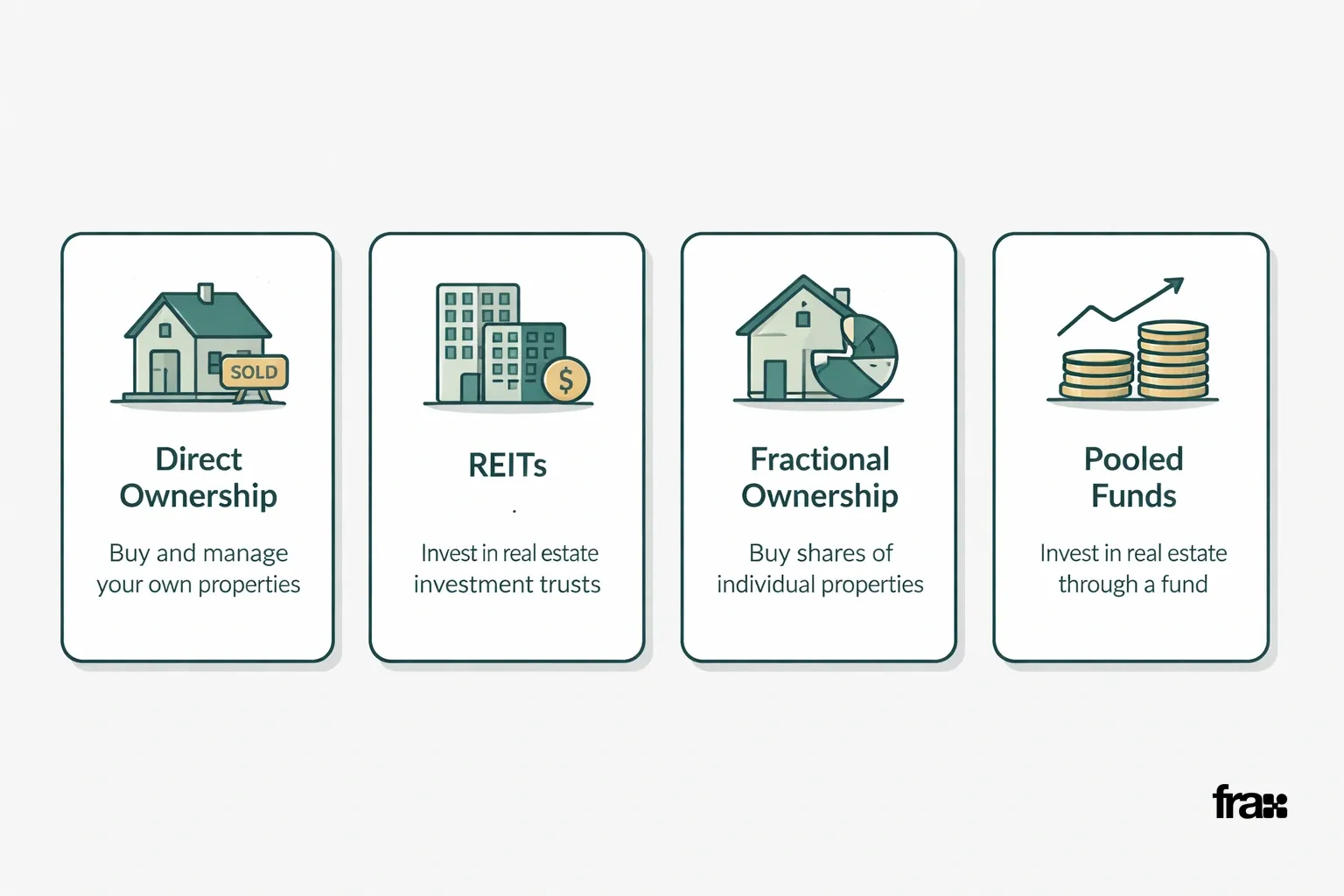
REITs (Real Estate Investment Trusts) let you buy units in a trust that holds commercial properties like office parks or malls. They trade on stock exchanges.
You get rental income distributed as dividends, and you can sell your units anytime the market is open. The trade-off: prices fluctuate with market sentiment, not just property value. If you want a detailed breakdown, this guide on REIT investing in India explains how commercial exposure works through this route.
REITs are good for liquidity, but you give up control. You can't pick the specific building you want to own.
This content is for informational purposes only and does not constitute financial, legal, or investment advice.
Fractional real estate: The new player
Fractional real estate allows multiple investors to co-own a property via a legal structure (usually an LLP). Investors hold direct beneficial partnership interests in dedicated LLP SPVs, not direct individual property titles.
This model addresses the two biggest barriers: capital and complexity. You can start with ₹10,000 and own a share of a pre-vetted property. For a walkthrough of the mechanics, check out this explainer on how fractional real estate investing works.
FraX sets up every property as its own LLP. One property, one entity. The money moves through an ICICI Bank escrow account, watched by Universal Trustees.
Key features:
Start at ₹10,000.
No fixed lock-in (buy and sell anytime).
Legal documentation for every property.
1% buy and sell fee.
If you're new to this, the beginner's guide to a first fractional investment walks through the process start to finish.
This content is for informational purposes only and does not constitute financial, legal, or investment advice.
Real estate investment companies: What to check
Not all platforms are the same. Some are transparent; some are black boxes. You need to look for clear legal structures, independent escrow accounts, and a track record.
Be cautious of claims promising certain outcomes. Real estate has risk, and no platform can promise risk-free gains.
This fractional real estate glossary helps decode the jargon. Also, look at how a platform protects your capital: this breakdown on how investor money is safeguarded covers the checks that matter.
This content is for informational purposes only and does not constitute financial, legal, or investment advice.
Start Building Your Real Estate Portfolio Today
Investing online: The actual steps
This content is for informational purposes only and does not constitute financial, legal, or investment advice.
It’s mostly app-based now. You verify your identity, pick a property, and pay. The platform handles the paperwork.
The usual flow:
Download the app and do your KYC.
Browse properties with disclosed financials.
Pick one and decide how much to invest (min ₹10,000).
Pay into the escrow account.
Get your digital documentation.
Track and exit via the app.
This cuts out the broker dependency and physical site visits. FraX, for example, has 40,000+ downloads and a 4.8-star rating, with ₹3+ crore deployed so far.
Quick comparison
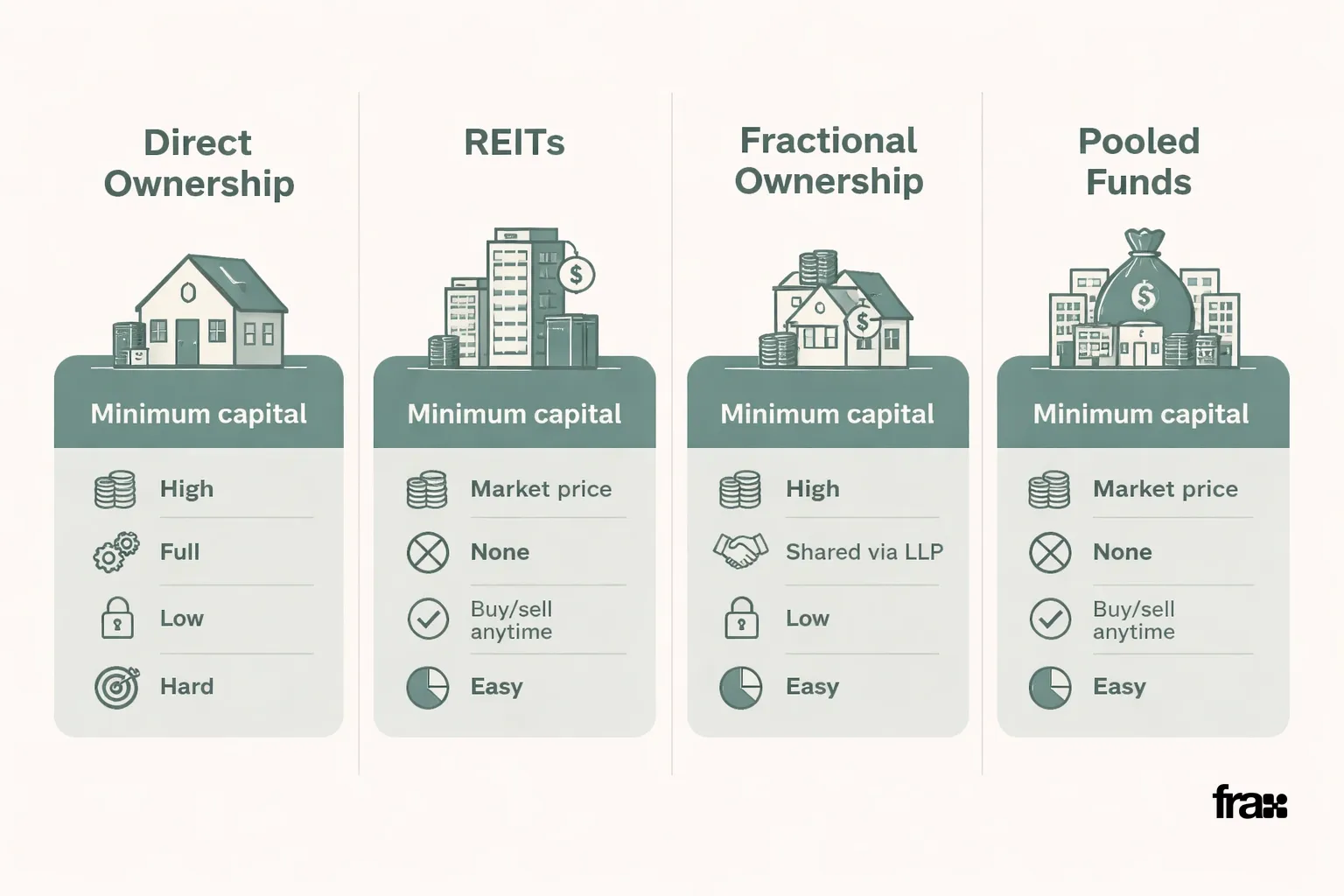
Factor | Direct Ownership | REITs | Fractional Ownership |
|---|---|---|---|
Minimum capital | High | Market price | ₹10,000 |
Control | Full | None | Investors hold direct beneficial partnership interests in dedicated LLP SPVs, not direct individual property titles. |
Liquidity | Low | High | Buy/sell anytime |
Diversification | Hard | Easy | Easy |
This content is for informational purposes only and does not constitute financial, legal, or investment advice.
For more on where these opportunities are concentrated, see the guide on the best cities for fractional real estate investing.
The risks
This content is for informational purposes only and does not constitute financial, legal, or investment advice.
Real estate is risky. Values fall. Tenants leave. Platforms vary in quality.
Fractional models help by spreading your money across multiple properties, reducing volatility compared to betting everything on one flat. This piece on how fractional real estate reduces volatility explains the math.
Read the risk disclosure first. This smart investor's guide to risk and reward covers what to watch for.
Building a portfolio
Diversification is key. Don't put everything into one asset. Fractional ownership lets you spread smaller amounts across different properties and cities.
For more on how digital ownership fits into broader portfolio building, check this guide on tokenized real estate and fractional property investment.
Past performance and realized XIRR figures are historical and do not guarantee future property returns or rental yields. Investors hold direct beneficial partnership interests in dedicated LLP SPVs, not direct individual property titles. This content is for informational purposes only and does not constitute financial, legal, or investment advice.
FAQs
Q: What’s the minimum I need to start? A: On fractional platforms like FraX, ₹10,000. Direct purchase requires lakhs or crores.
Q: Is fractional ownership the same as buying a physical property? A: No. You hold a partnership interest in the LLP that owns the property, not the title deed yourself.
Q: How is my money protected? A: FraX uses an ICICI Bank escrow with independent oversight from Universal Trustees.
Q: Can I exit whenever I want? A: FraX has no lock-in, so you can sell anytime, but the actual exit depends on finding a buyer on the platform.
Q: Are REITs better than fractional? A: Depends on your goal. REITs are liquid and traded; fractional offers targeted exposure to specific buildings.
Q: What are the fees? A: FraX charges 1% on buying and 1% on selling.
Learn more
Discover more from the latest posts.


