
Top Cities for Property Investment in India 2026
Top Indian property investment cities 2026: Bengaluru, Pune, Hyderabad & emerging markets - infrastructure, rental demand, legal clarity.
Property investment in India works best in cities where infrastructure growth meets steady rental demand: think Bengaluru, Pune, Hyderabad, and newer micro markets near metro corridors. Location quality, legal clarity, and exit flexibility matter more than headline price tags when deciding where to put your money.
Choosing the wrong city or locality can lock up capital for years with little appreciation or rental income. India's property investment landscape has shifted fast through 2026, with infrastructure projects, IT corridors, and new ownership models reshaping which cities deserve attention. This guide breaks down what actually makes a location worth investing in, and how newer models are making entry simpler for everyday investors.
This content is for informational purposes only and does not constitute financial, legal, or investment advice.
What Makes a Location Ideal for Property Investment in India
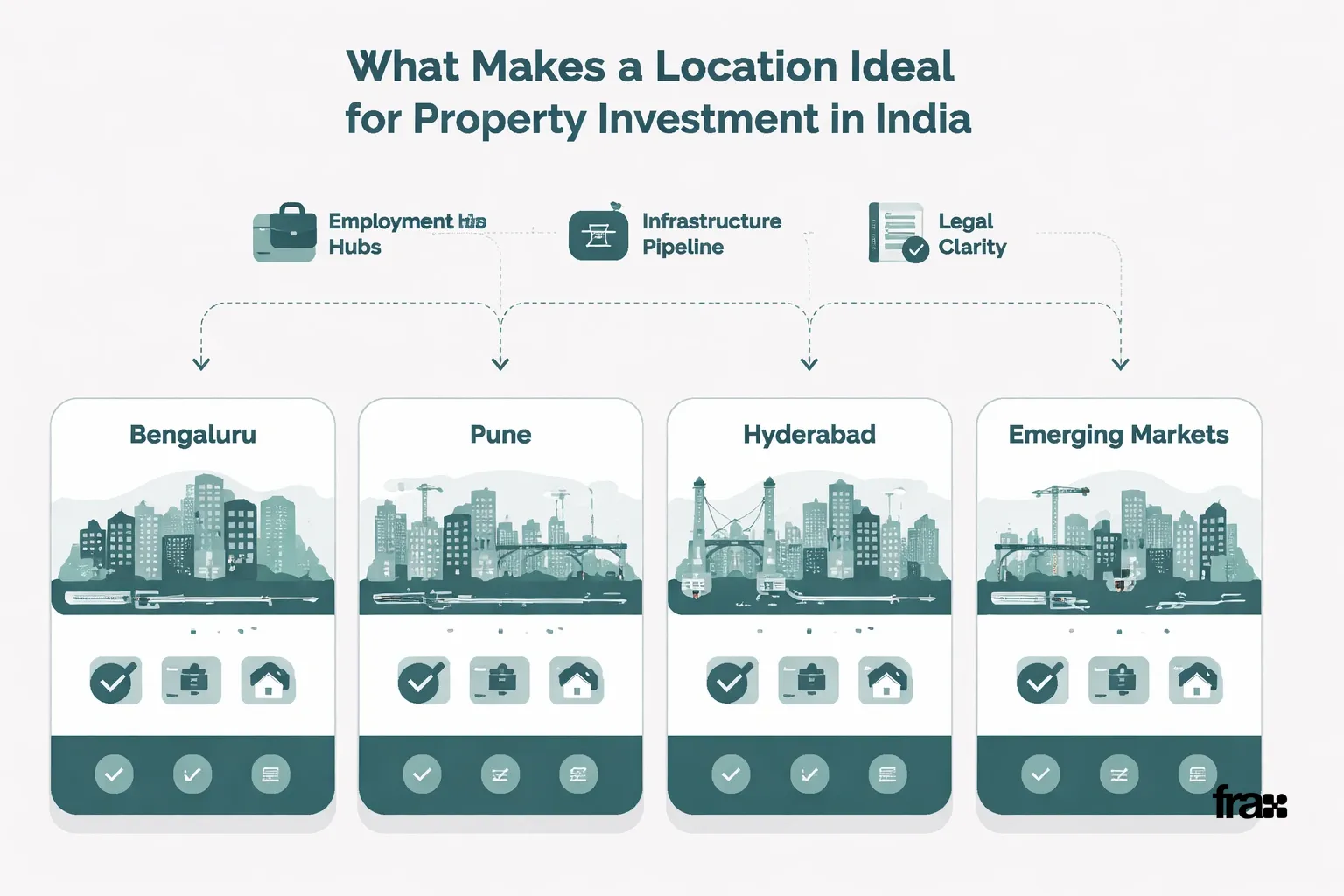
A location becomes ideal for property investment in India when it combines three things: job creation, infrastructure connectivity, and legal transparency. Cities with expanding IT parks, upcoming metro lines, and clear land titles tend to see steadier price movement over time. Rental demand matters just as much, since strong tenant pull supports income even when appreciation slows down.
Here's what separates a genuinely promising location from a hyped-up one:
Employment hubs: IT, finance, and manufacturing corridors draw working professionals who need housing nearby.
Infrastructure pipeline: Metro expansions, expressways, and airport connectivity support long-term value growth.
Legal transparency: RERA-registered projects and documented titles reduce dispute risk significantly.
Rental demand: Proximity to tech parks or business districts keeps occupancy levels healthy.
Social infrastructure: Schools, hospitals, and retail access reduce vacancy periods for rented units.
None of these factors work in isolation. A city can have great job growth but weak legal frameworks, and that combination rarely favors investors. Checking all four together gives a more honest picture before committing funds.
This content is for informational purposes only and does not constitute financial, legal, or investment advice.
Top Cities for Property Investment in India in 2026
This content is for informational purposes only and does not constitute financial, legal, or investment advice.
Bengaluru, Pune, Hyderabad, Chennai, and parts of the National Capital Region currently lead property investment in India in 2026. Each city offers a distinct growth driver, ranging from IT expansion to industrial corridors, that supports long-term demand. Tier-2 cities like Kochi and Indore are also gaining attention as infrastructure spreads beyond the usual metro belt.
City | Primary Growth Driver | Investor Appeal |
|---|---|---|
Bengaluru | IT and startup ecosystem | Consistent rental demand and ongoing office expansion |
Pune | IT parks, education, manufacturing | Balanced mix of appreciation potential and rental activity |
Hyderabad | Pharma, IT, improved connectivity | Comparatively lower entry costs with fast infrastructure growth |
Chennai | Auto and manufacturing corridors | Steady demand from industrial belt employment |
Gurugram and NCR | Corporate hubs, upcoming infra | Strong pull for premium commercial and residential projects |
Kochi | Port connectivity, IT corridor | Early-stage coastal growth story with rising interest |
Indore | Smart city push, logistics hub | Lower entry price with growing investor curiosity |
State-level economic performance often shapes which of these cities stay ahead. You can read more in our breakdown of state-wise GDP growth and its real estate impact to understand how regional output ties back to property demand.
Investors looking specifically at fractional opportunities across these cities can also check our dedicated guide on top cities for fractional real estate investment in India, which maps city-level data against ticket sizes.
Emerging Micro-Markets Worth Watching
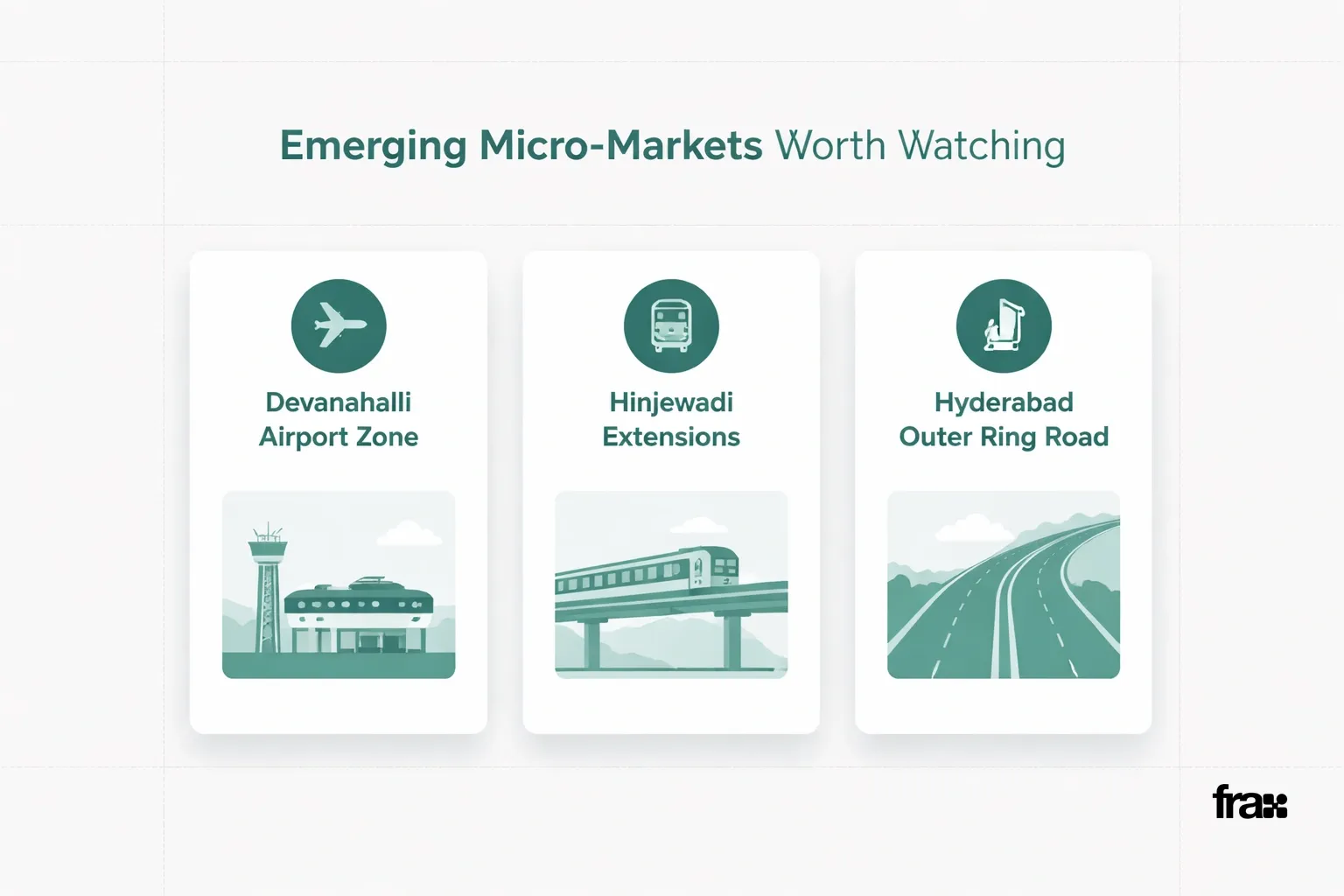
Emerging micro-markets sit just outside established city centers but benefit from the same infrastructure push. Areas like Devanahalli near Bengaluru's airport, Hinjewadi extensions in Pune, and the outer ring road belt of Hyderabad are drawing early investor interest. These pockets often offer lower entry prices today, with upside tied closely to infrastructure completion timelines.
A few micro-markets to track closely in late 2026 include:
Peripheral zones around new metro stations still under construction
Logistics corridors near upcoming expressway interchanges
Satellite townships positioned near expanding IT campuses
Coastal belts gaining traction from port and trade policy shifts
The catch with micro-markets is timing risk. Infrastructure delays are common in India, and an area tied entirely to one planned project can stall if that project slips. Diversifying across a few locations rather than betting on a single emerging pocket tends to be a steadier approach.
Our city-focused guide on fractional real estate strategies for beginners covers how to balance exposure across established and emerging locations.
This content is for informational purposes only and does not constitute financial, legal, or investment advice.
How Fractional Ownership Changes Where You Can Invest
Fractional ownership lets investors access property investment in India without buying an entire unit outright. Instead of saving for years to afford a flat in Bengaluru or Mumbai, investors can start with as little as ₹10,000 and own a share of a premium asset. This structure opens doors to cities and projects that were previously out of reach for most salaried professionals.
This model is explained in detail in our piece on how fractional real estate investing works in India, which breaks down the mechanics step by step.
Start Investing in Premium Properties with ₹10,000
Each property under this model is held through a dedicated LLP SPV, meaning one property corresponds to one legal entity. Investors hold direct beneficial partnership interests in dedicated LLP SPVs, not direct individual property titles. This structure, paired with an ICICI Bank escrow account overseen by Universal Trustees, adds a layer of financial discipline to the transaction process.
If terms like SPV or escrow sound unfamiliar, our beginner's glossary for fractional real estate investment walks through the vocabulary in plain language. And for a full comparison against traditional ownership and REITs, see which is the best way to invest in real estate.
This cluster of content builds on the foundations covered in our parent guide, starting fractional real estate in India with ₹10,000, which explains four different entry routes available today.
This content is for informational purposes only and does not constitute financial, legal, or investment advice.
Key Factors to Evaluate Before You Invest
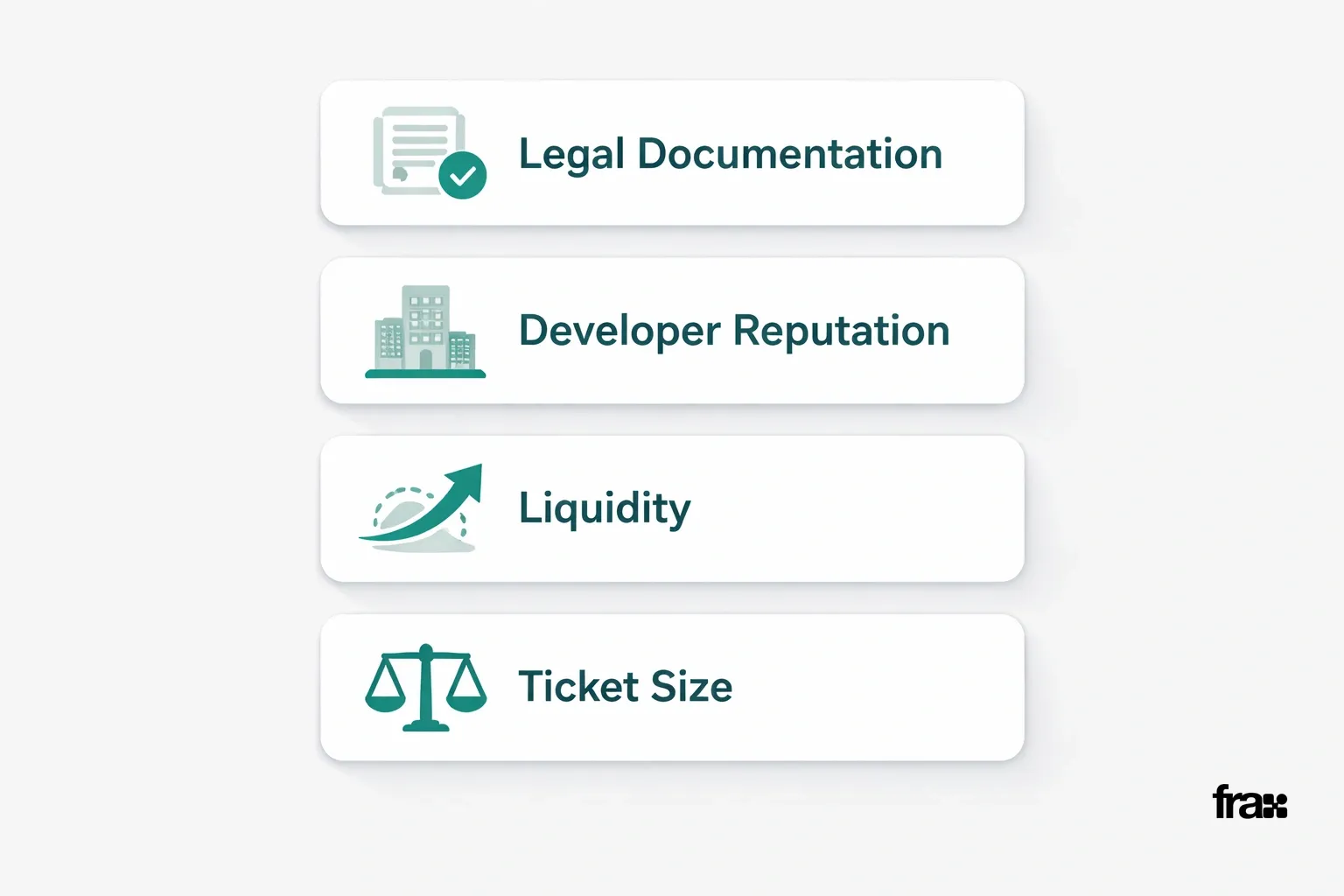
Smart property investment in India depends on evaluating a handful of factors beyond location hype. Price trends alone rarely tell the full story behind a deal. Investors should check legal documentation, developer track record, liquidity options, and ticket size before committing any capital.
Run through this checklist before finalizing a decision:
Legal documentation: Confirm RERA registration and clean title records.
Developer reputation: Look at past project completion timelines and quality.
Liquidity: Understand how and when you can exit the investment.
Ticket size: Match the investment to your budget without over-concentrating.
Rental patterns: Study demand specific to that micro-market, not the city average.
Infrastructure timelines: Treat announced completion dates with healthy skepticism.
Professionals earning salaries in the ₹15-20 lakh range often struggle with the ticket size issue the most, since premium properties usually demand far larger upfront capital. Our article on how young professionals access premium real estate looks at this gap in more detail.
This content is for informational purposes only and does not constitute financial, legal, or investment advice.
Common Mistakes Investors Make
Many investors chase trending localities without checking the fundamentals behind the trend. Buying solely based on word-of-mouth tips or social media hype often leads to overpaying for a property. Ignoring liquidity, legal paperwork, and realistic infrastructure timelines remain the most common missteps in property investment in India.
A few patterns show up repeatedly:
Over-leveraging on a single property instead of spreading capital
Skipping due diligence on developer history and project approvals
Concentrating an entire portfolio in one city or one micro-market
Ignoring exit options until funds are urgently needed
Falling for unrealistic appreciation promises without supporting data
Avoiding these mistakes usually comes down to patience and documentation. Reading the fine print on legal paperwork and asking about exit timelines before investing saves a lot of regret later.
This content is for informational purposes only and does not constitute financial, legal, or investment advice.
How FraX Simplifies Property Investment in India
This content is for informational purposes only and does not constitute financial, legal, or investment advice.
FraX simplifies property investment in India by combining location research, legal structuring, and exit flexibility into one digital platform. Investors can start with ₹10,000, review properties across multiple cities, and exit through the platform's buy and sell model without rigid lock-in periods. Over ₹3 crore in cumulative investor capital has already been deployed through the platform so far.
Founded in November 2025 by Prabhav Tanay and Tushar Chaudhary, both IIT-BHU alumni, FraX operates under FraX Digital Private Limited. The platform has crossed 40,000 app downloads with a 4.8 star rating across the App Store and Play Store. A 1% buy fee and 1% sell fee apply to transactions, keeping the cost structure simple and upfront.
For investors who want to understand how their money is protected at each step, our article on how FraX safeguards investor funds covers the escrow and trustee framework in depth.
Explore Property Investment Options on FraX
Picking the right city or locality still matters more than the platform you use to invest. But a platform that structures the legal and financial side properly makes it far easier to act on good research without years of saving first.
Frequently Asked Questions
Q: Which city is best for property investment in India right now?
A: Bengaluru, Pune, and Hyderabad currently show strong fundamentals due to IT growth, infrastructure expansion, and rental demand. The right choice still depends on your budget, risk appetite, and whether you prefer established markets or emerging micro-markets.
Q: How much money do I need to start investing in Indian real estate?
A: Through fractional platforms like FraX, you can start with a minimum ticket size of ₹10,000. Traditional direct ownership usually requires far larger upfront capital, often running into lakhs or crores.
Q: Are tier-2 cities like Indore or Kochi worth considering for property investment?
A: Tier-2 cities can offer lower entry prices and rising infrastructure investment, but timelines for growth are less predictable than in established metros. They work best as part of a diversified approach rather than a sole focus.
Q: What legal protections exist for fractional property investors?
A: Each property is held through a dedicated LLP SPV, with transactions routed through an ICICI Bank escrow account overseen by Universal Trustees as an independent trustee. Investors hold direct beneficial partnership interests in these LLP SPVs, not direct individual property titles.
Q: Can I exit my property investment quickly if I need funds?
A: Platforms like FraX offer a buy and sell model without fixed lock-in periods, giving more flexibility than traditional direct ownership. Actual exit timing still depends on market demand for that specific property share.
Q: Does fractional investing guarantee rental income or appreciation?
A: No. Past performance and realized XIRR figures are historical and do not guarantee future property returns or rental yields. Property investment always carries market-linked uncertainty.
This content is for informational purposes only and does not constitute financial, legal, or investment advice. Investors hold direct beneficial partnership interests in dedicated LLP SPVs, not direct individual property titles. Past performance and realized XIRR figures are historical and do not guarantee future property returns or rental yields.
Learn more
Discover more from the latest posts.