

Commercial Real Estate in India 2026
Explore commercial real estate investing in India 2026. Learn about fractional ownership, liquidity, and returns with expert insights.
This content is for informational purposes only and does not constitute financial, legal, or investment advice.
If you've looked into Indian real estate lately, you've probably noticed commercial property is getting a lot of attention heading into 2026. We aren't just talking about buying a flat to rent out. We're talking about office spaces, retail units, and warehouses that throw off income through leasing rather than resale.
Commercial real estate behaves very differently from residential. The lease cycles are longer, the tenants are businesses, and the pricing structure can be outright confusing for first-timers. Let's break down what commercial property actually means, why it matters for your portfolio, and how regular investors are getting in without needing crores locked away in a single building.
What Is Commercial Property in India
This content is for informational purposes only and does not constitute financial, legal, or investment advice.
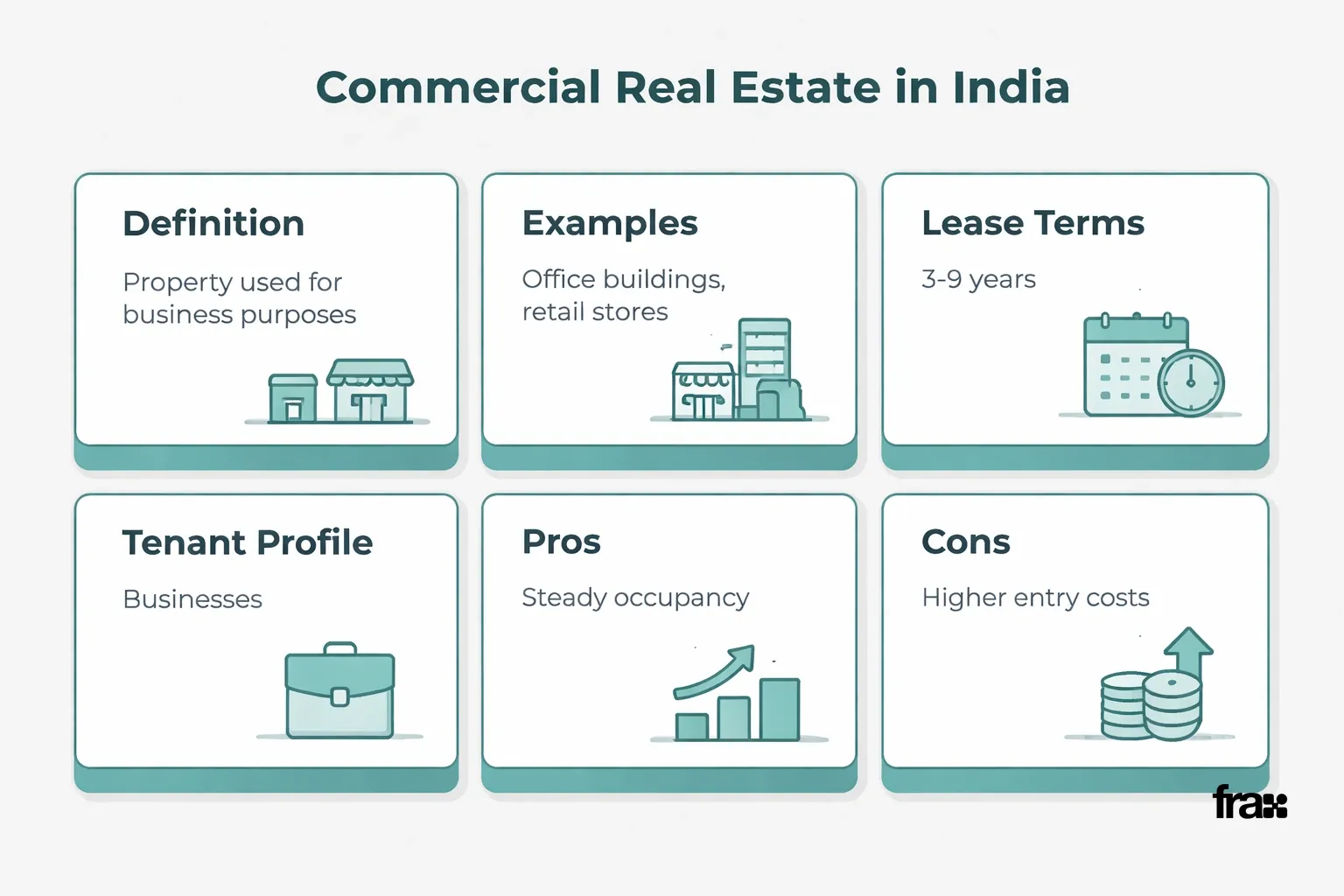
Commercial property is real estate used for business. Think office buildings, retail stores, warehouses, and co-working spaces. You lease these to companies or retailers, not individual families.
The biggest difference is the tenant profile. Businesses sign longer lease agreements, usually three to nine years. Compare that to the eleven-month cycles typical of residential rentals. I genuinely think this is why commercial real estate appeals to people looking for steady occupancy. You don't have to worry about chasing a new tenant every year. But there's a catch: higher entry costs and way more due diligence before you buy.
A commercial site can be a single shop in a local market. Or it can be a floor in a Grade A office tower in Bengaluru. Each type has its own risk and return profile, which we'll get into below.
Why Property Investment in India Is Shifting Toward Commercial Assets
Why are people moving away from just buying flats and plots? Commercial real estate tends to generate better income. Office and retail spaces in growth corridors often have stronger occupancy than residential units in the same area.
India's commercial sector has grown massively thanks to IT expansion, retail growth, and the co-working culture. Cities with strong GDP contribution see the fastest absorption of office space. If you want a broader economic backdrop, our piece on India's economic growth and real estate outlook connects macro trends to property demand.
A few things are driving this shift. Business tenants generally maintain the property better than short-term residential tenants. Commercial leases often include rent escalation clauses from the start. Warehousing and logistics space demand has exploded alongside e-commerce. And co-working operators are snapping up smaller office floors in Tier 1 and Tier 2 cities.
This content is for informational purposes only and does not constitute financial, legal, or investment advice.
Types of Commercial Real Estate You Should Know
This content is for informational purposes only and does not constitute financial, legal, or investment advice.
Commercial real estate in India isn't just one thing. It spans several categories, each with its own tenant base and risk profile. You mostly encounter office spaces, retail units, warehouses, and hospitality assets.
Here is a simple breakdown:
Category | Typical Tenant | Lease Length | Common Cities |
|---|---|---|---|
Office Space | IT firms, startups, BPOs | 3-9 years | Bengaluru, Pune, Hyderabad |
Retail Units | Brands, restaurants, showrooms | 3-5 years | Mumbai, Delhi NCR, Chennai |
Warehousing | Logistics, e-commerce firms | 5-10 years | Ahmedabad, Chennai outskirts |
Co-working Floors | Flex space operators | 3-6 years | Gurugram, Bengaluru, Pune |
Each category reacts differently to the economy. Office space demand tracks closely with corporate hiring. Warehousing grows steadily because of online retail. Retail units live or die by footfall and location quality.
If you're trying to decide which city fits your goals, our guide on top cities for fractional real estate investment in India 2026 offers a city-by-city comparison worth reviewing before committing capital.
The Traditional Barriers to Commercial Real Estate Investing
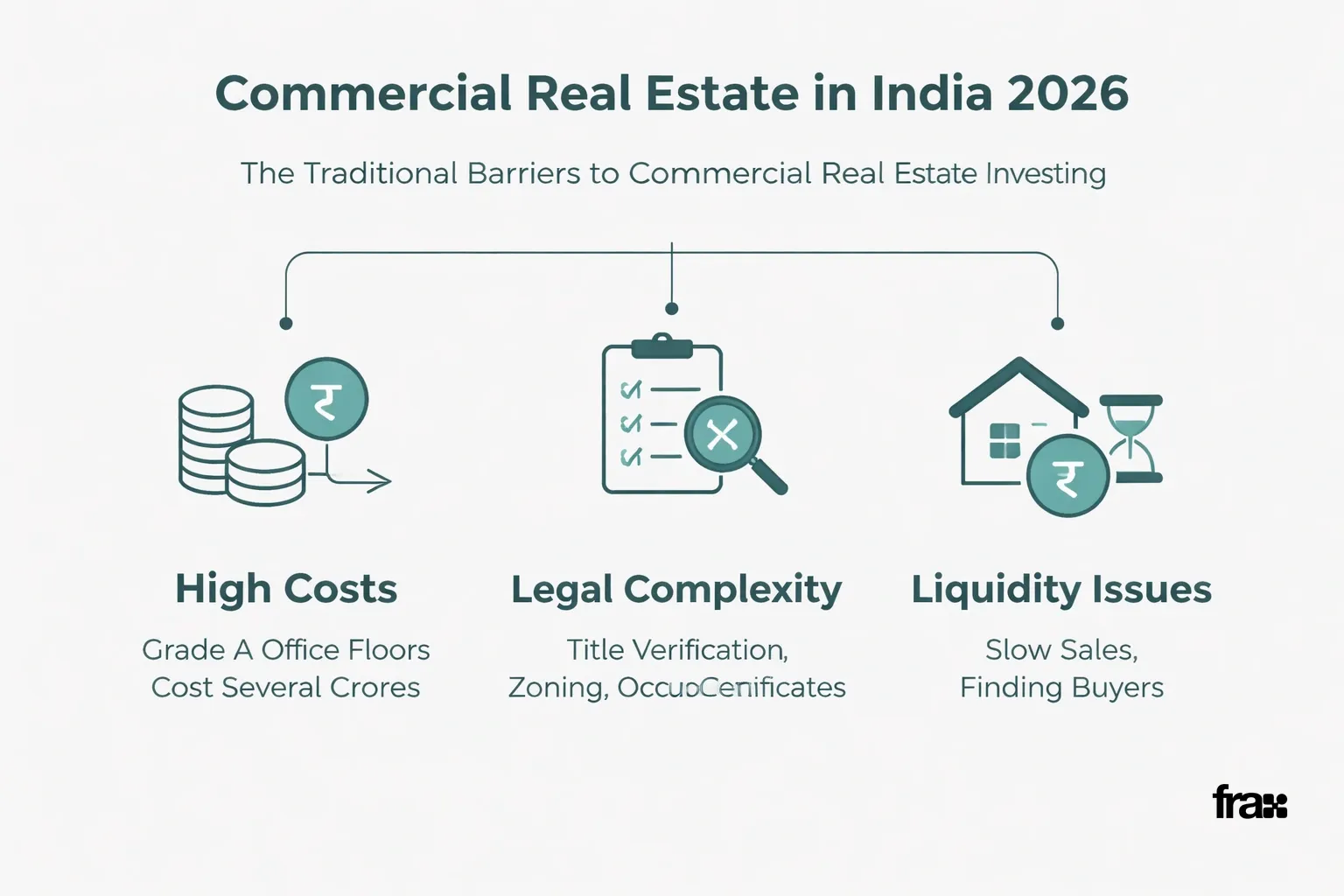
Let's be honest: commercial real estate used to be a rich man's game. A single Grade A office floor can cost several crores. That put it completely out of reach for a salaried professional earning ₹15-20 lakh a year.
Beyond the price tag, buying commercial property involves serious legal complexity. You have to verify title documents, check zoning approvals, confirm occupancy certificates, and negotiate lease terms with tenants. This usually means dealing with brokers, lawyers, and months of back-and-forth.
Then there's liquidity. Selling a commercial site is rarely quick. Finding a buyer willing to match your valuation can take months. Sometimes years, especially in slower micro-markets.
These barriers kept working professionals out of the market for years. That is exactly where newer investment models have started to change things.
This content is for informational purposes only and does not constitute financial, legal, or investment advice.
How Fractional Ownership Is Changing Commercial Property Access
This content is for informational purposes only and does not constitute financial, legal, or investment advice.
Fractional ownership lets multiple investors collectively own a share of a commercial property instead of buying the whole thing. This model breaks a high-value asset, like an office floor or retail unit, into smaller, affordable pieces. It lets individual investors participate with far less capital.
Platforms built around this model, including FraX, structure each property under a dedicated LLP SPV. Simply put, one property corresponds to one LLP. Investors hold direct beneficial partnership interests in these LLP SPVs rather than direct individual property titles. This structure allows a commercial building worth crores to be divided among dozens of investors. You can get in with as little as ₹10,000.
This approach solves two problems at once. It removes the need for massive upfront capital, and it takes the paperwork burden off individual investors. The legal structuring, tenant management, and documentation are handled at the platform level.
Start Exploring Fractional Commercial Real Estate Today
For a deeper dive into how this works end to end, read our detailed explainer on fractional real estate investing in India: how it works.
Liquidity: A Key Difference From Traditional Commercial Real Estate
Liquidity in commercial real estate has always been terrible. Sellers wait months or years to exit. Modern fractional platforms are trying to fix this by letting you buy and sell property shares digitally without the long holding periods tied to direct ownership.
FraX uses a "Buy & Sell Anytime" model. You can list your holdings for exit digitally rather than searching for a buyer through traditional broker networks. This does shorten the exit timeline drastically compared to selling an entire building outright.
Liquidity concerns have long scared smaller investors away from commercial real estate. Knowing there is a structured path to exit, even if not instantaneous, changes the risk calculation completely.
If you want to understand how risk and reward balance out in this model, our guide titled risk and reward: a smart investor's guide to fractional real estate covers this in more depth.
This content is for informational purposes only and does not constitute financial, legal, or investment advice.
Security and Trust in Commercial Property Transactions
This content is for informational purposes only and does not constitute financial, legal, or investment advice.
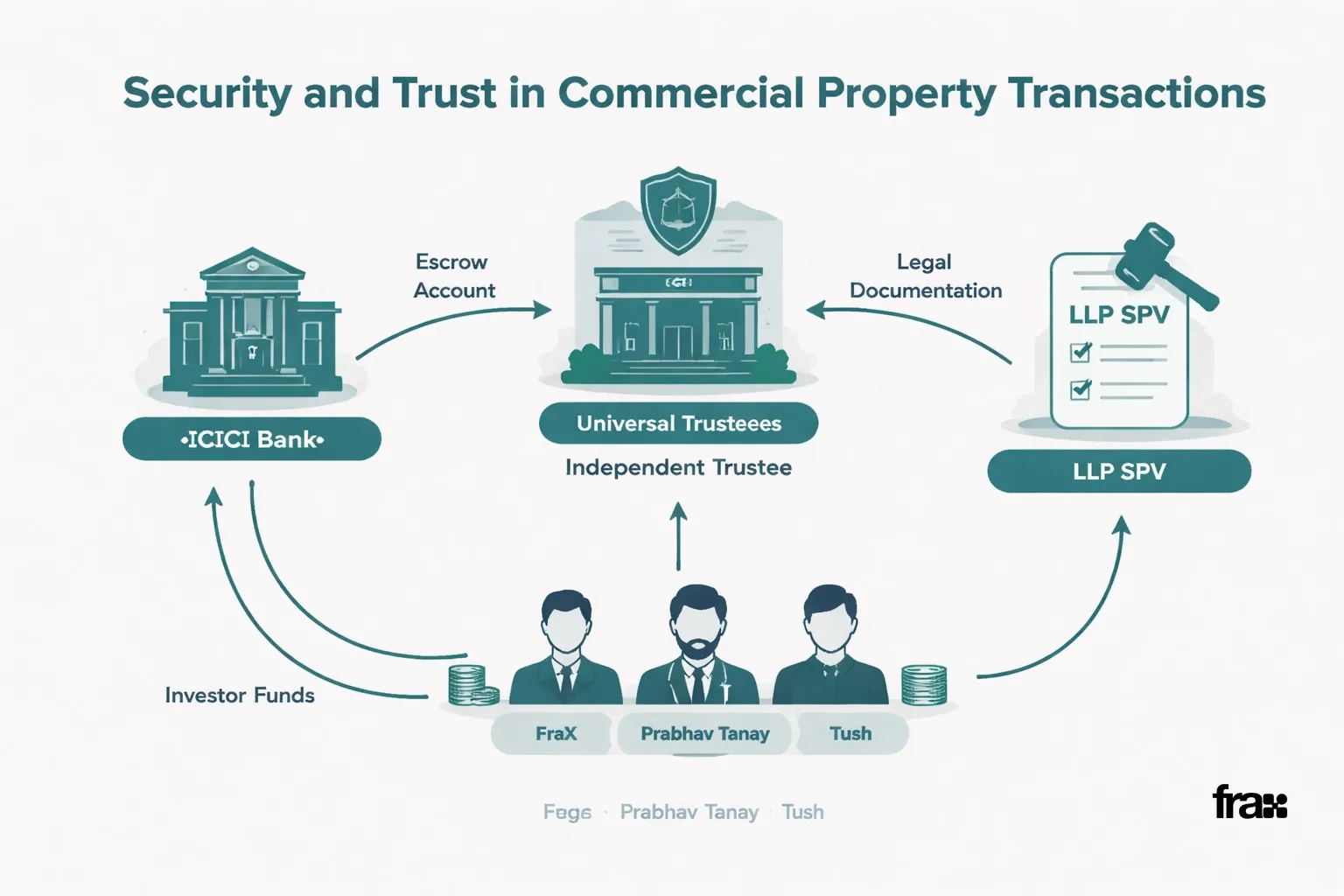
When you invest in commercial property, security depends entirely on how transactions are structured and monitored. Escrow mechanisms, independent trustees, and proper legal documentation are the backbone of any trustworthy platform.
FraX structures its transactions through an ICICI Bank escrow account, overseen by Universal Trustees acting as an independent trustee. This layered structure adds checks around how investor funds move through each transaction. Investors hold direct beneficial partnership interests in dedicated LLP SPVs, not direct individual property titles, and investments are backed by proper legal documentation at the LLP SPV level.
Since launching in November 2025 by Prabhav Tanay and Tushar Chaudhary, both IIT-BHU alumni, the platform (operated by FraX Digital Private Limited) has grown to more than 40,000 app downloads with a 4.8 star rating across the App Store and Play Store. Cumulative investor capital deployed through the platform has crossed ₹3 crore.
For investors evaluating safety mechanisms more broadly, our article on how FraX safeguards investor money at every stage walks through the full process.
Who Should Consider Commercial Property Investment in India
This content is for informational purposes only and does not constitute financial, legal, or investment advice.
Commercial property investment is for people looking for income-generating assets with longer lease stability compared to residential real estate. It appeals strongly to working professionals who want real estate exposure without managing tenants or dealing with paperwork.
Roughly 80% of FraX users are under the age of 35. Many earn ₹15-20 lakh annually. This demographic was traditionally priced out of premium commercial real estate because direct ownership required capital far beyond their savings.
Fractional models change this by lowering the entry ticket size dramatically. Investors hold direct beneficial partnership interests in dedicated LLP SPVs, not direct individual property titles. You can start building exposure to a commercial building in India with ₹10,000 instead of saving for years to afford a single unit outright.
That said, this isn't for everyone. If you want very short holding periods, or if you are uncomfortable with property-linked assets in general, you might prefer other instruments. It helps to read a basic primer first, and our fractional real estate investment in India: a beginner's glossary is a good starting point.
Building a Diversified Portfolio With Commercial Real Estate
This content is for informational purposes only and does not constitute financial, legal, or investment advice.
A good portfolio spreads exposure across multiple property types and cities rather than concentrating in one asset. When you blend commercial real estate with residential and other fractional investments, you reduce the impact of localized market slowdowns.
Spreading smaller amounts across different commercial sites, whether office floors in Bengaluru or retail units in Mumbai, lets you avoid overexposure to a single tenant or sector. This is exactly how larger institutional investors diversify holdings, just scaled down for individual portfolios.
Our piece on portfolio stability made easy: how fractional real estate reduces volatility explores this diversification logic in more detail, including how spreading capital across properties can smooth out returns over time.
The platform highlights the potential for investors to earn up to 92% returns over a five-year period. Keep in mind, past performance and realized XIRR figures are historical and do not guarantee future property returns or rental yields.
Build Your Diversified Real Estate Portfolio Now
Getting Started: A Practical Checklist
Getting started in commercial property investment requires a few deliberate steps. You can't just jump straight into a purchase. Research, platform verification, and portfolio planning all matter before you commit capital.
Here's a simple checklist to work through:
Understand the difference between office, retail, warehousing, and co-working assets.
Decide how much capital you can allocate without touching your emergency fund.
Research the city and micro-market where the property sits.
Verify how the platform structures ownership and escrow mechanisms.
Start small, even ₹10,000, to understand how the process works before scaling up.
Track your holdings and diversify across multiple properties over time.
For a step-by-step walkthrough aimed specifically at first-timers, our guide on your first fractional real estate investment: a step-by-step beginner's guide is worth bookmarking.
Commercial property in India is no longer just for large corporations and ultra-wealthy investors. With fractional models, proper escrow structuring, and lower entry tickets, everyday professionals now have a realistic path into this asset class. The key is starting informed, diversifying sensibly, and understanding exactly how ownership and liquidity work before you put your money down.
This content is for informational purposes only and does not constitute financial, legal, or investment advice. Investors hold direct beneficial partnership interests in dedicated LLP SPVs, not direct individual property titles. Past performance and realized XIRR figures are historical and do not guarantee future property returns or rental yields.
Frequently Asked Questions
What is the minimum amount needed to invest in commercial property in India through fractional platforms?
On platforms like FraX, you can start investing with as little as ₹10,000. That is significantly lower than the crores typically required for direct commercial property ownership.
How is fractional ownership of commercial real estate legally structured?
Each property is held under a dedicated LLP SPV, meaning one property corresponds to one LLP. Investors hold direct beneficial partnership interests in these LLP SPVs, not direct individual property titles.
Is commercial real estate investment through fractional platforms as liquid as stocks?
No. FraX follows a "Buy & Sell Anytime" model that allows digital listing and exit without traditional lock-in periods, but this does not replicate instant stock-exchange liquidity.
How are investor funds protected during a commercial property transaction?
Transactions are structured through an ICICI Bank escrow account, overseen by Universal Trustees as an independent trustee, alongside proper legal documentation at the LLP SPV level.
What types of commercial real estate can I invest in?
Common categories include office spaces, retail units, warehousing, and co-working floors. Each comes with different tenant profiles, lease lengths, and demand drivers.
Does commercial property investment guarantee fixed returns?
No. The platform highlights potential returns of up to 92% over five years, but past performance and realized XIRR figures are historical and do not guarantee future property returns or rental yields.
Learn more
Discover more from the latest posts.


