

Fractional Commercial Property Investment in India: How It Works
Invest in commercial real estate from ₹10,000 with fractional platforms like FraX. Learn benefits, risks, and how to start.
For the longest time, commercial real estate in India was a closed club. If you were a salaried professional making ₹15-20 lakh a year, you were stuck watching institutional players grab up the good office spaces and warehouses. You needed crores just to sit at the table.
That’s finally changing. Fractional ownership platforms are opening the door, letting you buy slices of office spaces, retail units, and warehouses starting at ₹10,000. Commercial real estate has historically delivered steadier rental cycles and better yield potential than residential property in many Indian markets. Now regular folks can actually get in on it. Here's a practical look at what commercial property investment means today, why it matters, and how to approach it.
This content is for informational purposes only and does not constitute financial, legal, or investment advice.
What commercial property investment actually means
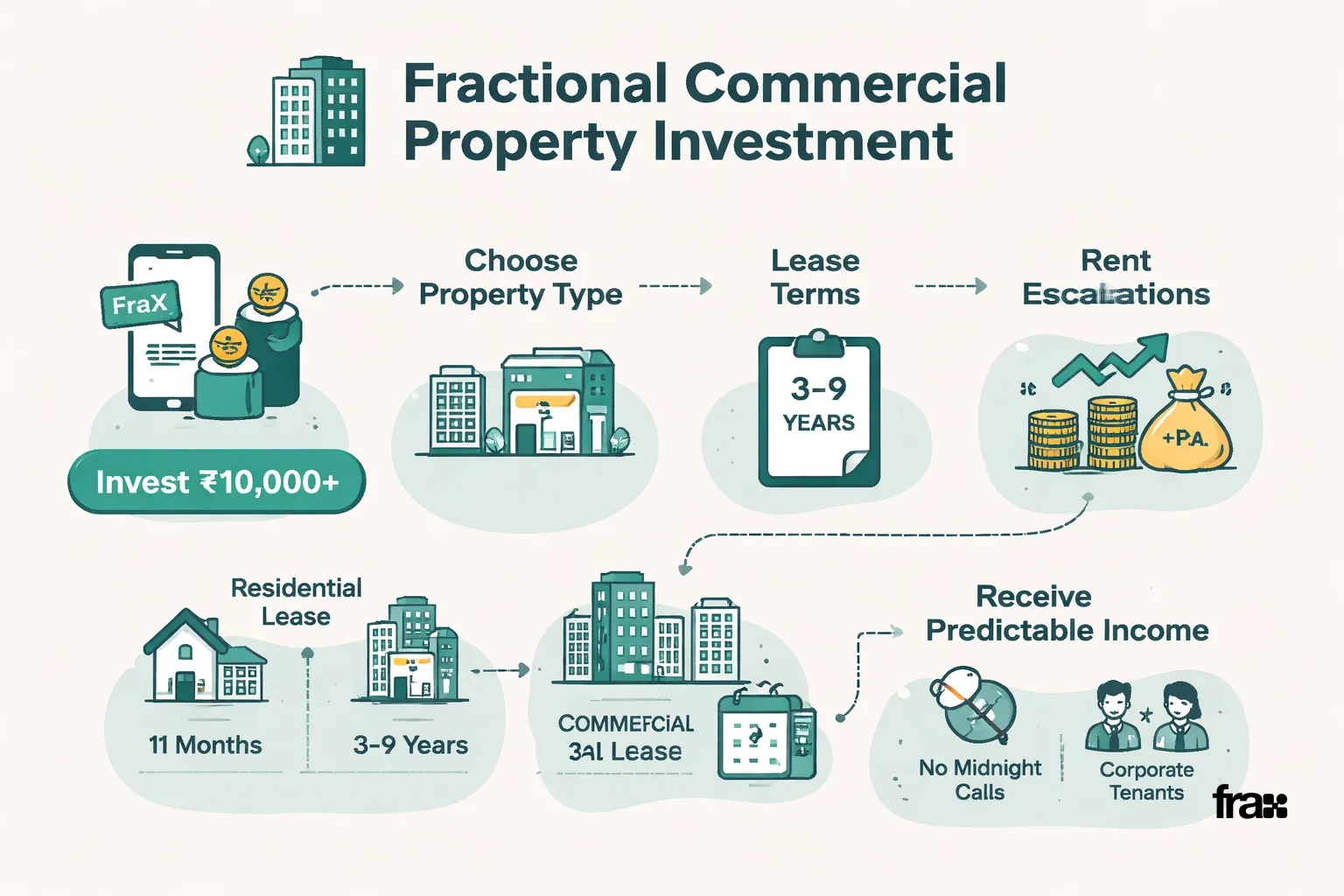
It just means putting your money into income-generating business spaces office buildings, retail showrooms, warehouses, and co-working spaces instead of homes. Historically, this required massive upfront capital, legal expertise, and the patience to deal with ongoing management.
The main difference from residential is the lease structure. You're leasing to businesses, not families. Corporate tenants usually sign three to nine-year leases with built-in rent escalations. That means fewer midnight calls about broken faucets and more predictable income. It's what made commercial property attractive to institutional investors and high net-worth individuals for decades.
But the barrier to entry was always the price. A single Grade A office floor in Mumbai or Bengaluru could easily cost several crores. Fractional ownership platforms changed the math by splitting these large commercial assets into smaller, purchasable units through dedicated legal structures.
This content is for informational purposes only and does not constitute financial, legal, or investment advice.
Why the shift toward commercial assets?
This content is for informational purposes only and does not constitute financial, legal, or investment advice.
Property investment in India is tilting toward commercial because the income is more predictable. You deal with corporate tenants who actually sign long-term leases. That beats dealing with residential renters who bounce after a year and leave you with a vacancy.
A few things are driving this right now in late 2026:
IT, BFSI, and e-commerce companies are still expanding their office and warehousing footprints across tier 1 and tier 2 cities.
People are spending more, which helps retail and mixed-use commercial spaces.
Digital access means platforms like FraX let you buy fractions of premium commercial properties without dealing with brokers or paperwork. Investors hold direct beneficial partnership interests in dedicated LLP SPVs, not direct individual property titles.
The investor base is getting younger. Reports show 80% of FraX users are under 35, a crowd that prefers app-based investing over traditional property purchases.
Plus, commercial assets tend to be less sensitive to short-term sentiment swings than residential flats, since lease agreements lock in occupancy and rental terms for years at a stretch.
How fractional ownership makes it accessible
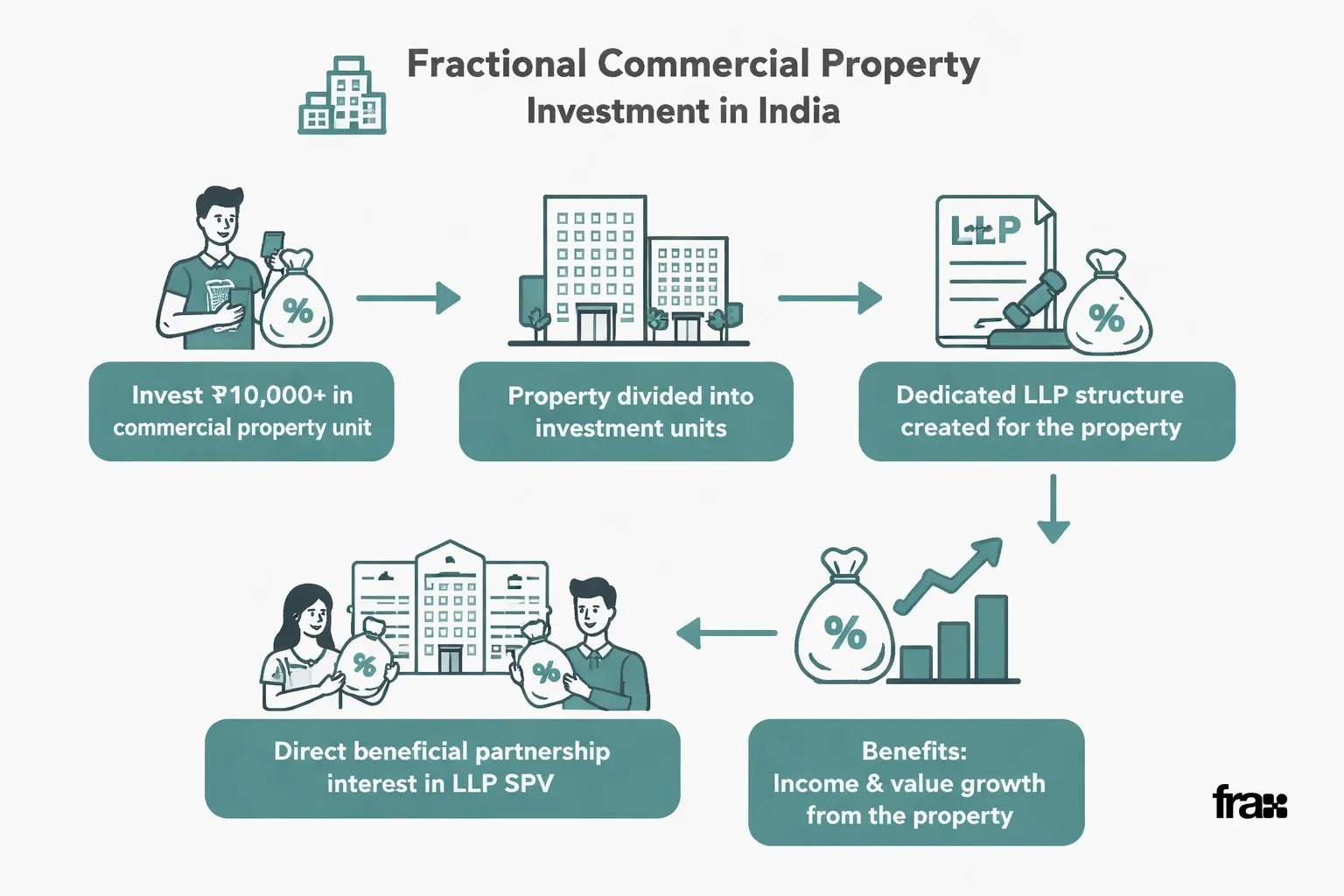
The concept is simple: you break a commercial property into smaller investment units. Instead of buying an entire office floor, you buy a fraction of it for ₹10,000 or more, gaining exposure to the same property's income and value trends.
On platforms like FraX, they don't actually hand you the title deed to a corner of the building. Each property is held through a dedicated LLP structure, meaning one property equals one LLP. Investors hold direct beneficial partnership interests in dedicated LLP SPVs, not direct individual property titles. It keeps things legally clean and transparent.
Here’s how it actually works:
A commercial property is identified and legally vetted.
The property is structured under its own LLP SPV.
Units representing fractional interests are listed on the platform.
Investors browse available properties and invest starting at ₹10,000.
Transactions are routed through an ICICI Bank escrow account, overseen by Universal Trustees as an independent trustee.
Investors can track performance and explore exit options digitally over time.
This model means you don't have to personally manage tenants, negotiate leases, or handle maintenance: the underlying property management is handled at the SPV level.
This content is for informational purposes only and does not constitute financial, legal, or investment advice.
Explore Commercial Property Fractions Starting at ₹10,000
What to evaluate before you invest
This content is for informational purposes only and does not constitute financial, legal, or investment advice.
Don't just throw money at a property because the pictures look nice. Due diligence matters before committing capital to any commercial property investment. You need to assess location quality, tenant profile, lease terms, and the legal structure backing the investment.
Instead of just trusting the marketing pitch, here's what you actually need to verify:
Factor | What to Check |
|---|---|
Location | Proximity to business hubs, transit, and commercial demand zones |
Tenant quality | Reputation and financial stability of leasing businesses |
Lease structure | Lock-in period, escalation clauses, renewal terms |
Legal documentation | SPV structure, ownership records, escrow mechanism |
Entry cost | Minimum ticket size and associated platform fees |
Exit flexibility | Options available to sell or exit the fractional unit |
FraX keeps it simple with a 1% buy fee and 1% sell fee, keeping costs transparent for first-time investors. They push a "Buy & Sell Anytime" approach, giving investors more flexibility than traditional commercial property, which often locks capital for years with no easy exit route.
Keep in mind that past performance and realized XIRR figures are historical and do not guarantee future property returns or rental yields. Every commercial asset carries its own risk profile tied to location, tenant stability, and market cycles.
Commercial vs. residential: Where things are heading
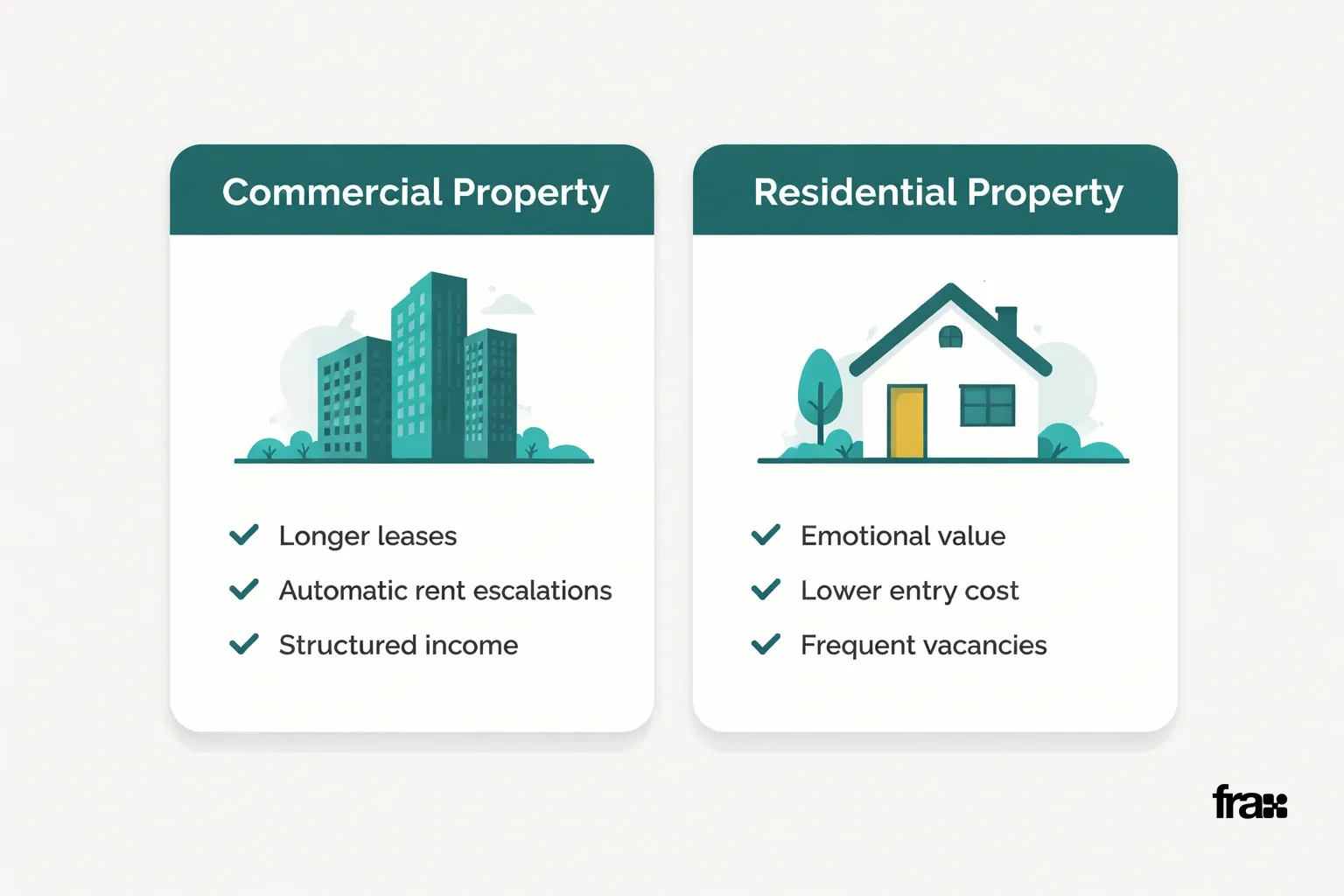
Commercial property is increasingly pulling capital away from pure residential plays, especially among younger professionals. Residential property is emotionally significant for many Indian households, but as a pure investment vehicle, commercial assets just offer more structured income potential.
Think about it:
Commercial leases run longer, reducing the frequent vacancy cycles you get with residential rentals.
Commercial rent agreements often have automatic escalations built right into the contracts.
Direct residential investment might start cheaper, but premium commercial assets traditionally needed crores: a gap fractional platforms finally close.
Residential landlords often handle tenant issues directly, while commercial SPV structures centralize this responsibility.
This doesn't mean residential investment loses relevance. It just means commercial property investment in India has become a more realistic option for retail investors than it was even three years ago, thanks to digital fractional platforms.
For a broader look at how commercial real estate trends are evolving across Indian cities this year, the Commercial Real Estate in India 2026 guide offers useful context on sectoral momentum and city-level demand.
This content is for informational purposes only and does not constitute financial, legal, or investment advice.
Start Your Commercial Property Portfolio Today
How to actually get started
Once you understand the fractional model, getting in is surprisingly simple. It beats the old way of dealing with brokers, lengthy paperwork, and large capital outlays.
If I were starting out today, I’d take this approach:
Figure out your budget, even if it starts at the ₹10,000 minimum.
Review the commercial properties listed on a trusted platform.
Actually check the location, tenant profile, and legal structuring for each option.
Diversify across multiple smaller commercial units instead of taking one large exposure.
Monitor performance periodically and know your exit options.
If you're exploring broader strategies for a diversified real estate portfolio, it's useful to look at fractional real estate investing and how it connects with commercial asset selection. Understanding the basics of fractional ownership also helps new investors grasp how pooled capital structures function before committing funds.
For those comparing city-level opportunities, resources on top cities for property investment and top Indian cities for real estate investment can provide additional location-specific context relevant to commercial demand zones.
This content is for informational purposes only and does not constitute financial, legal, or investment advice.
Risks and keeping your expectations realistic
Commercial property investment carries real risks. Market cycles, tenant vacancies, and economic shifts can all influence returns, and no platform can eliminate these factors entirely.
Investors should keep a few realistic expectations in mind:
Commercial property values and rental income can fluctuate based on local demand and broader economic conditions.
Liquidity, while improved through digital exit options, is still not comparable to instant stock market transactions.
Returns depend on property-specific performance and are not fixed or assured in advance.
Legal ownership sits at the LLP SPV level, representing beneficial partnership interest rather than a direct physical title deed.
Readers interested in understanding risk frameworks more broadly can review this guide to fractional real estate risk before making allocation decisions. It's also worth reviewing how FraX safeguards investor money at various stages of the investment lifecycle.
Commercial property investment in India, when approached with proper research and realistic expectations, can be a meaningful addition to a diversified portfolio. It is not a shortcut to guaranteed wealth, but a structured way to participate in an asset class that was historically closed off to most individual investors. Just remember this content is for informational purposes only and does not constitute financial, legal, or investment advice. Investors hold direct beneficial partnership interests in dedicated LLP SPVs, not direct individual property titles. Past performance and realized XIRR figures are historical and do not guarantee future property returns or rental yields.
Frequently asked questions
Q: What is the minimum amount needed for commercial property investment in India through fractional platforms? A: You can start with as little as ₹10,000 on platforms like FraX. That's a massive drop from the crores you'd need to buy commercial property outright.
Q: How is ownership structured in fractional commercial property investment? A: Each property is held through a dedicated LLP SPV. You hold a direct beneficial partnership interest in that LLP, rather than a direct physical title deed.
Q: Is commercial property investment in India safer than residential property investment? A: Commercial leases usually run longer and have rent escalations, which is nice. But every investment has risk tied to the tenant, location, and market. Neither is risk-free.
Q: Can investors exit a commercial property investment easily? A: FraX has a "Buy & Sell Anytime" model with no lock-in, which helps. But don't expect instant stock-exchange-level liquidity.
Q: What fees apply when investing in fractional commercial property? A: FraX keeps it simple: a 1% buy fee and a 1% sell fee.
Q: Are transactions on fractional real estate platforms secure? A: Money goes through an ICICI Bank escrow account, and Universal Trustees oversees it as an independent trustee. It adds a solid layer of oversight to the process.
Learn more
Discover more from the latest posts.


