
Top 10 Best Places to Invest in India 2026
Top 10 Indian investment firms for 2026: banks, mutual funds, fractional real estate like FraX. Find the best fit for your portfolio.
If you're looking for the absolute best place to invest in India in 2026, I have to break it to you: there isn't just one. It's a mix of regulated banks, mutual fund houses, discount brokers, and newer fractional real estate platforms. Each plays a completely different role depending on your risk appetite and how quickly you need to access your cash.
Picking the wrong investment company can mean locked-in capital, hidden charges, or years of underwhelming growth. Hundreds of financial institutions are competing for Indian investors' attention right now, so filtering out the noise matters. Here is a breakdown of ten investment companies worth knowing in 2026, and a look at where fractional real estate actually fits into the picture. For a broader view of real estate options specifically, check out our guide to top real estate companies and investment options.
This content is for informational purposes only and does not constitute financial, legal, or investment advice.
What Makes a Company the "Best Place to Invest"?
When I look at where to put my money, I care about three things: trust, fees, and how easy it is to get my money out. Returns are great, but they don't mean much if the company is sketchy or locks up your cash.
Indian investors today weigh liquidity, minimum ticket size, and digital convenience alongside brand reputation. Companies scoring well across these factors tend to attract younger, salary-earning investors looking to diversify beyond fixed deposits.
Four qualities separate the best from the rest. Look for clear compliance history and a solid legal structure. Check if you can exit an investment without excessive delay. Make sure the minimums don't require lakhs upfront. And demand real-time tracking, clear documentation, and no hidden fees. These four filters apply whether you're evaluating a bank, a mutual fund house, or a fractional real estate platform.
This content is for informational purposes only and does not constitute financial, legal, or investment advice.
Top 10 Investment Companies in India for 2026
This content is for informational purposes only and does not constitute financial, legal, or investment advice.
Here is a look at ten of the biggest players in India right now. They span public banks, private banks, mutual fund houses, discount brokers, and fractional real estate platforms. Together, they cover nearly every asset class an Indian investor might consider this year.
Company | Category | Known For | Typical Entry Point |
|---|---|---|---|
State Bank of India (SBI) | Public Sector Bank | Fixed deposits, savings schemes | Low, bank-dependent |
HDFC Bank | Private Bank | FDs, wealth management desks | Moderate |
SBI Mutual Fund | Asset Management Company | Equity and debt mutual funds | SIPs from small amounts |
ICICI Prudential Mutual Fund | Asset Management Company | Diversified fund portfolios | SIPs from small amounts |
Zerodha | Discount Broker | Direct stocks and ETFs | No account minimum |
Groww | Investment App | Stocks, mutual funds, gold | Very low starting amount |
Bajaj Finance | NBFC | Fixed deposits, loans | Moderate |
LIC | Insurance-linked Investment | Endowment and ULIP plans | Policy-dependent |
Post Office Schemes | Government-backed | PPF, NSC, KVP | Very low starting amount |
FraX | Fractional Real Estate Platform | Premium property portfolios via LLP SPVs (Investors hold direct beneficial partnership interests in dedicated LLP SPVs, not direct individual property titles) | ₹10,000 |
Notice how nine of these ten companies deal in paper assets like deposits, funds, or equities. Only one, FraX, lets you own a slice of physical real estate without needing crores upfront. That's a structural difference worth understanding before you decide where your money goes next.
Explore Real Estate Investment Options on FraX
How Fractional Real Estate Fits In
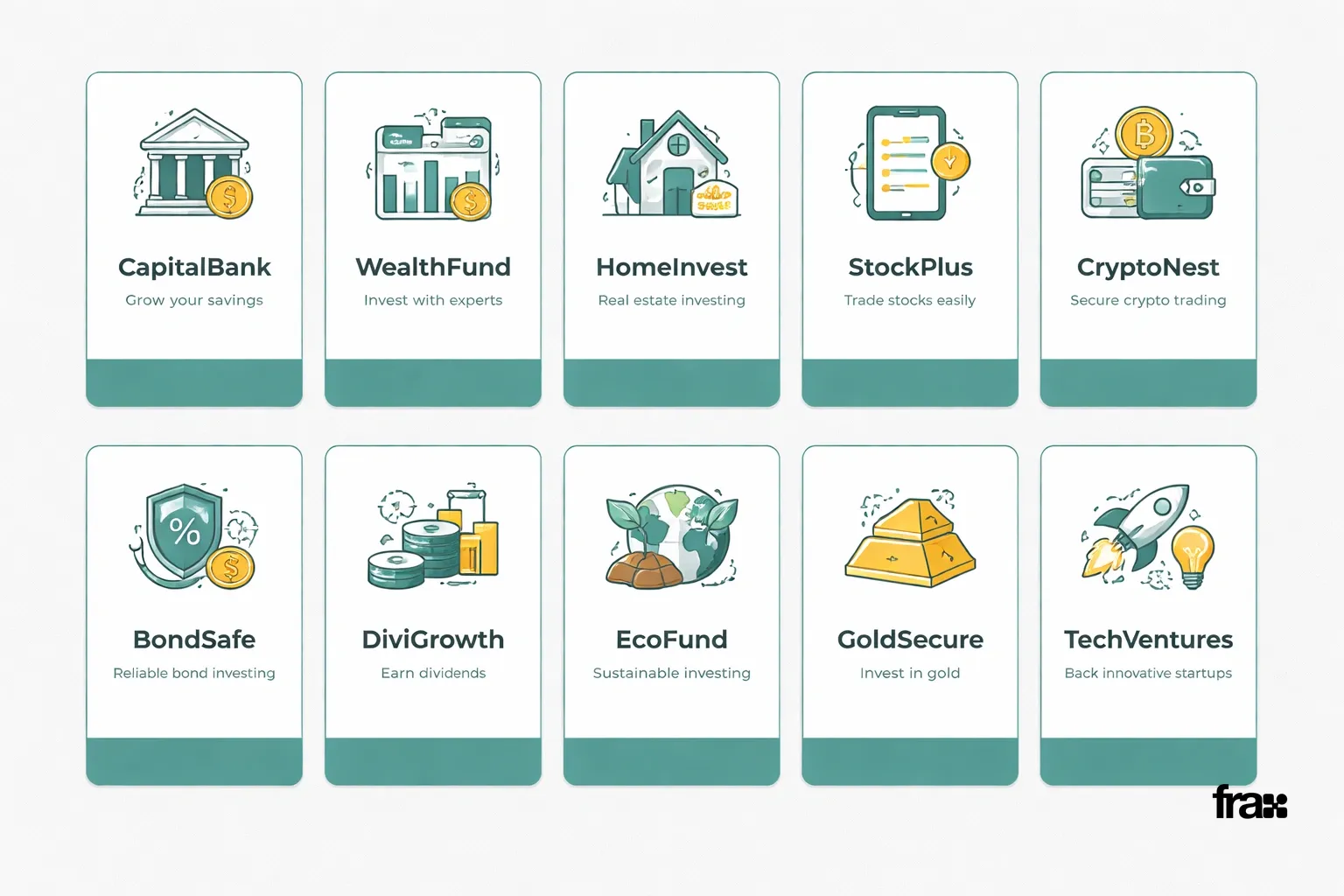
Fractional real estate is a newer category in India. FraX Digital Private Limited operates one such platform, letting investors buy into premium properties starting at ₹10,000. Investors hold direct beneficial partnership interests in dedicated LLP SPVs, rather than direct individual property titles. This structure opens real estate access to salaried professionals who traditionally couldn't participate.
FraX was founded in November 2025 by Prabhav Tanay and Tushar Chaudhary, both IIT-BHU alumni. Each property on the platform sits under its own dedicated LLP SPV. That structure keeps assets legally separated and easier to track for every investor.
A few operational details set this category apart from the traditional companies on the list above. Transactions run through an ICICI Bank escrow account, overseen by Universal Trustees as an independent trustee. The fee structure is straightforward: a 1% buy fee plus 1% sell fee, with no hidden layers. Liquidity is handled through a "Buy & Sell Anytime" approach, without traditional real estate lock-ins. The platform currently has over 40,000 app downloads with a 4.8 rating across app stores, and has deployed more than ₹3 crore in cumulative investor capital to date.
If you're curious about how the underlying mechanics work, our beginner's guide to fractional real estate investing walks through the entire process step by step. You can also browse our glossary of fractional real estate terms if some of this vocabulary feels new.
This content is for informational purposes only and does not constitute financial, legal, or investment advice.
Traditional Companies vs Fractional Real Estate Platforms
Traditional financial companies and fractional real estate platforms solve different problems for Indian investors. Banks and mutual funds offer familiarity and long track records. Fractional platforms offer access to an asset class that was previously out of reach for most salaried professionals. This content is for informational purposes only and does not constitute financial, legal, or investment advice.
Factor | Traditional Companies (Banks, MFs, Brokers) | Fractional Real Estate Platforms |
|---|---|---|
Asset class | Cash, debt, equity | Investors hold direct beneficial partnership interests in dedicated LLP SPVs, not direct individual property titles. |
Minimum entry | Varies, often low | ₹10,000 |
Liquidity | High for stocks, low for FDs | Digital exit, no traditional lock-in |
Documentation | Standard KYC and fund documents | Legal LLP agreements per property |
Diversification role | Core portfolio holdings | Portfolio diversification into real assets |
Neither category replaces the other. Most seasoned investors treat fractional real estate as a complement to their existing SIPs and deposits, not a substitute. Our post on portfolio stability through fractional real estate covers this balance in more depth.
Checklist: Choosing the Best Place to Invest in India in 2026
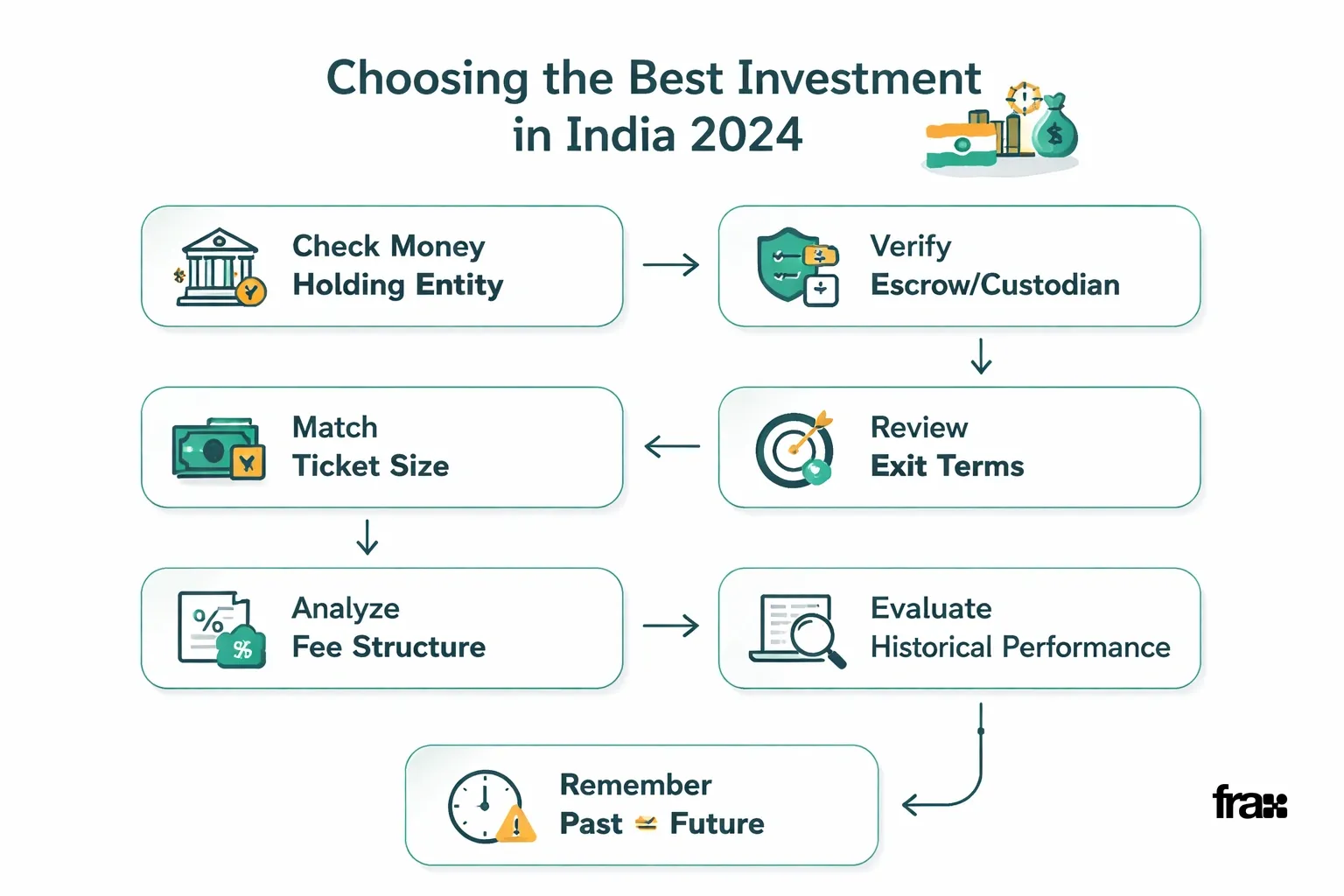
Before you put money anywhere, run a few basic checks. Ask how the company holds your money and under what entity. Check if there is an independent escrow or custodian setup so you aren't relying on a single point of risk. Make sure the minimum ticket size actually fits your monthly investing capacity. Read the exit terms carefully so you understand how and when you can withdraw. Look at the fee schedule, because flat, transparent fees beat vague percentage ranges. And review historical performance data, but remember that past results don't predict future ones.
Past performance and realized XIRR figures are historical and do not guarantee future property returns or rental yields. This applies to every company on this list, not just fractional platforms.
This content is for informational purposes only and does not constitute financial, legal, or investment advice.
Start Your First Fractional Investment Today
Making Your Final Decision
Figuring out where to invest usually comes down to your timeline. If you need short-term liquidity, you'll probably lean toward stockbroking apps like Zerodha or Groww. If you're building a long-term base, you might spread your money across mutual funds, deposits, and fractional real estate.
FraX is just one piece of that puzzle: the real estate piece, made accessible at a ₹10,000 entry point. Comparing it against REITs and direct property ownership can help clarify which route suits your goals; our comparison of fractional ownership, REITs, and direct ownership breaks this down further. For a deeper look at how the FraX platform itself is built, read about the FraX advantage for everyday investors and how the platform safeguards investor money at every stage.
You can also browse our full blog archive or visit the FraX homepage to see current property listings available for fractional investment.
This content is for informational purposes only and does not constitute financial, legal, or investment advice.
Frequently Asked Questions
This content is for informational purposes only and does not constitute financial, legal, or investment advice.
Q: What is the best place to invest in India for someone earning ₹15 to 20 lakh annually?
A: It depends on your goals, but many professionals in this bracket combine mutual fund SIPs, fixed deposits, and fractional real estate to diversify without needing large lump sums.
Q: Are fractional real estate platforms among the top investment companies in India?
A: Yes, platforms like FraX have grown into a distinct category, letting investors access premium property starting at ₹10,000 through dedicated LLP SPV structures.
Q: How does FraX differ from a mutual fund or bank fixed deposit?
A: FraX gives investors beneficial partnership interests in real estate-holding LLPs, while mutual funds and FDs deal in market securities or cash-based instruments respectively.
Q: What should I check before choosing an investment company in India?
A: Verify the legal structure, escrow arrangements, minimum ticket size, exit terms, and fee transparency before committing any capital.
Q: Is there a minimum amount needed to start investing in fractional real estate?
A: On FraX, the minimum investment ticket size is ₹10,000, making premium real estate accessible without needing crores upfront.
Q: Does FraX guarantee returns on real estate investments?
A: No. Past performance and realized XIRR figures are historical and do not guarantee future property returns or rental yields.
Learn more
Discover more from the latest posts.