

Top Real Estate Companies in India & Investment Options 2026
Explore top real estate companies in India, REITs, and fractional ownership models. Learn how to invest in 2026 with expert insights.
Property real estate investment in India runs through publicly listed developers, REITs, and newer fractional platforms. Understanding the top real estate companies in India helps investors gauge market direction before choosing how they want exposure through stocks, REITs, or fractional ownership models like FraX.
Real estate wealth-building looks different in 2026 than it did a decade ago. Big real estate companies in India still shape skylines and city infrastructure, but ordinary investors now have more ways to participate than buying shares or waiting for a home loan approval. This guide covers the major players, how real estate stocks fit into a portfolio, and where fractional ownership sits alongside traditional realty companies.
This content is for informational purposes only and does not constitute financial, legal, or investment advice.
What Are the Top Real Estate Companies in India Right Now?
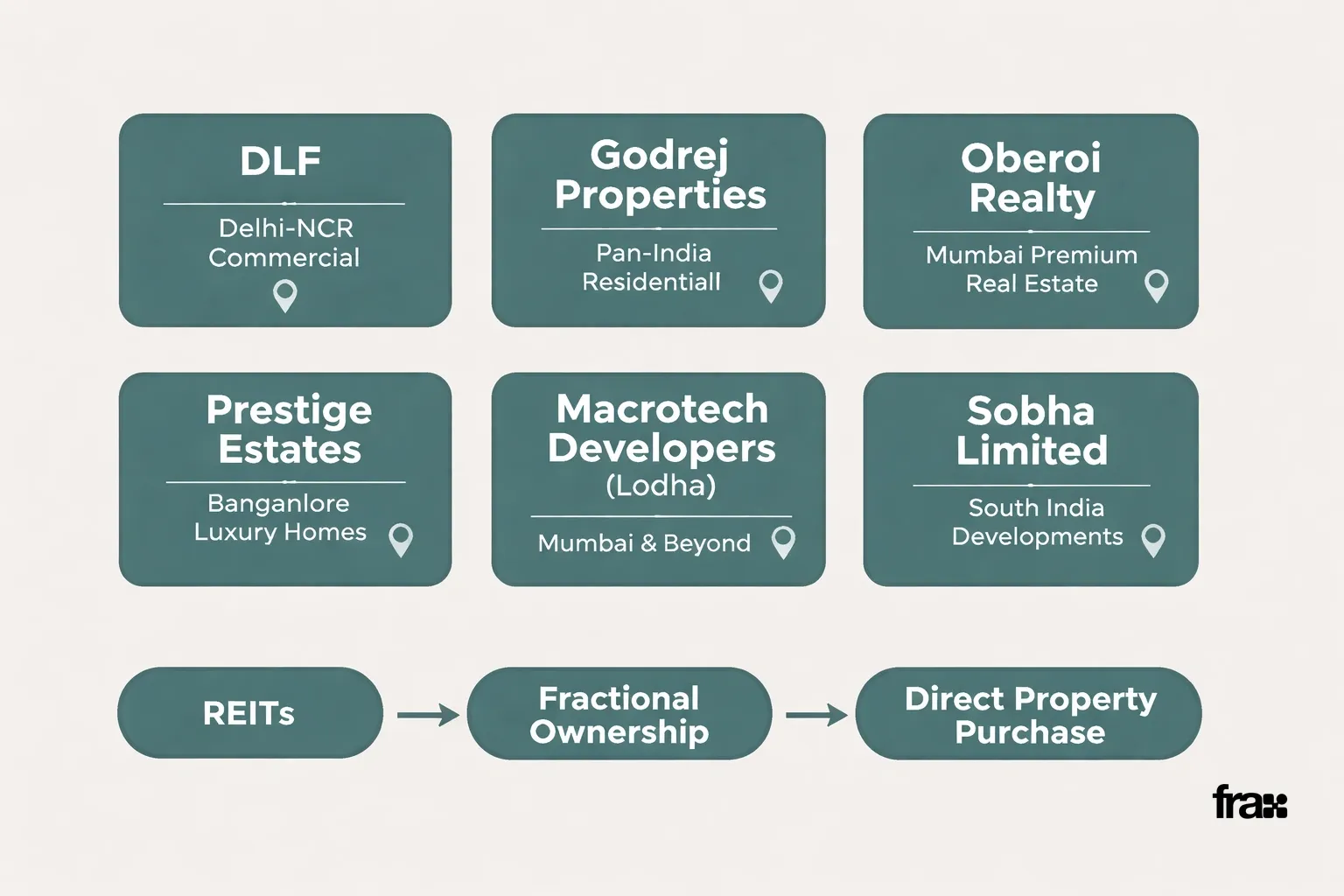
DLF, Godrej Properties, Oberoi Realty, Prestige Estates, Macrotech Developers (Lodha), and Sobha Limited. These names come up repeatedly when investors research listed real estate. They dominate residential, commercial, and mixed-use development across major metros.
Each focuses differently. DLF is strong in Delhi-NCR's commercial and luxury residential space. Godrej Properties has expanded aggressively across Mumbai, Pune, Bangalore, and NCR they've built a reputation for faster project turnarounds. Oberoi Realty focuses almost entirely on premium Mumbai real estate. Prestige Estates has a South India footprint spanning residential, retail, and hospitality.
Macrotech Developers (the Lodha brand) has moved into logistics and industrial real estate alongside residential towers. Sobha Limited does in-house construction, which gives them more control over quality and delivery timelines.
Company | Core Focus | Notable Strength |
|---|---|---|
DLF | Residential & Commercial | NCR dominance, luxury projects |
Godrej Properties | Residential | Pan-India expansion pace |
Oberoi Realty | Premium Residential | Mumbai market leadership |
Prestige Estates | Mixed-use | South India footprint |
Macrotech (Lodha) | Residential & Industrial | Diversification into logistics |
Sobha Limited | Residential | In-house construction quality |
This covers the companies most investors research when looking at big real estate companies in India. There are others, but these are the names that come up in allocation discussions.
This content is for informational purposes only and does not constitute financial, legal, or investment advice.
Why Real Estate Stocks Matter for Property Investors
Real estate stocks give investors indirect exposure to the property sector without buying physical assets. They reflect company performance, project pipelines, and real estate cycles not individual property values. For many investors, stocks are the first entry point into real estate investing.
But here's what people miss: buying shares of a listed developer means betting on management execution, not a specific building or locality. Stock prices swing with quarterly earnings, interest rate changes, and regulatory shifts. Not just property demand. This makes real estate stocks more correlated with equity market volatility than with the underlying real estate asset class.
Someone buying DLF shares isn't investing in a particular commercial tower in Gurugram. They're investing in the company's overall business debt levels, land acquisition strategy, project delivery speed, everything. That's different from owning a fraction of one specific property, which is the model platforms like FraX use.
Investors researching how fractional real estate investing works in 2026 often start by comparing this stock-based exposure against direct fractional ownership of individual assets.
This content is for informational purposes only and does not constitute financial, legal, or investment advice.
Explore Fractional Property Investment on FraX
Realty Companies vs. REITs vs. Fractional Ownership
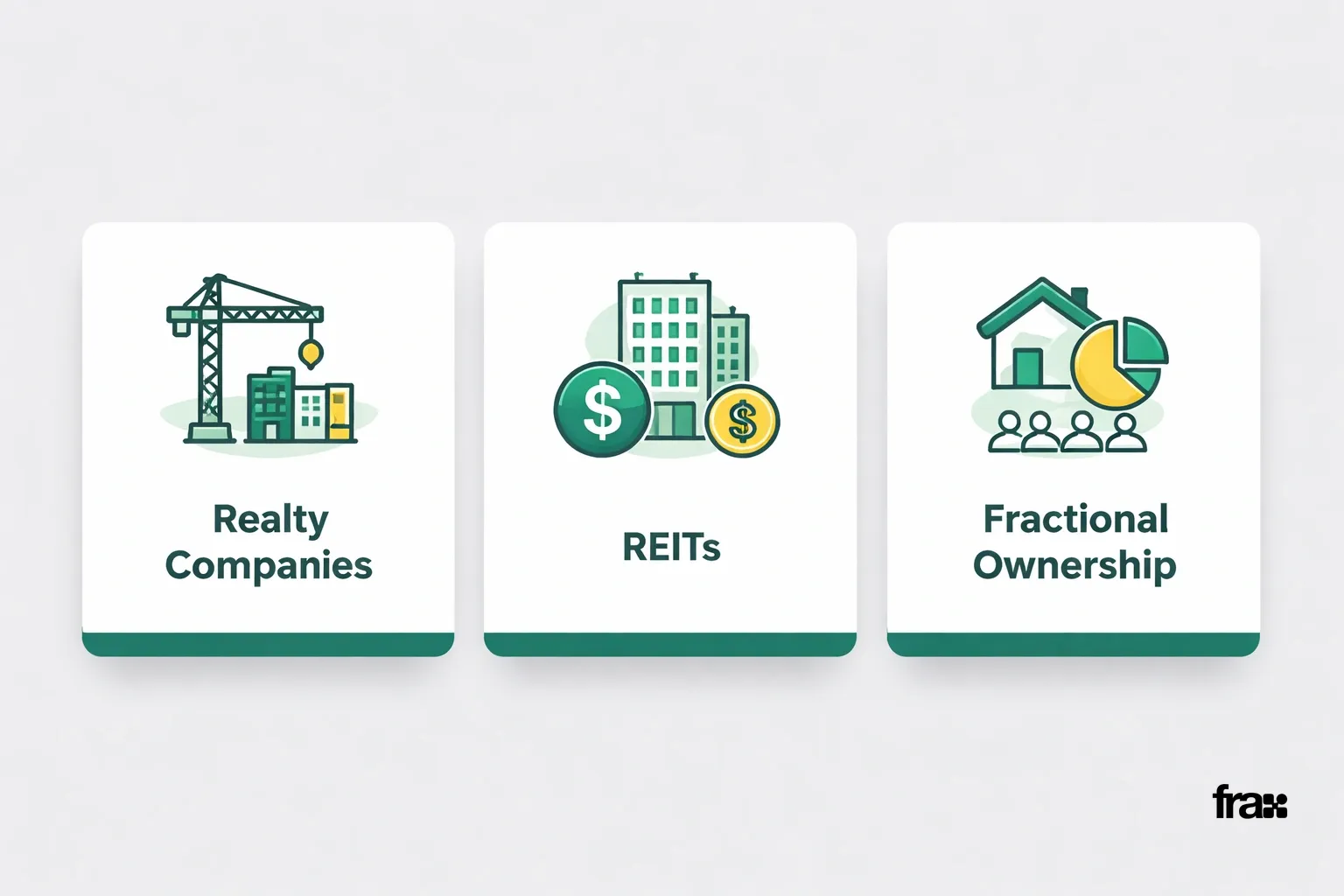
Three different models, three different risk profiles. Realty companies build and sell projects. REITs pool rental-yielding commercial assets into tradable units. Fractional platforms let investors co-own specific properties through structured SPVs.
Buying shares in a realty company exposes you to that company's entire business risk execution delays, debt levels, regulatory headaches. REITs offer diversified exposure to a basket of commercial properties, usually with more liquidity than direct property ownership. Fractional ownership ties your capital to one specific asset. It's closer to how traditional property investment works, just at a fraction of the cost.
FraX structures each property through a dedicated LLP SPV. One property equals one LLP. Investors hold direct beneficial partnership interests in these SPVs, not direct individual property titles. This sits between the pooled-diversification model of REITs and the single-asset ownership model of traditional real estate.
For readers weighing these options side by side, this comparison of fractional ownership, REITs, and direct ownership breaks down the mechanics further.
This content is for informational purposes only and does not constitute financial, legal, or investment advice.
Big Real Estate Companies in India: What Drives Their Scale
Land bank accumulation. Brand trust. Access to institutional capital. That's what separates the big players from smaller developers.
Scale lets large companies negotiate better financing terms and absorb longer project timelines. Smaller developers can't always match this staying power during market downturns.
Land banking is a core strategy. DLF and Macrotech hold large parcels of undeveloped land. This gives them flexibility to launch projects when demand peaks. They're not dependent on buying land at volatile market prices during active development phases.
Brand trust compounds over decades. Buyers paying premium prices for Oberoi Realty or Prestige Estates properties are partly paying for a track record timely delivery, quality construction. Newer developers can't replicate that overnight.
Institutional capital matters too. Large real estate companies attract private equity, foreign institutional investment, easier debt financing. This capital advantage lets them take on large mixed-use townships or commercial complexes that smaller players simply can't finance.
But scale doesn't automatically translate to smoother returns for retail investors buying shares. Real estate stocks still carry company-specific risk tied to debt levels, execution delays, regulatory approvals. These are separate from the health of the underlying property market.
This content is for informational purposes only and does not constitute financial, legal, or investment advice.
Where Fractional Real Estate Fits Into the Bigger Picture
Fractional real estate investing gives individual investors exposure to specific properties without needing crores upfront. It's different from buying shares in realty companies or REIT units. You co-own a defined asset through a legal structure built around that single property. Investors hold direct beneficial partnership interests in dedicated LLP SPVs, not direct individual property titles.
The gap it fills is real. Someone earning ₹15–20 lakh annually often can't afford a premium property outright. Buying a developer's stock doesn't give them ownership in any specific building. Fractional platforms close that gap FraX starts at ₹10,000 per investment.
The mechanics work differently from public markets. Platforms structure buy and sell processes with defined fee models. FraX charges a 1% buy fee and 1% sell fee per transaction. Funds move through an ICICI Bank escrow account overseen by Universal Trustees as an independent trustee.
Younger investors have gravitated toward this model. About 80% of FraX users are under 35. The "Buy & Sell Anytime" flexibility is something traditional property ownership never offered no need to find a buyer manually or navigate months of paperwork to exit.
For a deeper walkthrough of getting started, this step-by-step beginner's guide covers the practical onboarding process. This beginner's glossary helps decode common terms.
This content is for informational purposes only and does not constitute financial, legal, or investment advice.
Start Your Fractional Investment Journey Today
Comparing the Investment Routes: A Quick Snapshot
Realty stocks, REITs, fractional platforms each serves different needs. The choice depends on capital available, desired involvement, liquidity needs. None is universally "better." They solve different problems. This content is for informational purposes only and does not constitute financial, legal, or investment advice.
Investment Route | Minimum Capital | Asset Specificity | Liquidity Model |
|---|---|---|---|
Realty Company Stocks | Market price of 1 share | Company-wide, not asset-specific | Stock exchange trading |
REITs | Market price of 1 unit | Pooled commercial assets | Exchange-listed trading |
Fractional Ownership (FraX) | ₹10,000 | Single specific property via LLP SPV (Investors hold direct beneficial partnership interests in dedicated LLP SPVs, not direct individual property titles) | Buy & sell anytime on platform |
Direct Property Purchase | Lakhs to crores | Single specific property | Low; manual buyer search |
Real allocation strategies often blend multiple routes. An investor might hold real estate stocks for market-wide exposure, a REIT unit for diversified commercial income, and a fractional stake in a specific property for targeted growth.
Readers exploring risk considerations across these routes may find value in this smart investor's guide to risk and reward in fractional real estate.
How FraX Approaches Property Real Estate Investment
FraX structures each asset as an independent LLP SPV. Investors hold direct beneficial partnership interests in dedicated LLP SPVs, not direct individual property titles. The platform was founded in November 2025 by Prabhav Tanay (CEO) and Tushar Chaudhary, both IIT-BHU alumni, and operates under FraX Digital Private Limited.
The platform has crossed 40,000+ app downloads with a 4.8-star rating on both App Store and Play Store. Cumulative investor capital deployed has surpassed ₹3 crore.
Security is built into the structure. Every transaction routes through an ICICI Bank escrow account. Universal Trustees acts as an independent oversight trustee. This adds financial checks around fund movement.
For more context on how this compares to historically fragmented property markets, this piece on bringing structure to a chaotic asset class is useful. For platform safeguards, see how FraX protects investor money at every stage.
Prospective investors might also explore the FraX advantage for everyday investors and how portfolio stability improves through fractional exposure.
This content is for informational purposes only and does not constitute financial, legal, or investment advice.
Building a Balanced Real Estate Strategy in 2026
A balanced real estate strategy in 2026 blends exposure across stocks, REITs, and fractional ownership. Diversification across formats reduces dependency on any single market mechanism. This applies whether someone is a salaried professional or a seasoned investor.
Younger investors especially those earning ₹15–20 lakh annually have been moving toward fractional platforms. They avoid the traditional hurdles: large capital requirements, extensive paperwork, broker dependency. This shift is reshaping how property real estate investment works nationally.
Top real estate companies in India still attract long-term stock investors who prefer indirect, company-level exposure. REITs remain relevant for diversified commercial rental exposure through exchange-traded instruments. All three routes coexist. Each serves different portfolio goals.
Investors interested in how this shift is playing out among younger demographics can read more in fractional real estate for young investors: 5 ways it's changing the game.
This content is for informational purposes only and does not constitute financial, legal, or investment advice. Investors hold direct beneficial partnership interests in dedicated LLP SPVs, not direct individual property titles. Past performance and realized XIRR figures are historical and do not guarantee future property returns or rental yields.
Q: What's the difference between real estate stocks and fractional real estate investment?
A: Real estate stocks give exposure to a company's entire business performance. Fractional ownership ties investment to one specific property through a legal SPV structure more direct asset-level exposure.
Q: Which are considered the top real estate companies in India for stock investors?
A: DLF, Godrej Properties, Oberoi Realty, Prestige Estates, Macrotech Developers, and Sobha Limited come up most often. Each has different regional strengths and project focuses.
Q: Is fractional real estate investing a substitute for buying stocks in big real estate companies?
A: Not really a substitute they serve different purposes. Stocks offer company-wide exposure. Fractional platforms offer direct exposure to individual properties. Many investors use both.
Q: How does FraX structure property ownership for fractional investors?
A: FraX creates a dedicated LLP SPV for each property. One property equals one LLP. Investors hold beneficial partnership interests in that specific SPV.
Q: What is the minimum amount needed to start fractional real estate investing on FraX?
A: ₹10,000. Premium property exposure without requiring lakhs or crores upfront.
Q: Are transactions on fractional real estate platforms like FraX secure?
A: FraX routes transactions through an ICICI Bank escrow account. Universal Trustees acts as an independent trustee overseeing fund movement during buy and sell activity.
Learn more
Discover more from the latest posts.


