

FraX Fractional Real Estate: Exit, Risk & NRI Guide (2026)
Considering FraX real estate investment options? Learn exit options before lock-in, real risks of fractional ownership, and how NRIs should invest in India in 2026.
If you already know what FraX real estate investment is about, you probably don't need another explainer on what fractional ownership means. What you actually want to know is more practical: what happens if you need to exit before a lock-in period ends, what could genuinely go wrong if you put a real amount of money in, whether anyone in India is teaching this properly, and whether NRIs should even bother. This guide answers those questions directly. For the broader introduction to how fractional ownership works in the first place, our piece on fractional real estate as a new era for young investors covers the basics in more depth.
This content is for informational purposes only and does not constitute financial, legal, or investment advice.
What Are Your Options If You Need to Exit a Fractional Real Estate Investment Before the Lock-In Period Ends?
If you're investing through FraX, this scenario mostly doesn't apply, there's no fixed lock-in window to wait out in the first place. The platform runs on a "Buy & Sell Anytime" model, so you can list your fraction for sale through the app whenever you decide to exit, without waiting years for a buyer the way you would with a physical property.
That said, not every fractional ownership platform in India works this way, and lock-in structures aren't standardised across the industry. On platforms that do impose a holding period, your realistic options are usually limited to requesting a secondary transfer to another investor, waiting out the remaining term, or in some cases accepting a reduced payout to exit early. None of that is guaranteed liquidity, it depends entirely on the platform's own terms.
The practical takeaway: before you invest anywhere, read the exit clause in the SPV or offer document, not just the headline pitch. On FraX, this is disclosed upfront as part of the "no lock-in" structure, but it's worth confirming for yourself in the documents rather than taking any marketing claim at face value.
What Could Go Wrong? The Real Disadvantages of Putting ₹5-10 Lakh Into a Fractional Real Estate Platform
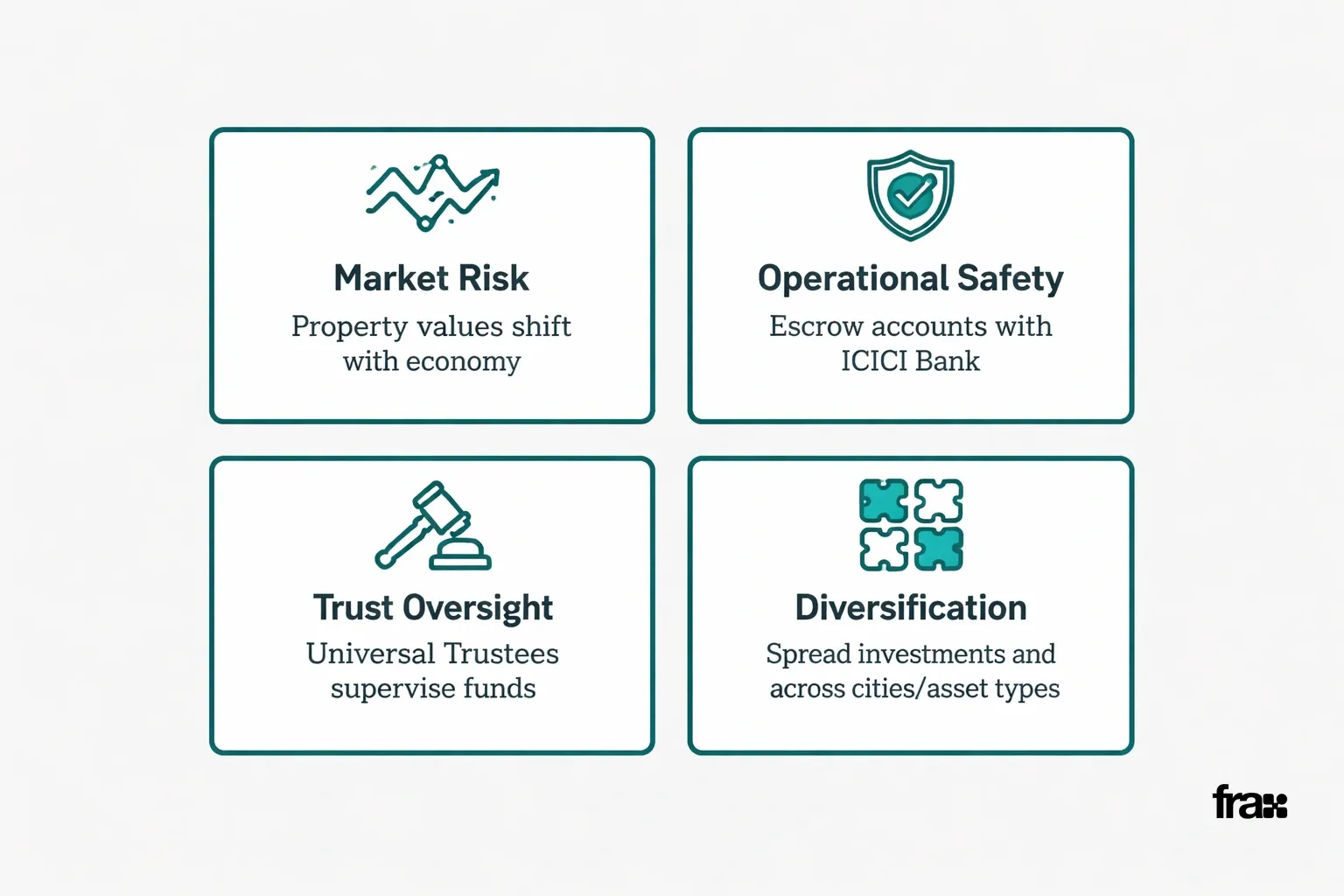
The honest answer is that fractional ownership doesn't remove real estate's underlying risks, it just changes how much capital you need to be exposed to them. Put ₹5-10 lakh into a single fractional property and the risks are the same ones any property owner faces, just at a smaller ticket size.
Market risk: property values and rental demand move with local demand cycles, interest rates and infrastructure timelines. Nothing about the fractional structure changes that.
Liquidity depends on demand, not a promise: even on a "no lock-in" model, selling your fraction still depends on there being buyer interest in that specific property. It is not the same as instantly selling a listed stock.
Concentration risk: putting your entire ₹5-10 lakh into one property is riskier than splitting it across several. This is true whether the property is fractional or fully owned.
Different regulatory footing than a REIT: fractional ownership through an LLP SPV sits outside the SEBI REIT framework, so its legal treatment and investor protections differ from a listed, SEBI-regulated REIT. Understand which structure you're actually in.
New asset class, shorter track record: most fractional platforms in India, FraX included, are only a few years old at most, so there is less long-term performance history to lean on than with traditional real estate or listed REITs.
Past performance and realized XIRR figures are historical and do not guarantee future property returns or rental yields. If you want a deeper look at how returns actually get generated, appreciation versus rental income, our guide on fractional real estate returns: appreciation vs rental yield breaks it down further, and the risk and reward guide goes deeper into managing exposure across properties.
Are There Educational Programs or Awareness Initiatives About Fractional Ownership in India?
Not really, not in the formal, university-level sense. There is no widespread institutional curriculum specifically on fractional real estate ownership in India yet. What exists instead is education delivered by the platforms themselves, through app walkthroughs, glossaries, and step-by-step content aimed at first-time investors.
If you're new to the terminology, our beginner's glossary is a reasonable starting point, and the step-by-step beginner's guide walks through the actual investing flow. Treat these as a starting point, not a substitute for reading the specific legal and escrow documents for any property you're considering. Awareness in this space is still catching up to the product, so a healthy amount of self-directed reading before you invest is currently the norm rather than the exception.
How Should NRIs Invest in Indian Real Estate in 2026: Traditional Ownership, REITs, or Fractional Ownership?
It depends on how hands-on an NRI investor wants to be and how much capital is available. Traditional ownership gives full control and a direct title but demands physical presence, extensive paperwork, and full capital upfront. REITs offer stock-market liquidity and SEBI regulation but no connection to a specific property. Fractional ownership sits between the two, smaller capital, a fully digital process, but no direct title deed.
Factor | Traditional Ownership | REITs | Fractional Ownership |
|---|---|---|---|
Capital required | Full property value, often crores | Cost of listed units, relatively low | From ₹10,000 per property |
Physical presence needed | Usually yes, for registration and possession | No | No, fully digital process |
Paperwork and logistics | Heavy: title checks, registration, local agents | Minimal, handled via demat account | Handled digitally through the platform and LLP SPV documents |
Exit and liquidity | Slow, can take months or years | Fast, tradeable on stock exchanges | No lock-in on some platforms, but depends on buyer interest |
Connection to a specific property | Direct, full ownership | Indirect, part of a large pooled trust | Beneficial interest tied to a named property's SPV |
For an NRI weighing where to start, city selection matters as much as the model. Our guide to the top cities for fractional real estate investment in India is a useful next read, as is our broader look at real estate companies and investment options in India if you want to compare fractional ownership against other routes side by side. One thing this article won't do is give you tax guidance, NRI tax treatment on Indian real estate income and gains varies by residency status and is genuinely worth a conversation with a qualified tax advisor before you commit capital.
How Does FraX Structure Investments to Protect New Investors?
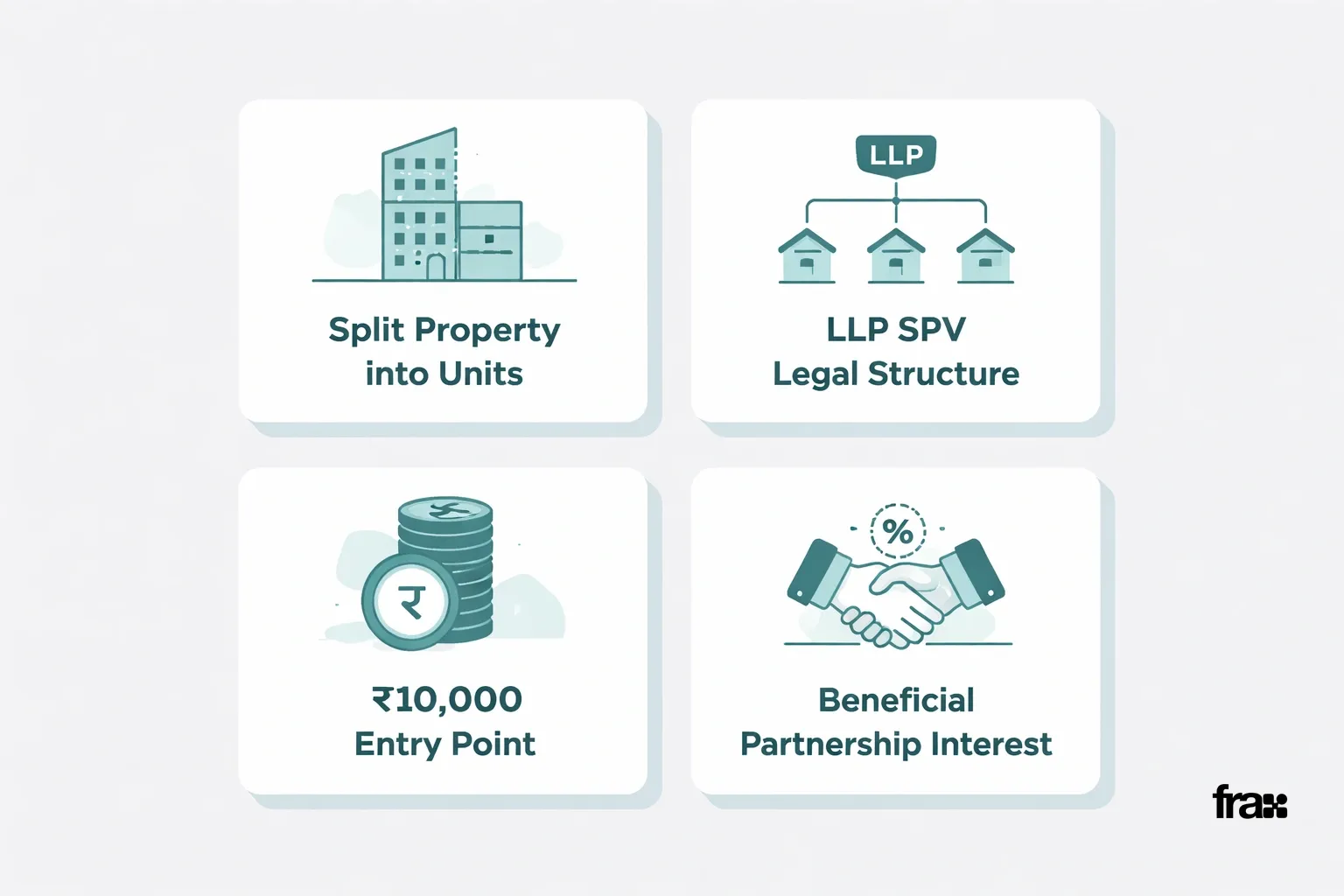
FraX creates a dedicated legal entity for every property it lists, one property, one LLP. Investors hold direct beneficial partnership interests in dedicated LLP SPVs, not direct individual property titles. That structure isolates risk: if one property underperforms, it doesn't drag down returns on any other property you've invested in.
The platform was founded in November 2025 by Prabhav Tanay (CEO) and Tushar Chaudhary, both IIT-BHU alumni, and operates under FraX Digital Private Limited. It has crossed 40,000 app downloads with a 4.8 star rating on both the App Store and Play Store, and investors have collectively deployed more than ₹3 crore through the platform so far.
Money moves through an ICICI Bank escrow account overseen by Universal Trustees as an independent trustee, so funds don't sit with the platform directly at any stage of a transaction. Fees are straightforward: 1% to buy, 1% to sell, with no lock-in penalties layered on top. For a closer look at how investor money is protected at every stage, see the breakdown on investor fund safety.
Explore Verified Properties on FraX Now
How Do You Actually Start Investing in Fractional Real Estate in India?
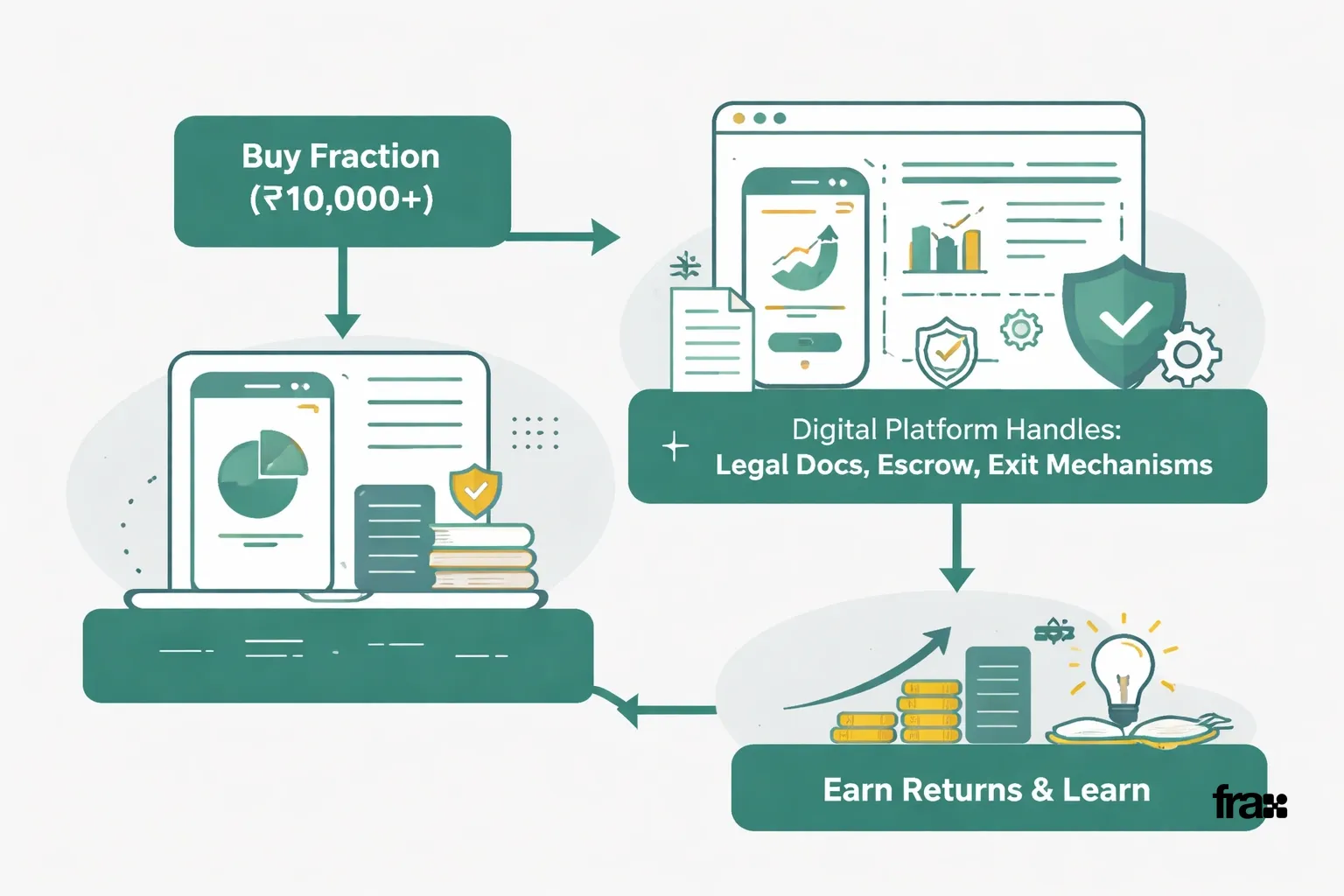
In short: sign up, complete KYC, pick a property, read the legal documents, transfer funds through escrow, and track the investment from an app dashboard. What used to take weeks of paperwork now happens in a single sitting.
Step | What Happens | Time Required |
|---|---|---|
1. Sign up and KYC | Identity and bank verification | 10-15 minutes |
2. Browse properties | Review location, pricing, projected returns | Varies |
3. Read legal documents | SPV structure, escrow terms, risk disclosures | 20-30 minutes |
4. Invest | Transfer funds via ICICI Bank escrow | Instant |
5. Track performance | Monitor via app dashboard | Ongoing |
6. Exit when ready | List your fraction for sale digitally | No lock-in period |
For the full mechanics of how the underlying investment actually works once your money is in, our detailed guide on fractional real estate investing in India: how it works covers that in more depth than we will here. Don't let the speed of the sign-up process fool you into skipping the document review, that step matters more than how quickly you can transfer funds.
Start Your First ₹10,000 Real Estate Investment Today
Frequently Asked Questions
What are my options if I need to exit a fractional real estate investment before the lock-in period ends?
On FraX there's no lock-in period at all, you can list your fraction for sale anytime through the app's Buy & Sell Anytime feature. On platforms that do have lock-ins, options are usually limited to secondary transfers or waiting out the term. Always check a platform's exit terms in its documents before investing since they vary widely.
What are the disadvantages of fractional ownership, and what could go wrong with ₹5-10 lakh in a fractional real estate platform?
Property values and rental demand can fall, returns are never guaranteed, and selling still depends on finding buyer interest even without a lock-in. Fractional ownership also sits outside the SEBI REIT framework, so its legal treatment differs from listed REITs. Diversifying across properties instead of one large ticket reduces concentration risk.
Are there educational programs or initiatives creating awareness about fractional ownership in India?
Formal, university-level courses on fractional ownership are still rare in India. Most awareness currently comes from platforms themselves through app walkthroughs, glossaries and step-by-step guides rather than dedicated institutional programs. Reading a platform's own educational content before investing is currently the most practical way to get up to speed.
How should NRIs invest in Indian real estate in 2026, traditional ownership, REITs, or fractional ownership?
It depends on how hands-on an NRI wants to be. Traditional ownership needs physical presence and heavy paperwork, REITs offer stock-market liquidity but no connection to a specific property, and fractional ownership offers a smaller, fully digital entry point into named properties. Consult a tax advisor for NRI-specific rules.
How do I invest in fractional real estate in India?
Download a platform's app, complete KYC, browse available properties, review the legal documents for the SPV, and transfer funds through the platform's escrow account. On FraX this process typically takes under an hour from sign-up to your first ₹10,000 investment, with no paperwork beyond digital verification.
Is FraX real estate legit?
FraX is operated by FraX Digital Private Limited, founded in November 2025. Transactions run through an ICICI Bank escrow account overseen by Universal Trustees, and each property sits in its own LLP SPV with legal documentation. The platform has over 40,000 app downloads and a 4.8 star rating.
What fees does FraX charge?
FraX charges a flat 1% fee to buy and 1% fee to sell, with no lock-in penalties. There are no hidden charges beyond these two fees, and you can see the exact amount before confirming any transaction in the app.
Investors hold direct beneficial partnership interests in dedicated LLP SPVs, not direct individual property titles. Past performance and realized XIRR figures are historical and do not guarantee future property returns or rental yields. This content is for informational purposes only and does not constitute financial, legal, or investment advice.
Learn more
Discover more from the latest posts.


