

Investing in REITs in India: A Beginner's Guide
Discover how REITs in India provide affordable access to commercial real estate with regular income and liquidity. Learn to invest today.
Buying a flat in a metro city in India usually means signing up for a massive loan or having a few crores sitting around. REITs, or Real Estate Investment Trusts, offer a workaround. They pool money from thousands of investors to buy income-generating commercial buildings. You buy units through a regular demat account, just like you would buy shares of a company, often starting with a few thousand rupees.
Real estate is one of India's most trusted asset classes, but a single flat in a metro can cost anywhere from 60 lakh to several crores. REITs changed that math for retail investors after the first Indian REIT listed in 2019. Here is a breakdown of how they function, how to buy units, and where they sit alongside other real estate options available today.
This content is for informational purposes only and does not constitute financial, legal, or investment advice.
What is a REIT in India?
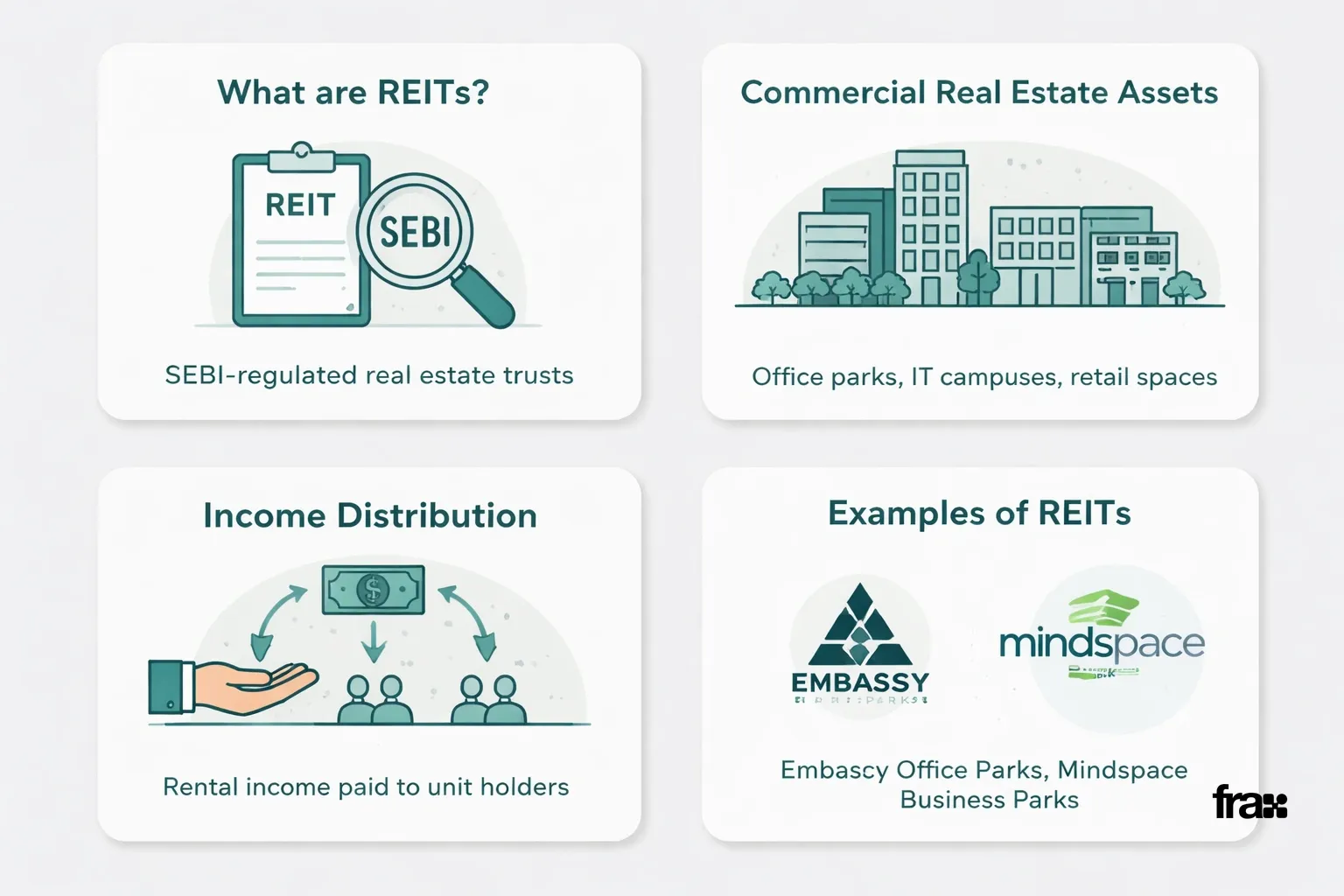
A REIT is a trust regulated by SEBI under the 2014 regulations. It owns and operates commercial real estate on behalf of its unit holders. Indian REITs usually hold large office parks, IT campuses, and retail spaces. Investors buy units representing a share of this pooled portfolio.
Rental income and capital gains flow back to unit holders periodically. It works somewhat like a mutual fund, except the underlying assets are physical buildings instead of stocks or bonds. India currently has a handful of listed REITs, including Embassy Office Parks, Mindspace Business Parks, Brookfield India, and Nexus Select Trust. Each holds a different mix of properties across cities like Bengaluru, Mumbai, Pune, and Hyderabad.
Unlike buying a flat directly, a REIT investor never holds a title deed to any specific unit within the building. Ownership sits at the trust level. You hold units that represent an economic interest in the whole portfolio.
How REITs work in the Indian market
This content is for informational purposes only and does not constitute financial, legal, or investment advice.
REITs convert large commercial properties into tradable units on the stock exchange. A sponsor sets up the trust, transfers assets into it, and lists units on the NSE or BSE through an initial offer. From that point, you trade units the same way you trade equity shares.
The trust structure requires that a large majority of the portfolio stays invested in completed, revenue-generating assets rather than under-construction projects. REITs also have to distribute a significant portion of their net distributable cash flows to unit holders at regular intervals. That distribution mechanism is a big reason REITs attract investors looking for periodic income alongside potential capital appreciation.
Trading happens during normal market hours on the exchange, and prices move based on demand, supply, and the underlying portfolio's performance. That said, REIT unit prices can be volatile in the short term, reacting to interest rate changes and broader market sentiment, not just property fundamentals.
Step-by-step: How to invest in REITs in India
This content is for informational purposes only and does not constitute financial, legal, or investment advice.
Investing in a REIT in India follows the same basic path as buying any listed security. You need a demat and trading account, funds to invest, and access to NSE or BSE through a broker. If you already trade in stocks, the entire process takes less than a day.
Here is the practical sequence most first-time REIT investors follow:
Open a demat and trading account with a stockbroker if you don't already have one.
Complete your KYC using your PAN, Aadhaar, and bank details.
Transfer funds into your trading account through UPI or net banking.
Search for the listed REIT ticker, such as EMBASSY, MINDSPACE, or BROOKFIELD, on your broker's app.
Place a buy order for the number of units you want at the current market price.
Track distributions and price movement through your portfolio dashboard.
Because REIT units trade on the open market, you can sell them whenever the exchange is open, subject to available buyers at your desired price. This is different from direct property, where finding a buyer can take months.
Explore Real Estate Investment Options Beyond REITs
Minimum investment and ticket size for REITs
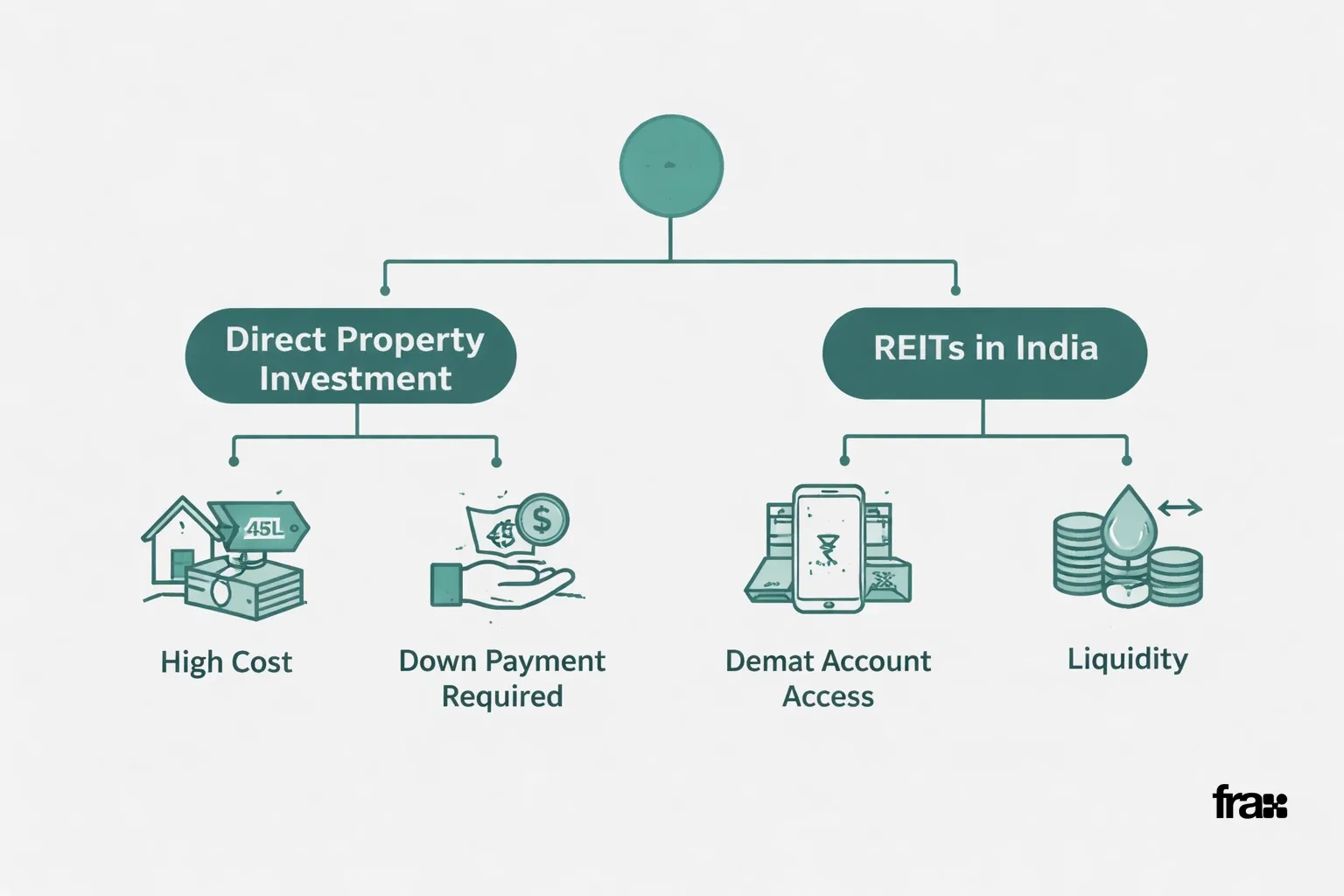
REITs require a much lower entry point than direct property. A single REIT unit in India often costs between 300 and 400 rupees, though this varies by trust and market conditions. Most brokers don't impose a minimum lot size beyond one unit, making REITs accessible to almost anyone with a demat account.
This low ticket size is exactly why REITs became popular among salaried professionals who can't afford a down payment on a flat. However, getting meaningful exposure to commercial real estate through REITs still requires buying enough units to matter within a broader portfolio. Someone earning 15 to 20 lakh a year, for example, might allocate a modest monthly amount toward REIT units through systematic buying, similar to how they would approach mutual fund SIPs.
For readers exploring how different real estate investment options compare on minimum ticket size, the parent guide on real estate investment options in India breaks down several routes side by side, including REITs, direct ownership, and fractional platforms.
This content is for informational purposes only and does not constitute financial, legal, or investment advice.
REITs vs other ways to invest in real estate in India
This content is for informational purposes only and does not constitute financial, legal, or investment advice.
REITs sit alongside several other paths for investing in Indian real estate. Direct property ownership gives you full control but demands large capital and heavy paperwork. Fractional real estate platforms sit somewhere between REITs and direct ownership, offering exposure to specific residential or commercial assets rather than a diversified trust portfolio.
Here is how the three main options compare:
Feature | REITs | Fractional Real Estate | Direct Property |
|---|---|---|---|
Minimum investment | A few hundred rupees per unit | Often starts around ₹10,000 | Several lakh to crores |
Asset type | Diversified commercial portfolio | Specific chosen property | Specific chosen property |
Trading mechanism | Stock exchange, market hours | Platform-managed buy and sell | Broker-negotiated, slow process |
Ownership structure | Units in a trust | Beneficial interest in an SPV | Direct title deed |
Paperwork | Minimal, done through broker | Digital agreements | Extensive legal documentation |
Readers who want a deeper breakdown of how fractional ownership specifically works can check the sibling guide on fractional real estate investing in India. For a direct head-to-head between the three models, the article comparing fractional ownership, REITs, and direct property covers the decision framework in more depth.
Platforms like FraX approach real estate differently from REITs. Instead of a single diversified trust, FraX structures each property as a dedicated LLP SPV, meaning one property maps to one LLP. Investors hold direct beneficial partnership interests in dedicated LLP SPVs, not direct individual property titles. This gives investors more choice over which specific asset they back, rather than buying into a pre-set commercial portfolio the way a REIT works.
Pros and cons of REIT investing in India
This content is for informational purposes only and does not constitute financial, legal, or investment advice.
REITs solve a real problem for investors seeking real estate exposure without direct ownership hassles. They have a low entry cost compared to buying property outright, they trade on the exchange during market hours, and they offer diversification across multiple large commercial assets in one trust. You also get regular income distributions from rental cash flows. Past performance and realized XIRR figures are historical and do not guarantee future property returns or rental yields.
But they carry limitations that matter before you commit capital. India has only a few listed REITs, so your choice of underlying assets is limited. Unit prices can swing with broader market sentiment, not just property fundamentals. You have no control over which specific building or city your money supports, and the portfolio is concentrated mostly in commercial office and retail space, not residential property.
Investors looking for more say over the specific property, city, or asset class they back sometimes explore fractional real estate as a beginner, where each investment maps to one identified property rather than a shared trust.
Start Building a Diversified Real Estate Portfolio Today
Choosing the right REIT in India
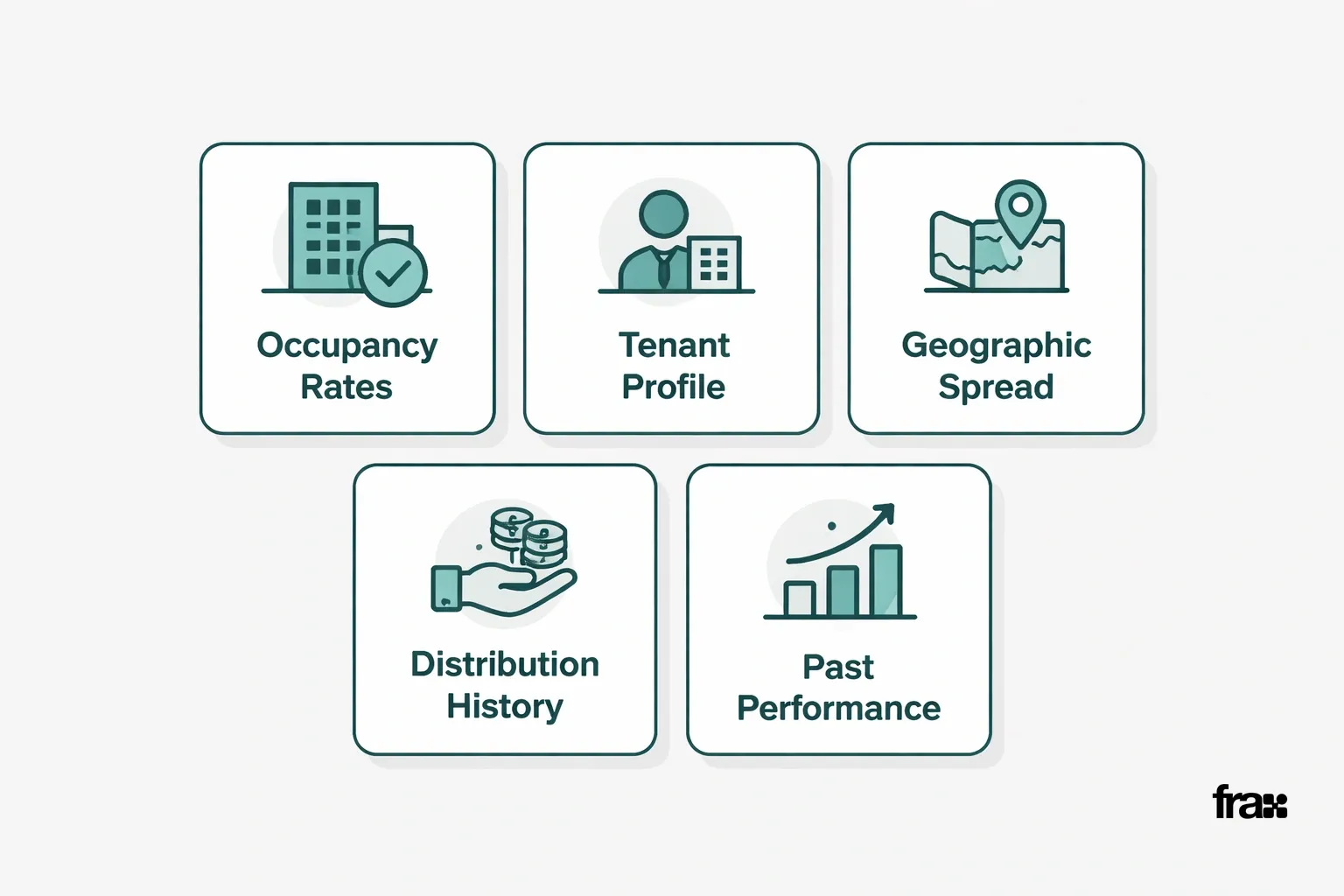
When you actually look at which REIT to buy, start with the buildings themselves. You want to study occupancy rates, tenant profile, and the geographic spread of properties held by each trust. A REIT concentrated in one city carries different risk than one spread across multiple metros.
Distribution history matters too, since it shows how consistently the trust has paid out cash flows in the past. Past performance and realized figures are historical and do not guarantee future property returns or rental yields, for REITs or any other real estate investment vehicle. You should also track the trust's debt levels, since high leverage can affect distribution stability during economic slowdowns.
For readers building a broader real estate allocation strategy, the glossary on fractional real estate terms in India explains many of the structural terms that apply across REITs, SPVs, and other pooled investment vehicles. The guide on reducing portfolio volatility through real estate also offers useful context on balancing REIT exposure against other assets.
This content is for informational purposes only and does not constitute financial, legal, or investment advice.
Where REITs fit in your portfolio
REITs give Indian investors a genuine entry point into commercial real estate through a familiar stock market mechanism. They suit investors who want liquidity, low ticket size, and exposure to large completed assets without ownership headaches. Investors seeking more control over specific properties or cities may want to explore fractional models alongside REITs, not instead of them.
Both paths belong within the broader category of real estate investment options available to Indian investors in 2026. Reviewing the top investment companies and platforms in India can help investors see how REITs, fractional platforms, and traditional developers stack up against each other. You can also browse more guides on the FraX blog or learn about the platform directly on the FraX homepage.
This content is for informational purposes only and does not constitute financial, legal, or investment advice.
Frequently asked questions
This content is for informational purposes only and does not constitute financial, legal, or investment advice.
What is the minimum amount needed to invest in a REIT in India? There is generally no fixed minimum beyond the price of one unit, which often falls between 300 and 400 rupees depending on the trust and market price at the time of purchase.
Can I sell REIT units whenever I want? REIT units trade on NSE and BSE during regular market hours, so you can place a sell order anytime the exchange is open, subject to available buyers at your desired price.
How many REITs are currently listed in India? India has a small number of listed REITs, including Embassy Office Parks, Mindspace Business Parks, Brookfield India, and Nexus Select Trust, each holding a different mix of commercial properties.
Do REIT investors own the underlying property directly? No, REIT investors hold units in the trust rather than a title deed to any specific building. Ownership and management decisions sit with the trust and its manager.
How is a REIT different from fractional real estate investing? A REIT holds a diversified portfolio of commercial assets chosen by the trust manager, while fractional platforms let investors back a specific property of their choice. Investors on platforms like FraX hold direct beneficial partnership interests in dedicated LLP SPVs, not direct individual property titles.
Are REIT distributions guaranteed? No. Distributions depend on the trust's rental income and cash flows, which can vary with occupancy and market conditions. Past performance and realized XIRR figures are historical and do not guarantee future property returns or rental yields.
Learn more
Discover more from the latest posts.