

Indian Investors Guide to Dubai Real Estate: LRS, Costs & Taxes
Dubai real estate for Indians: LRS limits, freehold zones, costs, tax impact. Compare with Indian fractional property options.
Everyone wants the Burj Khalifa view or a Palm Jumeirah villa. But getting money from an Indian bank account to a Dubai developer is a bureaucratic marathon. Indian residents can legally invest in Dubai real estate using the RBI's Liberalised Remittance Scheme (LRS), which lets you remit up to USD 250,000 per financial year for permissible purposes, including overseas property. But you'll hit TCS, bank compliance checks, and UAE-side registration costs along the way.
Dubai is easily one of the most searched overseas property destinations for Indians right now. The appeal is obvious: zero property tax, high rental yields, and a market that doesn't necessarily move in lockstep with Indian real estate. But the actual process is layered with compliance on both sides. LRS limits, freehold zones, transaction costs, and realistic return expectations matter way more than the glossy brochures suggest.
This content is for informational purposes only and does not constitute financial, legal, or investment advice.
What is LRS and why it controls your Dubai purchase

This content is for informational purposes only and does not constitute financial, legal, or investment advice.
If you're an Indian resident, LRS is your gatekeeper. It's the RBI framework that lets you send foreign currency abroad for specific things. Under current FEMA guidelines, you can remit up to USD 250,000 every financial year, and buying property overseas is explicitly allowed.
This $250,000 cap dictates practically everything about how an Indian buys in Dubai. A family of four can technically pool their individual limits to buy something bigger, since LRS applies per person, not per household. But banks scrutinize these joint remittances heavily. Your paperwork needs to clearly prove where the money came from and exactly why you're sending it.
Here’s what actually happens when you try to use LRS:
The USD 250,000 cap is per financial year (April to March), not calendar year.
You'll need Form A2 and a FEMA declaration to send the money.
Tax Collected at Source (TCS) applies to these remittances. The rates and thresholds change depending on the amount and purpose, so check the current TCS slabs with your bank before transferring.
Your bank (the Authorised Dealer) will do its own due diligence. If your KYC is incomplete or your fund source seems vague, they'll delay or block the transfer.
Because RBI revises these rules and TCS thresholds through circulars and Union Budgets, don't assume the limits are the same as last year. Checking with your bank or a FEMA-qualified advisor before moving money is non-negotiable.
Dubai ownership zones: where Indians can actually buy
This content is for informational purposes only and does not constitute financial, legal, or investment advice.
Foreigners can't just buy anything anywhere in Dubai. You can only hold full ownership rights in specific "freehold" zones. Outside these areas, non-UAE nationals are usually limited to leasehold arrangements for a fixed term, typically up to 99 years.
Dubai's freehold map has grown a lot over the last decade, but it's still not city-wide. Figuring out if a neighborhood qualifies is the first thing you should do before even looking at listings.
Zone Type | Examples | Ownership Rights |
|---|---|---|
Freehold | Dubai Marina, Downtown Dubai, Palm Jumeirah, Business Bay, JVC | Full foreign ownership |
Leasehold | Select older residential pockets | Long-term lease, up to 99 years |
Non-designated | Most of Deira, older Bur Dubai areas | Generally restricted for foreigners |
The Dubai Land Department (DLD) keeps the authoritative list of freehold areas, which keeps expanding as new master-planned communities open. Always verify a project's status with the DLD before sending any money. Developer marketing materials love to blur the lines.
See how FraX makes premium Indian real estate accessible from ₹10,000
The real costs of buying Dubai property from India
This content is for informational purposes only and does not constitute financial, legal, or investment advice.
The brochure price is never the final price. Most Indian buyers completely underestimate the overhead. By the time you factor in registration, agency, and transfer fees, your total acquisition cost is usually 6% to 8% higher than the property value.
Here's a realistic breakdown for a secondary-market freehold purchase:
Cost Component | Typical Rate |
|---|---|
DLD registration fee | 4% of property value |
DLD trustee/admin fee | Flat AED fee (varies by transaction) |
Real estate agency commission | 2% of property value |
Mortgage registration fee (if financed) | 0.25% of loan amount |
No Objection Certificate (NOC) fee | Flat AED fee, developer-dependent |
Conveyancing or legal fee | Negotiable, often 1% or flat fee |
On top of these UAE costs, you have currency conversion spreads, outward remittance charges, and TCS on the Indian side. Off-plan properties might lower some upfront costs, but then you're taking on construction-timeline risk and multi-year payment plans.
Rental yields: Dubai vs premium Indian real estate

Dubai's gross rental yields usually sit between 5% and 8% annually. That's significantly higher than the 2% to 4% you typically see in Indian metros. That yield gap is the main reason Indian investors look at Dubai.
But gross yield numbers lie if you don't look closely. Dubai yields are quoted before service charges, maintenance, vacancy periods, and property management fees. Service charges on apartments are charged per square foot annually and can eat up tens of thousands of dirhams, depending on the building's amenities. I've seen investors get excited about a 7% yield, only to realize service charges take 2% right off the top.
In India, premium real estate has historically been more about capital appreciation than rental yield, especially in commercial and Grade-A residential segments in cities like Mumbai, Bengaluru, and Pune. Platforms focused on fractional real estate in India are built to give you a piece of both appreciation and rental income, without the currency friction of buying overseas.
Things that will eat into your actual net yield in Dubai:
The building's age and its service charge structure
Tenant turnover and vacancy gaps
Property management fees (especially if you're managing it remotely from India)
How the AED-INR exchange rate moves while you hold the property
This content is for informational purposes only and does not constitute financial, legal, or investment advice. Past performance and realized XIRR figures are historical and do not guarantee future property returns or rental yields.
Taxes: what happens at both ends
Investing in Dubai property involves different regulatory environments in the UAE and India. The UAE does not levy annual property tax or personal income tax on rental income for individuals.
India taxes residents on global income, meaning rental income and capital gains from Dubai property may need to be reported in Indian tax filings, subject to the double taxation avoidance agreement between India and the UAE. Because tax treatment depends on residency status, holding structures, and bilateral agreements, you should consult a qualified tax professional for specific guidance.
This content is for informational purposes only and does not constitute financial, legal, or investment advice.
Step-by-step: how to actually invest
Once you understand LRS and freehold zones, the actual buying process is pretty linear. It usually goes through five stages:
Check your LRS eligibility and remittance capacity with your bank, accounting for any other foreign remittances you've made this year.
Shortlist freehold projects and independently verify their DLD registration status. Don't just trust the developer.
Hire a RERA-registered Dubai broker and a conveyancing professional who actually understands NRI and resident-Indian transactions.
Execute Form A2 with your bank and send the money, making sure the TCS deduction is accounted for.
Complete DLD registration and title transfer. You'll get an Oqood (for off-plan) or a title deed (for ready property).
Keep a spotless paper trail connecting your Indian income to the remitted funds. Both the RBI and UAE authorities can ask for documentation during audits or when you try to sell later.
This content is for informational purposes only and does not constitute financial, legal, or investment advice.
How Dubai compares to other countries
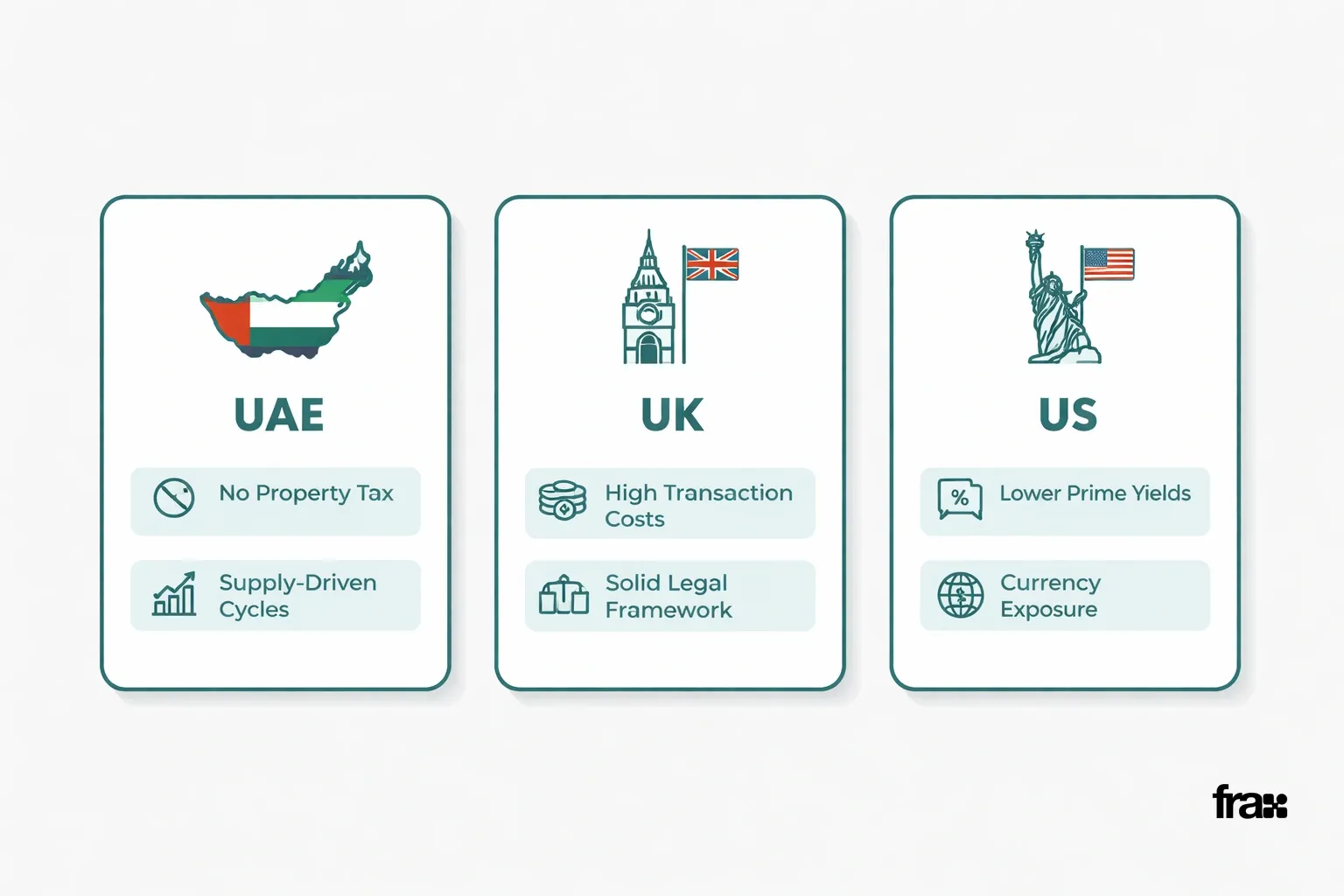
Dubai is definitely one of the more accessible global markets for Indians, but it's not automatically the "best" for everyone. The best market depends on your liquidity needs, risk appetite, and whether you can stomach currency exposure.
When Indian investors look at cross-border options, a few patterns usually show up:
UAE (Dubai, Abu Dhabi): No property tax, strong yields, but the market is historically prone to supply-driven cycles.
United Kingdom: Solid legal framework, but high transaction costs, stamp duty surcharges for overseas buyers, and lower yields in prime areas.
United States: Huge liquidity and transparent titles, but state-level property taxes and complex estate-tax rules for foreigners.
Singapore: Great governance and currency stability, but heavy additional buyer's stamp duty for foreigners.
India (domestic): No currency conversion risk, familiar legal system, and newer models like fractional ownership lowering the barrier to entry.
For Indians earning and spending in rupees, currency mismatch is a huge, often ignored risk in overseas property. You could buy a Dubai apartment at a great INR-AED rate, and the currency alone could wipe out your returns, regardless of how the property performs.
This content is for informational purposes only and does not constitute financial, legal, or investment advice.
Explore fractional commercial real estate in India with FraX
Dubai property vs fractional real estate in India via FraX
This content is for informational purposes only and does not constitute financial, legal, or investment advice.
If the LRS limits, currency risk, and cross-border legal complexity of Dubai sound like a headache, fractional real estate in India is the alternative. Platforms like FraX let you start with just ₹10,000 into institutional-grade, income-generating properties in Indian cities.
The structural differences are night and day. A Dubai purchase demands lakhs of rupees in minimum capital just to cover remittance, registration, and agency costs before the property price. Fractional platforms are built on the exact opposite premise: buy a slice of a premium asset instead of the whole thing.
On FraX, every property is held through a dedicated LLP SPV (one property equals one LLP). Investors hold direct beneficial partnership interests in these SPVs. Transactions run through an ICICI Bank escrow account, overseen by Universal Trustees. FraX also pushes a "Buy & Sell Anytime" model, trying to give investors a digital exit option instead of being stuck in long holding periods.
It's important to be precise about what this is. You hold beneficial partnership interests in an LLP, not a direct individual property title. That's fundamentally different from holding a title deed to a Dubai apartment. Anyone comparing the two needs to weigh the legal ownership structure, not just the ticket price.
Factor | Dubai Real Estate | FraX Fractional Real Estate (India) |
|---|---|---|
Minimum entry capital | Typically several lakhs INR equivalent | ₹10,000 |
Currency risk | Yes, AED-INR exposure | None, fully INR-denominated |
Regulatory layers | FEMA, LRS, UAE DLD rules | Indian LLP structure, escrow oversight |
Ownership form | Freehold title deed (in designated zones) | Beneficial partnership interest in property-specific LLP |
Liquidity approach | Resale market dependent, often slow | Buy & Sell Anytime model, no lock-in positioning |
Recurring costs | Service charges, property tax-free, management fees | Platform buy and sell fees |
FraX charges a flat 1% buy fee and 1% sell fee. That's considerably easier to model than the layered DLD, agency, and conveyancing costs in Dubai. If you want to understand this model better before comparing it to overseas property, check out the fractional real estate ownership guide and the step-by-step beginner's guide.
The platform has gained real traction recently, with over 40,000 app downloads, a 4.8-star rating, and more than ₹3 crore deployed. Past performance and realized XIRR figures are historical and do not guarantee future property returns or rental yields, whether you're looking at Dubai or Indian assets.
Making the right call for your portfolio
Choosing between Dubai real estate and Indian fractional real estate doesn't have to be an either-or decision. It comes down to sequencing, risk tolerance, and how much complexity you're willing to put up with.
If you have the remittance capacity, want currency diversification, and like the idea of direct foreign ownership, Dubai's freehold zones and tax-free rents are appealing. If you want rupee-denominated exposure, lower entry tickets, and simpler exits, starting in India makes more sense. You can look into commercial real estate fractional investing or check out the top cities for fractional real estate investment.
Honestly, a lot of investors do both. They put some capital overseas for currency diversification and keep a core domestic allocation through lower-ticket vehicles. Before committing money to either side, read the risk and reward guide to fractional real estate and see how FraX safeguards investor money.
This content is for informational purposes only and does not constitute financial, legal, or investment advice.
Frequently asked questions
This content is for informational purposes only and does not constitute financial, legal, or investment advice.
What is the current LRS limit for Indians buying property in Dubai? Currently, the cap is USD 250,000 per financial year under LRS for permissible purposes, including overseas property. Keep in mind that TCS rates and limits can change, so verify the current numbers with your bank before sending money.
Can Indians buy property anywhere in Dubai, or only specific areas? You can only own property outright in designated freehold zones like Dubai Marina, Downtown Dubai, and Business Bay. Everywhere else, you're looking at long-term leaseholds.
Are Dubai rental yields really higher than Indian real estate? Gross yields in Dubai are usually 5% to 8%, which beats the typical 2% to 4% in Indian metros. Past performance and realized XIRR figures are historical and do not guarantee future property returns or rental yields. But remember, Dubai numbers are quoted before service charges and management fees, which take a big bite out of the net return.
Is fractional real estate in India a substitute for buying property in Dubai? Not really, they serve different goals. FraX gives you lower-ticket, INR-denominated exposure to Indian properties via LLPs. Investors hold direct beneficial partnership interests in dedicated LLP SPVs, not direct individual property titles. Dubai gives you direct freehold ownership but with currency and cross-border exposure. Most investors use them together rather than as substitutes.
Do I need to pay tax in India on rental income earned from a Dubai property? Yes, India taxes residents on global income, so Dubai rental income and gains must be reported on your Indian tax filings, subject to the India-UAE tax treaty. This depends heavily on your specific situation, so talk to a tax professional.
What costs should I budget for beyond the Dubai property price? Assume you'll pay an extra 6% to 8% for DLD registration, agency fees, trustee fees, and conveyancing, plus Indian remittance charges and TCS. Off-plan might lower some upfront costs, but it adds construction-timeline risk.
Learn more
Discover more from the latest posts.


