

Knowledge Realty Trust REIT: Guide for Indian Investors
Discover India's listed Knowledge Realty Trust REIT-fractional office real estate, its mechanics, risks, and tax implications for investors.
Knowledge Realty Trust REIT is a listed real estate investment trust that owns commercial office buildings across Indian cities. Instead of buying a whole building, you buy units through a demat account, just like regular shares, and you get a cut of the rent from corporate tenants.
For Indian investors, a listed office REIT is a completely different animal compared to buying a fraction of a single property. Before you park your savings here, it helps to understand how KRT is structured, how it pays out, and what could go wrong. I'm sticking strictly to what the trust has publicly disclosed here, so we aren't guessing on numbers that aren't filed.
This content is for informational purposes only and does not constitute financial, legal, or investment advice.
What is Knowledge Realty Trust REIT?
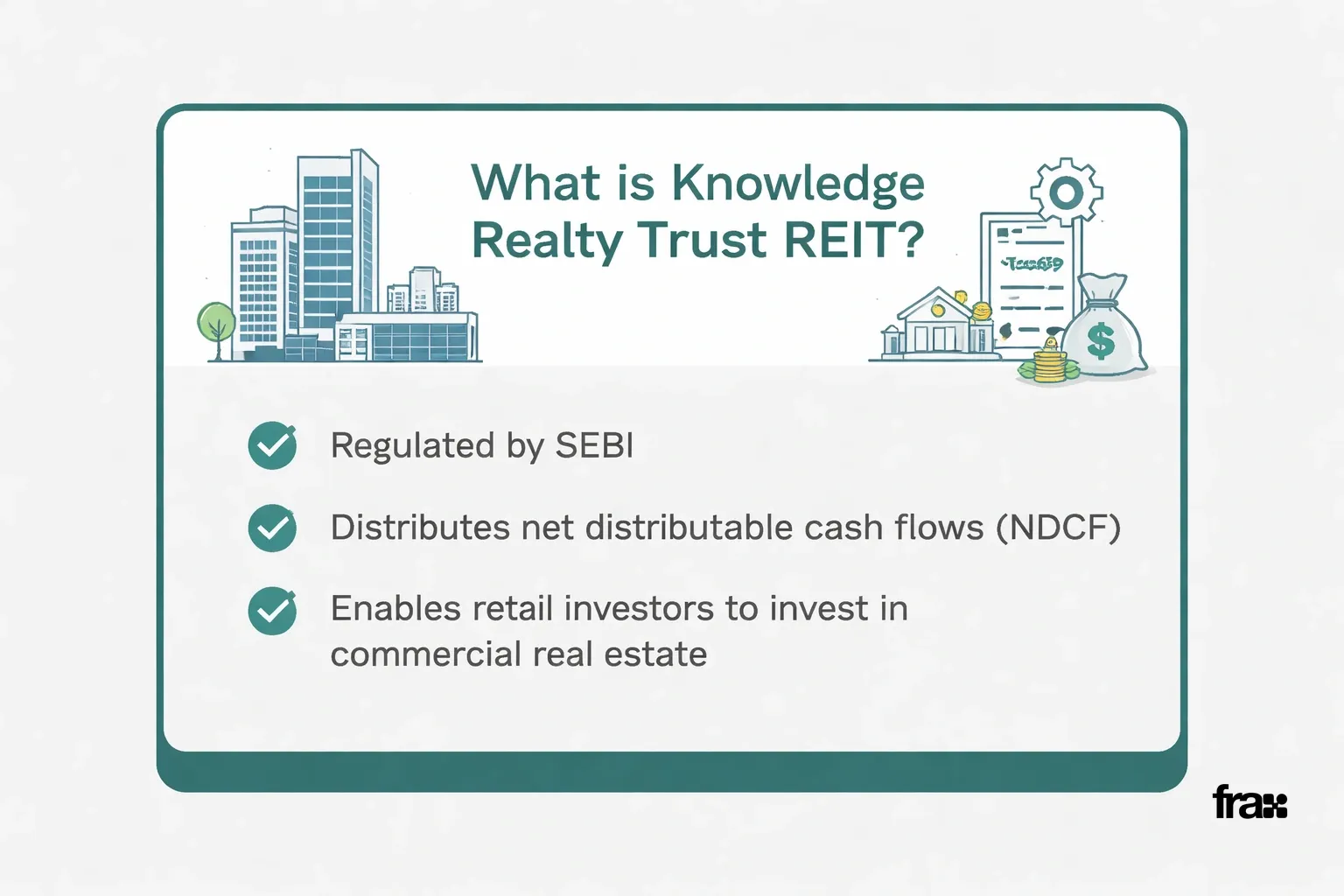
KRT holds income-generating office assets in India. It is structured to pass most of its net distributable cash flows back to unitholders on a regular schedule.
You aren't buying bricks or land directly. You are buying a beneficial interest in a trust that manages a basket of office buildings. This gives retail investors a backdoor into institutional-grade commercial real estate without needing to buy an entire building themselves. If you want a side-by-side look at this model versus single-asset ownership, check our breakdown on REIT investment options.
This content is for informational purposes only and does not constitute financial, legal, or investment advice.
Investors hold direct beneficial partnership interests in dedicated LLP SPVs, not direct individual property titles.
Past performance and realized XIRR figures are historical and do not guarantee future property returns or rental yields.
Sponsors and listing timeline
KRT is backed by Blackstone and Sattva Group. These are heavy hitters. Blackstone brings the global institutional money, while Sattva Group brings the actual on-ground development and leasing chops in India. The trust listed its units on Indian stock exchanges in 2025, opening the door for both retail and institutional investors to trade them.
Sponsorship matters because these are the entities that sourced and managed the properties before taking them public. Still, don't just take my word or any secondhand summary as gospel. Always dig into the manager and sponsor details in the actual offer documents and exchange filings.
This content is for informational purposes only and does not constitute financial, legal, or investment advice.
The office portfolio: cities and tenants
The portfolio is spread across major Indian hubs like Bengaluru, Mumbai, Pune, Hyderabad, Chennai, and Gurugram. You will find the exact asset count and leasable area in their filings, so verify it there directly.
The tenant base leans heavily on big occupiers who sign long-term leases. We are mostly talking about technology and IT services companies, global capability centers (GCCs) set up by multinationals, financial services firms, and consulting businesses.
Here is the catch with office investments. Your income is entirely dependent on these huge tenants renewing or expanding. Because the tenant base is concentrated in tech and IT, the income is going to be highly sensitive to hiring trends in those sectors. If tech companies stop hiring, leasing slows down. For a broader look at how commercial assets behave as a category, see our guide on commercial real estate in India.
This content is for informational purposes only and does not constitute financial, legal, or investment advice.
How Knowledge Realty Trust pays distributions

This content is for informational purposes only and does not constitute financial, legal, or investment advice.
Payouts from trusts usually mix three things: dividend income, interest income, and repayment of debt. The debt repayment acts as a return of capital. Trusts typically distribute a significant portion of their net distributable cash flows to unitholders at regular intervals.
Do not assume the split between dividend, interest, and capital repayment stays the same every quarter. It varies. You should read the actual distribution notice to see exactly how the current payout is structured. We compared this payout structure against a single office asset model in our piece on Embassy REIT dividends versus fractional real estate yields.
Occupancy and lease profile
KRT reports its occupancy and lease metrics every quarter through exchange filings. You will find data on occupancy levels, weighted average lease expiry (WALE), and rent escalation clauses built into the leases.
You generally want to see long remaining lease tenures and staggered expiries. If a bunch of tenants leave at the same time, you have a problem. Since these numbers shift every quarter, pull the latest investor presentation rather than relying on older estimates.
This content is for informational purposes only and does not constitute financial, legal, or investment advice.
How to buy units of Knowledge Realty Trust
Buying KRT units is just like buying regular equity shares. You need a demat account with a registered stockbroker, you place an order on the NSE or BSE, and you settle the trade.
SEBI removed the minimum lot size requirement for listed REITs a while ago, meaning you can literally buy a single unit now. You just need to open or use your existing demat account, search for the REIT's ticker symbol on the exchange, place a buy order at the market price, and keep an eye on corporate announcements for payout schedules.
Because units trade on an open exchange, the price will bounce around based on market sentiment, interest rate expectations, and the trust's actual performance. This is very different from how a fractional real estate platform prices entry and exit for a single building.
This content is for informational purposes only and does not constitute financial, legal, or investment advice.
Explore Fractional Ownership of a Single Commercial Property
How distributions are taxed

The tax treatment of REIT distributions depends on what component you actually received. The interest portion is taxed at your applicable slab rate. The dividend portion's treatment hinges on whether the underlying SPV opted for a concessional tax regime. The debt repayment portion usually isn't taxed immediately since it is a return of capital, but it does lower your cost basis for future capital gains calculations.
Tax rules around REITs are messy and change with every budget announcement. Treat this as general background only and talk to a qualified tax advisor before filing returns or making investment decisions based on expected after-tax income.
Key risks to weigh
This content is for informational purposes only and does not constitute financial, legal, or investment advice.
Investment in real estate carries inherent risks. Your income is tied to the underlying office assets and the broader market. If tech companies slow down hiring, the IT-heavy tenant base could struggle to renew leases, putting a dent in occupancy and cash flows.
Rising interest rates can pressure unit prices and make refinancing underlying debt more expensive. Market sentiment can cause assets to trade above or below the actual value of the buildings. There is also regulatory risk, as shifts in taxation or rules can alter investor outcomes. None of this is a buy or sell recommendation. Everyone's risk appetite and tax situation differ, so rely on the official filings for current facts.
Listed REIT vs fractional ownership of a single office
A listed REIT like KRT spreads your money across many buildings and many tenants at once. Fractional ownership through a platform typically ties your capital to one specific property held in a dedicated LLP SPV. You know exactly which asset you hold.
This difference shapes how the investment behaves. A REIT offers exchange-based trading and automatic diversification across a basket of buildings. A single property fractional investment offers direct exposure and transparency into one asset's rent roll, tenant, and lease terms. FraX structures each property under its own LLP SPV, meaning investors hold direct beneficial partnership interests in dedicated LLP SPVs, not direct individual property titles.
If you are comparing both routes, you can read our guide on fractional real estate investing in India and our broader comparison of REITs, InvITs, and fractional ownership. Past performance and realized XIRR figures are historical and do not guarantee future property returns or rental yields, whether for a listed REIT or a fractional ownership structure. Anyone weighing both models should also read our explainer on how SPVs work in real estate and our notes on building passive income through real estate.
Start Building a Diversified Real Estate Portfolio Today
For a wider view of how REITs stack up against other Indian real estate routes, our pillar guide on real estate investment options covers REITs, fractional ownership, and direct property purchases side by side. You can also browse our primer on fractional real estate ownership for a deeper look at how LLP SPV structures function property by property.
This content is for informational purposes only and does not constitute financial, legal, or investment advice.
Frequently asked questions
This content is for informational purposes only and does not constitute financial, legal, or investment advice.
What is Knowledge Realty Trust REIT? It is a listed real estate investment trust that owns commercial office assets across Indian cities and pays out rental income to unitholders who buy its exchange-traded units.
Who sponsors it? The trust is sponsored by Blackstone and Sattva Group, and listed its units on Indian stock exchanges in 2025.
How do I buy units? You need a demat and trading account. You can buy units through the NSE or BSE.
What makes up a distribution? Payouts generally combine dividend income, interest income, and debt repayment. The exact split is disclosed in every distribution notice filed by the trust.
How is this different from fractional real estate ownership? A REIT spreads your money across a basket of properties via exchange-traded units. Fractional ownership platforms like FraX tie your money to one specific property through a dedicated LLP SPV.
Is investing in it risk free? No. It carries tenant concentration risks, interest rate sensitivity, and market price volatility. Always review the trust's own filings before making any decision.
Learn more
Discover more from the latest posts.


