
Invest in Real Estate with FraX: Fractional Ownership Explained
Discover how FraX lets you invest in RERA-approved real estate with fractional ownership via LLP structures. Start at ₹10,000.
FraX is a real, registered company, FraX Digital Private Limited, not just some anonymous app. It lets Indians invest in property starting at ₹10,000 through dedicated LLP structures. Each listed property sits behind escrow banking and RERA approval, which makes it legit as a business. But don't confuse "legitimate business" with "zero risk." You're still dealing with property markets.
Fractional real estate is still finding its feet in India, and trust is something you build over years, not claim on day one. Thousands of young professionals are trying to figure out if FraX makes sense compared to traditional property buying, REITs, or just parking money in fixed deposits. I've gone through what FraX actually does, where your money goes, and what could go wrong, sticking purely to verifiable facts.
What FraX actually is
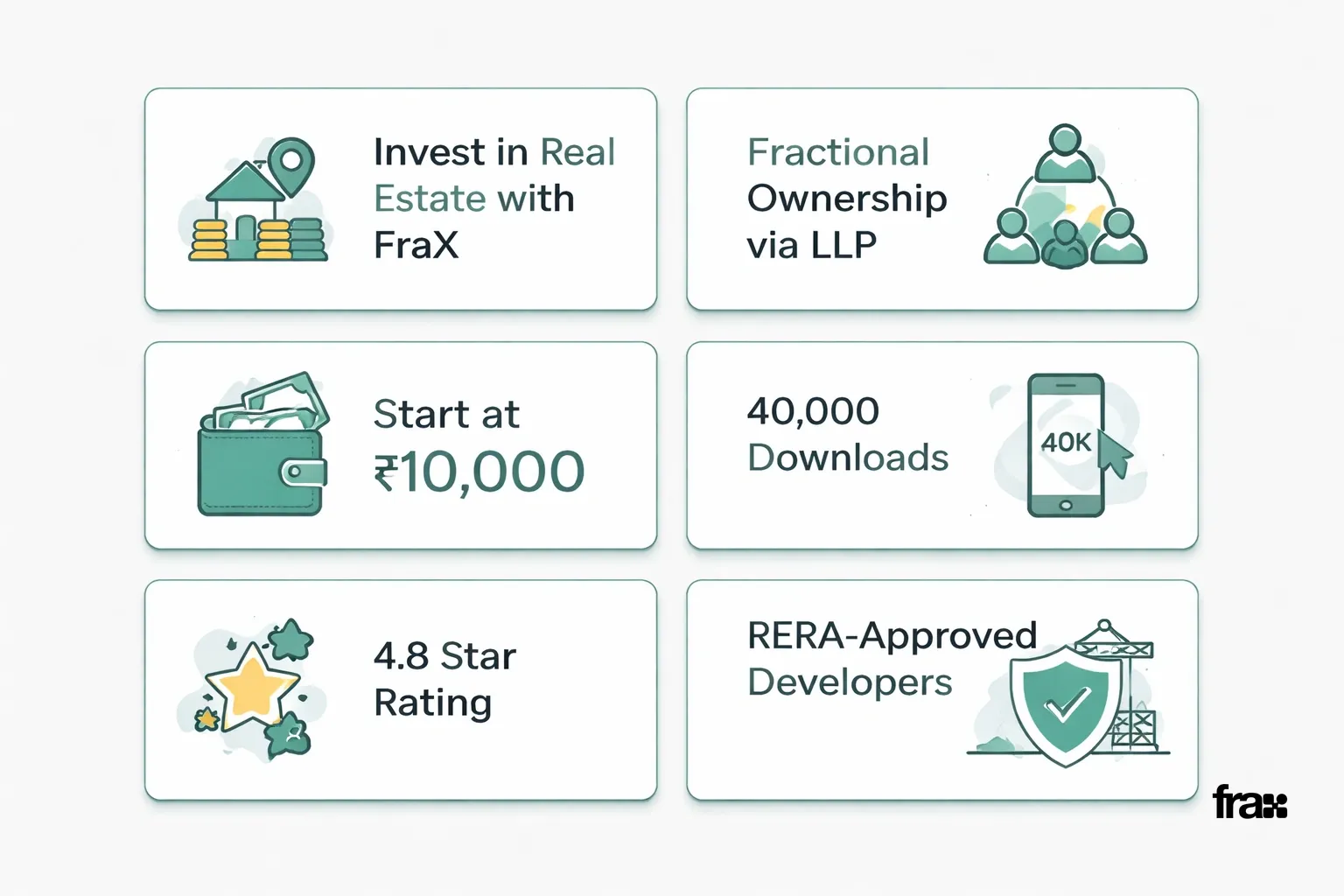
FraX is an investment app run by FraX Digital Private Limited, founded in November 2025. The co-founders are Prabhav Tanay (CEO) and Tushar Chaudhary, both IIT-BHU alumni. The pitch is simple: you buy fractional stakes in premium, RERA-approved real estate starting at ₹10,000. The app has crossed 40,000 downloads and holds a 4.8-star rating on the App Store and Play Store.
It tries to bridge the gap between traditional real estate and fintech. Instead of buying a whole flat or office floor, you buy a slice of it. Listed inventory has included RERA-approved projects from developers like DLF and Max Estate. If you're trying to understand how this differs from buying a full property outright, we broke down fractional real estate ownership in India separately.
But FraX is a young company. It launched about a year ago, so its track record is short by design. That doesn't mean it's a scam, but you should treat it like any early-stage platform: look at the legal and financial structure, not just the slick marketing.
How an investment actually works
This content is for informational purposes only and does not constitute financial, legal, or investment advice.
When you invest on FraX, your money goes into a dedicated LLP created specifically for that property. One property equals one LLP. You buy units inside that LLP, and one unit is structured to represent one square foot of the actual building. We've explained this in detail in our guide on SPVs in real estate.
The flow looks like this:
You browse a RERA-approved listing inside the app.
You decide how many units to buy, starting at ₹10,000.
Your payment goes into a designated escrow account.
Once the round closes, you get units allotted against that specific LLP.
You get an investment agreement in the app and by email.
Remember, this isn't the same as holding a title deed in your name. Investors hold direct beneficial partnership interests in dedicated LLP SPVs, not direct individual property titles. That distinction matters if you're comparing this to a traditional registry-based purchase. We go deeper into the practical differences in our piece on smart ownership versus fractional real estate.
See How a ₹10,000 FraX Investment Actually Works
How your money is protected
This content is for informational purposes only and does not constitute financial, legal, or investment advice.
Money on FraX moves through an ICICI Bank escrow account, overseen by Universal Trustees acting as an independent trustee. The logic is straightforward: your funds don't sit in a founder's personal account or some loosely controlled company wallet.
Having an independent trustee adds a layer of checks that a plain bank transfer just wouldn't have. Escrow accounts only release funds when agreed conditions are met. Combine that with RERA-approved listings, and you get a paper trail you can check independently. We cover this mechanism in more depth in our article on how FraX safeguards investor money at every stage.
But none of this removes market risk. Escrow protects how money moves during the transaction. It doesn't guarantee the property's value will go up or that rental income will hit projections. Those are two entirely separate questions, and conflating them is a mistake a lot of new investors make.
The fee structure

FraX charges a 1% fee when you buy units and another 1% when you sell. There are no hidden layers beyond this.
Action | Fee |
|---|---|
Buying units | 1% |
Selling units | 1% |
Lock-in period | None |
A flat buy-and-sell fee is pretty easy to compare against other routes. If you buy property directly, you're paying stamp duty, registration charges, and brokerage, which often runs into several percentage points. REITs have their own cost structures, which we explain in our guide to REITs and InvITs. Fees matter more than people expect because they compound with every transaction.
This content is for informational purposes only and does not constitute financial, legal, or investment advice.
Exits and the liquidity risk
Exiting FraX means listing your units for sale inside the app. You aren't selling instantly on demand. There is no lock-in period stopping you from trying to exit early, but your actual exit depends entirely on finding a buyer who wants those exact units.
This is probably the most important mechanical point in this whole review. FraX does not offer instant liquidity. It's a buy-and-sell marketplace where:
You list your units whenever you want.
A buyer on the other side has to want those exact units.
The sale completes only when a match happens, not on a fixed date.
The 1% sell fee applies when the transaction goes through.
If the market is moving fast, matching can happen quickly. If it's slow, you might be waiting a while. If you're used to selling mutual fund units on a T+1 basis, recalibrate your expectations here. We wrote an explainer on fractional real estate profit mechanics that walks through how holding periods interact with exit demand.
This content is for informational purposes only and does not constitute financial, legal, or investment advice.
The risks in plain words
This content is for informational purposes only and does not constitute financial, legal, or investment advice.
Risk on FraX falls into three buckets: company age, exit timing, and property market movement. Because FraX was founded in November 2025, it has a track record of roughly a year. That is simply not enough time to judge long-term performance with any real confidence.
Consider the risks honestly:
Company maturity risk: A one-year-old platform hasn't been tested through multiple real estate cycles.
Exit liquidity risk: Selling depends on buyer demand, not a guaranteed timeline.
Property market risk: Real estate values and rental demand can soften in any city or micro-market.
Past performance and realized XIRR figures are historical and do not guarantee future property returns or rental yields. This applies to any track record a fractional platform shares, not just FraX. Treat historical numbers as context, never as a forecast.
None of these risks are unique to FraX, though. They apply to fractional real estate as a category, and in different forms, to direct property ownership too. We took a broader look at fractional real estate investing and how these risks show up across the sector in 2026.
Explore RERA-Approved Properties on FraX
Who it suits and who it doesn't

FraX is for investors who want real estate exposure without arranging crores of rupees upfront. It fits people who are comfortable with a newer company and an exit process tied to buyer matching. It is not for anyone who needs immediate access to their capital.
Likely a good fit | Likely not a good fit |
|---|---|
Investors with ₹10,000 to ₹20 lakh who want diversification. Investors hold direct beneficial partnership interests in dedicated LLP SPVs, not direct individual property titles. | Investors who need funds on a fixed date |
Younger professionals comfortable with app-based investing | Investors uncomfortable with LLP-based legal structures |
Investors who already understand real estate holding periods | Investors expecting instant, stock-exchange style exits |
If you're curious about how fractional ownership fits into a broader portfolio strategy alongside REITs and direct rentals, check out our piece on passive income through real estate.
This content is for informational purposes only and does not constitute financial, legal, or investment advice.
How to verify FraX yourself
You don't have to take my word for it. FraX Digital Private Limited is a registered entity you can search on the MCA portal. Each LLP tied to a property is also a separate, searchable registration.
If you want to verify things yourself, here's what to do:
Search "FraX Digital Private Limited" on the MCA company search tool.
Check the specific LLP name listed against any property you are considering.
Confirm the project's RERA registration number on your state's RERA website.
Read the investment agreement sent to your email line by line before paying.
Check app store listings directly for the current rating and review volume.
This habit of independent verification matters for any fractional real estate platform. If you want a broader primer on how this investing category works across providers, see our guide on fractional real estate in India. And if you still have questions after doing your own research, FraX's contact page is the direct channel for platform-specific queries.
This content is for informational purposes only and does not constitute financial, legal, or investment advice.
Frequently asked questions
This content is for informational purposes only and does not constitute financial, legal, or investment advice.
Is FraX a SEBI-registered platform? FraX operates through RERA-approved properties, LLP SPV structures, and an ICICI Bank escrow account overseen by Universal Trustees.
How much money do I need to start? Investing starts at ₹10,000, which buys fractional units in a specific property's LLP, where one unit represents one square foot of that property.
Can I sell my FraX units whenever I want? There is no lock-in period, so you can list anytime. The actual sale completes once a matching buyer is found, so it's not instant.
What fees does FraX charge? You pay a 1% fee when buying and 1% when selling. There are no hidden layers beyond this.
Do I legally own the property? Investors hold direct beneficial partnership interests in dedicated LLP SPVs, not direct individual property titles. The agreement is issued in the app and by email, and the LLP is verifiable on the MCA portal.
How risky is this? FraX is a young company (founded Nov 2025), so you're dealing with a short track record, exit timing tied to buyer demand, and general property market movement. Past performance and realized XIRR figures are historical and do not guarantee future property returns or rental yields.
Learn more
Discover more from the latest posts.


