
Fractional Real Estate Ownership India: How It Works & Benefits
Discover fractional real estate in India via LLPs - returns, escrow protection, and low-barrier entry for investors.
Real estate has always been India's favorite asset class, but actually owning a piece of it required crores, endless paperwork, and patience. That barrier is finally crumbling. Fractional ownership lets multiple investors co-own a single property through a dedicated legal entity, usually a Limited Liability Partnership (LLP). You buy a share called a unit starting at ₹10,000. Returns come from rental income and property appreciation, split proportionally across everyone.
This guide breaks down the SPV structure, the trustee and escrow framework, where SEBI's SM-REIT rules fit in, and what returns, fees, and risks actually look like in 2026.
What Is Fractional Ownership of Real Estate in India?
This content is for informational purposes only and does not constitute financial, legal, or investment advice.
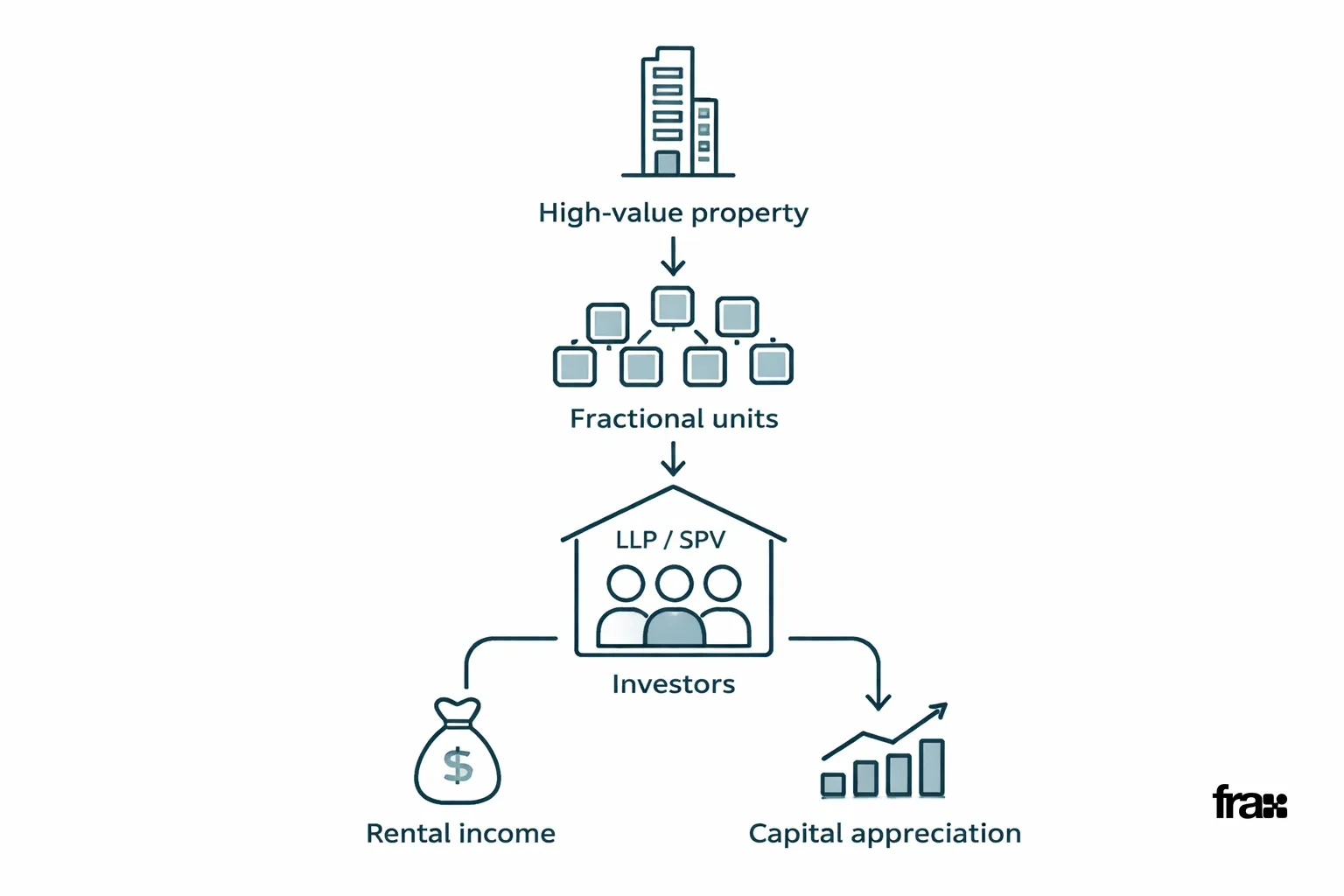
Fractional ownership splits a single high-value property into smaller, affordable units. Investors hold direct beneficial partnership interests in dedicated LLP SPVs, not direct individual property titles. Each unit represents a proportional economic interest in that specific asset, not the whole building. You earn returns through rental distributions and capital appreciation, scaled to your ownership percentage. Past performance and realized XIRR figures are historical and do not guarantee future property returns or rental yields.
This model exists because premium commercial and residential real estate in India's top cities is simply out of reach for most salaried professionals. A grade-A office space in Bengaluru or a warehouse in the NCR region can cost anywhere from ₹5 crore to ₹50 crore. Few individuals can write that cheque alone. Fractional ownership pools capital from dozens or hundreds of investors to buy the same asset, then distributes the economic benefits proportionally.
Platforms like FraX have built this model specifically for people earning ₹15-20 lakh annually, a segment that traditionally found premium real estate out of reach. You can read more about how this access works in our guide on fractional real estate investing in India.
How Fractional Real Estate Investing Works: The SPV Structure
This content is for informational purposes only and does not constitute financial, legal, or investment advice.
The SPV, or Special Purpose Vehicle, is the legal backbone of fractional ownership. Each property is held inside its own dedicated LLP. One property equals one LLP. Investors become partners in that LLP, holding beneficial interests tied directly to the specific asset they chose.
This structure matters because it ring-fences risk. If you invest in Property A, your capital and returns are tied only to Property A's LLP, not to any other property on the platform. There is no commingling of assets across different properties. Each LLP has its own bank account, its own lease agreements, and its own financial records.
Here is a simplified view of how the structure typically flows:
Step | What Happens |
|---|---|
1 | A property is identified, legally vetted, and acquired |
2 | A dedicated LLP SPV is created for that single property |
3 | Investors buy units in the LLP, starting from ₹10,000 |
4 | Rental income and appreciation flow through the LLP to unit holders |
5 | Investors can list their units for sale when they want to exit |
On FraX specifically, this means investors hold direct beneficial partnership interests in dedicated LLP SPVs, not direct individual property titles. That is a meaningful distinction from traditional real estate, where your name sits on a sale deed. Instead, your economic ownership is documented through the LLP partnership structure, which is still legally enforceable and backed by proper documentation.
For readers who want a deeper technical breakdown of terminology used across this ecosystem, our beginner's glossary on fractional real estate investment is a useful companion to this section.
The Role of ICICI Bank Escrow and Universal Trustees
This content is for informational purposes only and does not constitute financial, legal, or investment advice.
Escrow and trustee mechanisms exist to separate investor money from the platform operator's own funds. On FraX, investor transactions flow through an ICICI Bank escrow account, which is overseen by Universal Trustees acting as an independent trustee. This adds a layer of third-party oversight between your money and the platform.
Why does this matter for a first-time investor? Because in any pooled investment structure, the biggest risk is often operational, not market-related. Money could theoretically be misused, delayed, or mismanaged if there is no independent check. An escrow account held at a scheduled commercial bank, monitored by a trustee entity that has no stake in the platform's day-to-day decisions, reduces that risk meaningfully.
It is worth being precise here: ICICI Bank holds the escrow account, while Universal Trustees performs the independent trustee function overseeing that account. This is different from the trustee acting as a guarantor of returns. No trustee framework, and no escrow account, can promise guaranteed returns or risk-free outcomes. What it does provide is structural accountability, proper documentation, and a check against fund misuse.
You can explore how this safeguarding framework operates across the investment lifecycle in our article on how FraX safeguards investor money at every stage.
See how escrow-backed fractional ownership works on FraX
SEBI and SM-REITs: Where Fractional Ownership Fits in India's Regulatory Landscape
This content is for informational purposes only and does not constitute financial, legal, or investment advice.
SEBI introduced the Small and Medium REIT framework in 2024 to bring formal regulation to pooled real estate investment schemes above a certain size threshold. SM-REITs require minimum asset values, specific disclosure norms, and registration with SEBI as a regulated investment vehicle. Fractional ownership platforms using LLP SPV structures operate separately from this SM-REIT framework. Investors hold direct beneficial partnership interests in dedicated LLP SPVs, not direct individual property titles.
This distinction is important for investors to understand clearly. LLP-based fractional ownership platforms are not SEBI-registered REITs or SEBI-regulated schemes. They operate instead through a combination of LLP law, contractual agreements, escrow banking, and independent trustee oversight. This is a fundamentally different legal architecture from a registered REIT listed and traded on a stock exchange.
What does this mean practically?
REIT units trade on stock exchanges with real-time pricing and instant settlement.
LLP-based fractional units do not have that same exchange-traded liquidity mechanism.
SM-REITs follow SEBI's prescribed disclosure and governance norms as a regulated category.
LLP SPV platforms follow their own contractual, trustee, and escrow-backed governance framework.
If you are weighing fractional ownership against REITs directly, our detailed comparison on fractional ownership versus REITs versus direct ownership walks through the practical trade-offs of each path. You may also find our beginner's guide to REIT investing in India helpful for context on the regulated alternative.
Returns: Rental Distribution and Capital Appreciation
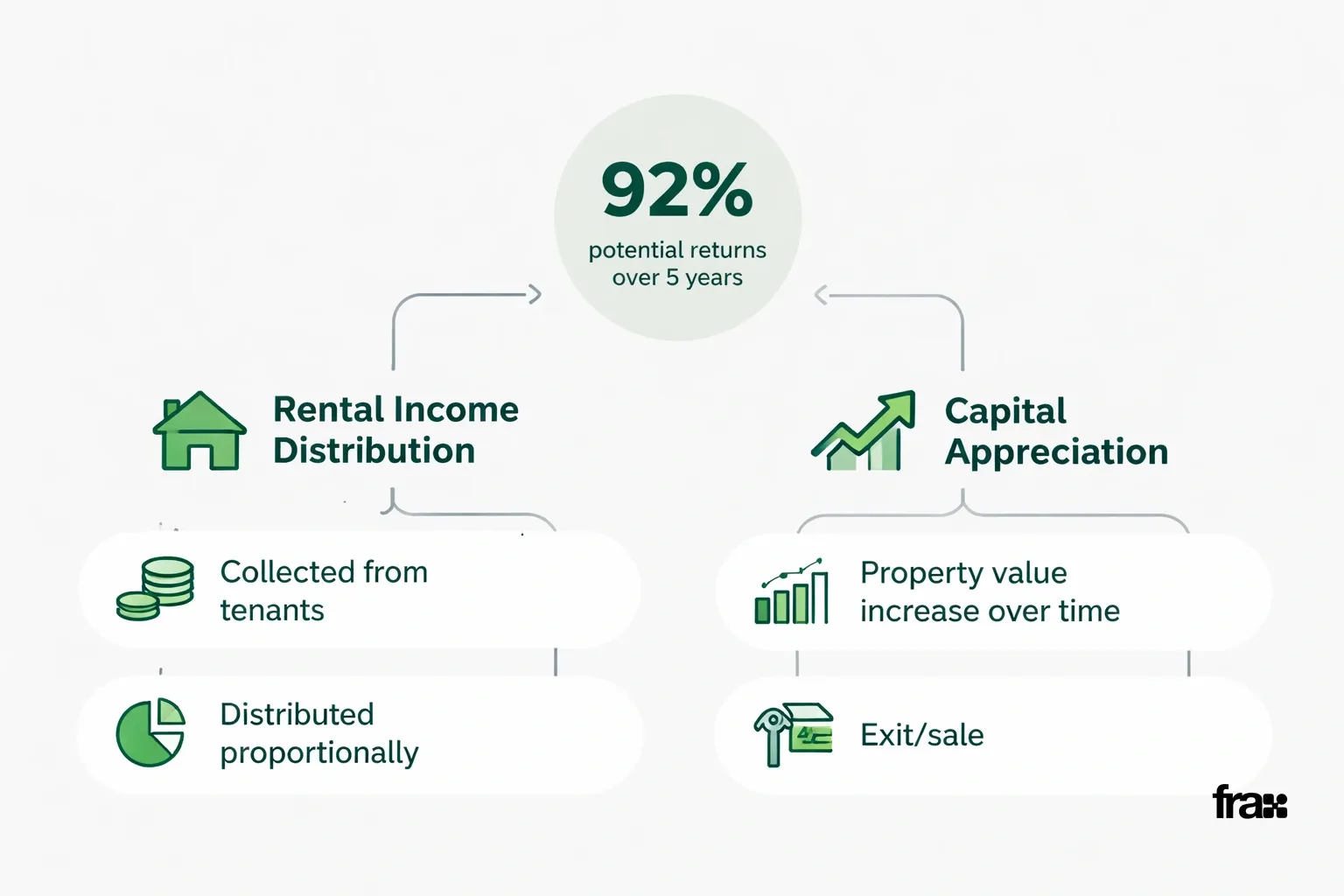
Returns in fractional ownership come from two sources: periodic rental income and capital appreciation at the time of exit or property sale. Rental income is collected from tenants and distributed to unit holders proportional to their holding. Capital appreciation reflects the change in the underlying property's value over the holding period.
Platforms like FraX highlight the potential for returns of up to 92% over a five-year holding period, based on a combination of rental yield and historical appreciation trends in the properties selected. It is critical to understand that this is a potential outcome, not a promise. Rental distributions depend on actual occupancy, lease terms, and tenant payment behaviour.
Past performance and realized XIRR figures are historical and do not guarantee future property returns or rental yields. Every property behaves differently depending on location, tenant quality, and market cycles. A commercial office in a high-demand micro-market may perform very differently from a residential asset in a slower-growing city.
For a closer look at how these two return components actually interact over time, read our breakdown of fractional real estate returns: appreciation versus rental yield. It is also worth understanding how diversifying across multiple fractional properties can smooth out some of this variability, which we cover in our piece on portfolio stability through fractional real estate.
This content is for informational purposes only and does not constitute financial, legal, or investment advice.
Fees: What You Pay to Buy, Hold, and Sell
This content is for informational purposes only and does not constitute financial, legal, or investment advice.
Fractional ownership platforms typically charge fees at the point of entry and exit. On FraX, the core fee structure includes a 1% buy fee and a 1% sell fee, applied directly to transaction value. There are no hidden recurring management charges layered on top of these two transaction fees.
This fee structure is simple by design. Compare it mentally to traditional real estate, where buyers routinely pay stamp duty, registration charges, brokerage fees, and legal costs that can collectively run into several percentage points of the property value. Fractional ownership strips much of that complexity down to a transparent, flat percentage at buy and sell.
Here is a quick comparison of typical cost touchpoints:
Cost Type | Traditional Real Estate | Fractional Ownership (LLP SPV model) |
|---|---|---|
Entry cost | Stamp duty, registration, brokerage | 1% buy fee |
Exit cost | Brokerage, negotiation delays | 1% sell fee |
Minimum capital | Often crores | ₹10,000 |
Paperwork | Extensive, manual | Digital, standardized |
Investors hold direct beneficial partnership interests in dedicated LLP SPVs, not direct individual property titles.
Understanding fees upfront helps you calculate net returns realistically before committing capital. For a full walkthrough of what your first transaction looks like end to end, check our step-by-step beginner's guide to your first fractional investment.
Exits: How Liquidity Works in Fractional Ownership
This content is for informational purposes only and does not constitute financial, legal, or investment advice.
Exits in fractional ownership happen when an investor lists their held units for sale on the platform to another interested investor. This is fundamentally different from traditional real estate, where selling a property can take months or even years. FraX's "Buy & Sell Anytime" model is built around removing rigid lock-in periods from this process.
It is important to be precise about what this liquidity actually means. This is not the same as trading on a stock exchange, where a trade settles in seconds against a live order book. Instead, your unit becomes available for other investors on the platform to purchase, and the transaction completes once a buyer is matched. This digital listing process removes much of the friction of traditional property resale, like finding a broker, negotiating in person, or waiting on buyer financing.
The absence of a mandatory lock-in period is a genuine structural advantage over direct property ownership, where selling even a small share of a house or office is practically impossible without selling the whole asset. Still, exit timing can vary based on buyer demand for that specific property at that specific moment.
Start building your fractional real estate portfolio today
Fractional Ownership Real Estate for Sale: What to Look for Before You Invest
This content is for informational purposes only and does not constitute financial, legal, or investment advice.
Fractional ownership real estate for sale should always be evaluated on legal documentation, trustee oversight, and property fundamentals before you commit capital. Not every listing or platform follows the same standards of transparency. A careful investor checks the paperwork before checking the projected returns.
Here is a practical checklist worth running through before buying any fractional unit:
Legal structure: Confirm the property sits inside a dedicated SPV, ideally one property per LLP, rather than a commingled pool.
Escrow and trustee: Verify that investor funds move through a bank escrow account overseen by an independent trustee.
Documentation: Ask for proper legal documentation covering title, leases, and partnership agreements.
Minimum ticket size: Understand exactly how much capital is required to enter, and whether that aligns with your budget.
Fee transparency: Check whether buy and sell fees are clearly disclosed upfront, with no hidden recurring charges.
Exit mechanism: Understand how listing and selling your unit actually works, and what factors might affect timing.
Property fundamentals: Look at location, tenant quality, and lease tenure for commercial assets specifically.
This kind of due diligence separates a well-structured fractional investment from a risky, opaque one. Our article on the FraX advantage for everyday investors expands on how these checks are built into the platform experience itself.
Fractional Real Estate vs Timeshare: Why They're Not the Same
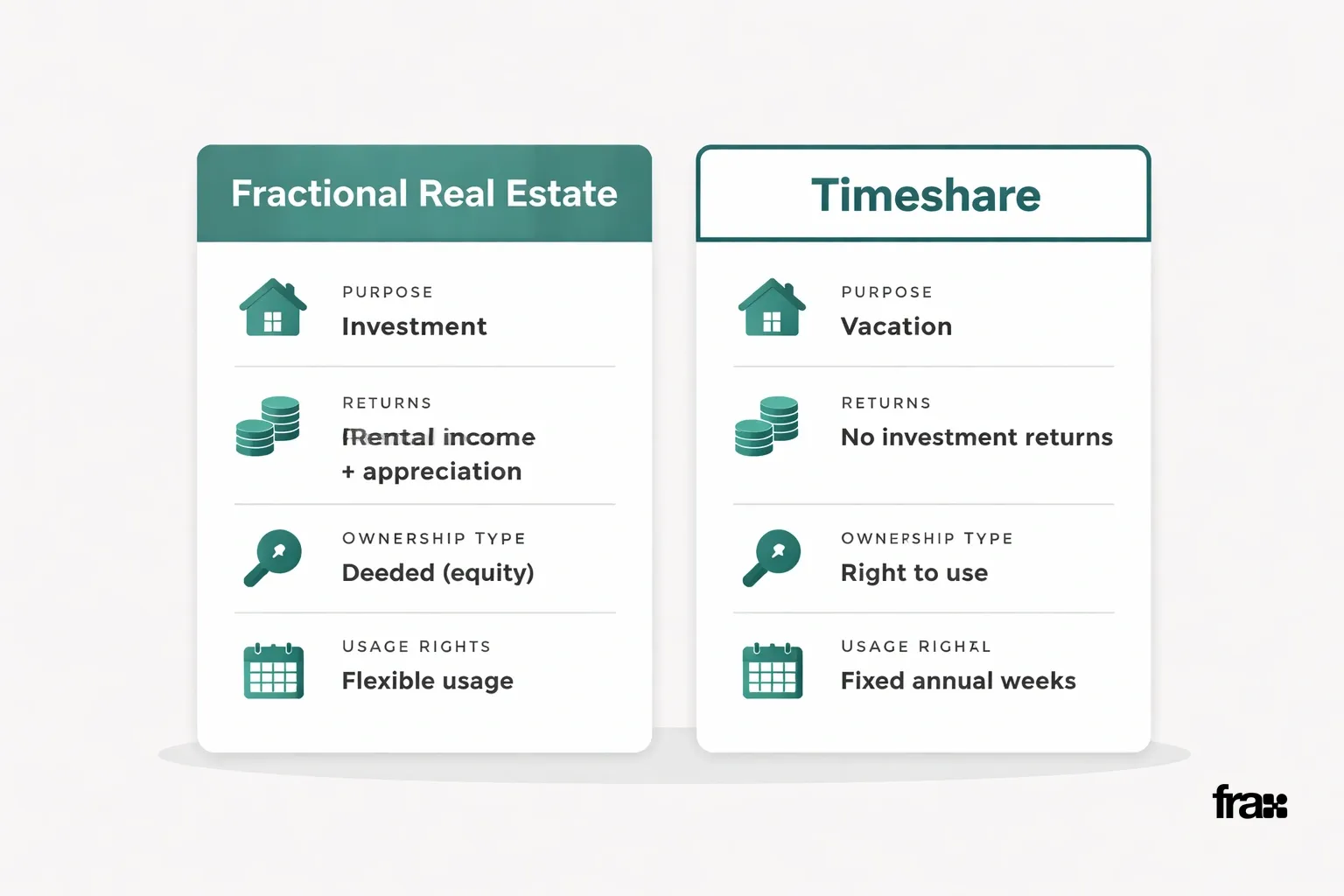
Fractional real estate and timeshares are fundamentally different products, even though both involve shared ownership of a physical asset. Fractional ownership gives you an economic, income-generating stake in a property. A timeshare gives you a time-bound right to use a property for personal stay, typically a holiday home or resort unit.
The confusion between the two is common, so the distinction deserves a direct comparison.
Feature | Fractional Real Estate | Timeshare |
|---|---|---|
Purpose | Investment, income generation | Personal usage rights |
Returns | Rental distribution and appreciation | None, it is a usage right |
Liquidity | Can be listed for sale on platform | Often difficult to resell |
Asset type | Commercial or residential income property | Mostly vacation or resort property |
Ownership form | Beneficial interest in an SPV | Contractual usage right, often non-transferable |
A timeshare is essentially a prepaid vacation arrangement dressed up as ownership. Fractional real estate, by contrast, is structured as an actual investment vehicle designed to generate financial returns over time. If you are researching "fractional real estate" expecting something similar to timeshares, this is the single most important distinction to internalize before investing any capital.
Disclaimer: This content is for informational purposes only and does not constitute financial, legal, or investment advice. Investors hold direct beneficial partnership interests in dedicated LLP SPVs, not direct individual property titles. Past performance and realized XIRR figures are historical and do not guarantee future property returns or rental yields.
Risks You Should Understand Before Investing
Every investment carries risk, and fractional real estate is no exception. Property values can fluctuate, rental income depends on tenant occupancy, and exit timing is not guaranteed to be instant. No fractional ownership structure, regardless of trustee or escrow backing, eliminates market risk entirely.
Specific risks worth considering include tenant vacancy affecting rental distributions, broader real estate market cycles affecting appreciation, and platform-specific execution risk around how listings and exits are managed. Diversifying across multiple properties, rather than concentrating capital in a single asset, is one practical way many investors manage this exposure. Our guide on a smart investor's approach to risk and reward in fractional real estate covers this in more depth.
It is also worth reading our dedicated resource on exits, risk, and the NRI investment process if you want a fuller picture of how these factors interact in practice. This content is for informational purposes only and does not constitute financial, legal, or investment advice.
Who Should Consider Fractional Real Estate Investing in India?
This content is for informational purposes only and does not constitute financial, legal, or investment advice.
Fractional real estate investing suits individuals who want real estate exposure without the capital burden of direct property ownership. Data shows that 80% of current fractional real estate users are under the age of 35, often salaried professionals earning between ₹15-20 lakh annually. This demographic typically has investable savings but not enough for a down payment on premium commercial property outright.
It also suits investors who already hold equities and mutual funds and want to diversify into real estate for portfolio diversification without locking up crores of rupees in a single asset. Since minimum entry starts at ₹10,000, it is accessible alongside existing financial commitments like SIPs, EMIs, or insurance premiums.
Platforms built specifically for this audience, like FraX, report over 40,000 app downloads with a 4.8 star rating and more than ₹3 crore in cumulative investor capital deployed across properties as of now. These numbers reflect growing comfort with digital-first real estate investing among younger Indians who grew up transacting everything else on an app.
Investors hold direct beneficial partnership interests in dedicated LLP SPVs, not direct individual property titles, and should factor this structural reality into their decision alongside expected returns. If you are exploring the broader category before committing, our overview of modern ways to invest in Indian real estate without crores is a good starting point, alongside our general fractional real estate explainer.
Fractional ownership has moved from a niche experiment to a credible, structured way for everyday Indians to hold real estate. The combination of low entry tickets, LLP SPV ring-fencing, escrow-backed fund flows, and independent trustee oversight gives this model a level of structure that was missing from informal co-ownership arrangements of the past. Understanding the regulatory distinction from other investment vehicles, and the real difference between fractional ownership and timeshares, helps set accurate expectations before you invest a single rupee.
Frequently Asked Questions
Q: Is fractional ownership of real estate legal in India?
A: Yes, fractional ownership is legal when structured properly through entities like LLPs, with clear partnership agreements, proper legal documentation, and transparent fund handling through escrow accounts. Investors hold direct beneficial partnership interests in dedicated LLP SPVs, not direct individual property titles.
Q: Is fractional real estate the same as a SEBI-registered REIT?
A: No. REITs and SM-REITs follow a specific regulatory framework with exchange listing. LLP SPV based fractional ownership platforms, like FraX, operate under a different structure involving trustee oversight and escrow banking.
Q: How much money do I need to start investing in fractional real estate in India?
A: On platforms like FraX, you can start with a minimum investment of ₹10,000, which is significantly lower than the crores typically required for direct premium property ownership.
Q: How is fractional real estate different from a timeshare?
A: Fractional real estate is an investment vehicle designed to generate rental income and capital appreciation through an ownership stake, while a timeshare only grants personal usage rights to a property, typically for vacations, with no income-generating component.
Q: What fees should I expect when investing through a fractional ownership platform?
A: On FraX, the core fee structure is a 1% buy fee and a 1% sell fee, with no hidden recurring management charges layered on top.
Q: Can I sell my fractional real estate investment whenever I want?
A: FraX supports a "Buy & Sell Anytime" model without mandatory lock-in periods, allowing you to list your units for sale, though actual exit timing depends on finding a matching buyer on the platform.
This content is for informational purposes only and does not constitute financial, legal, or investment advice.
Learn more
Discover more from the latest posts.