

India's Primary Sector: GDP Impact & Economic Trends 2026
Explore India's primary sector: 16-18% GDP, rural economy role, real estate impact, and investment trends shaping growth.
India's primary sector farming, forestry, fishing, and mining accounts for about 16 to 18 percent of GDP. That share has shrunk over the years as services and manufacturing grew, but it still matters. Rural incomes, food security, and the raw materials factories need all start here.
I think people forget how much this sector still drives the broader economy. Monsoon patterns, global commodity prices, and rural demand cycles dictate how policymakers read India's growth. If you're tracking macro signals for real estate or diversified investments, you need to understand how this part of the economy behaves.
What the primary sector actually covers
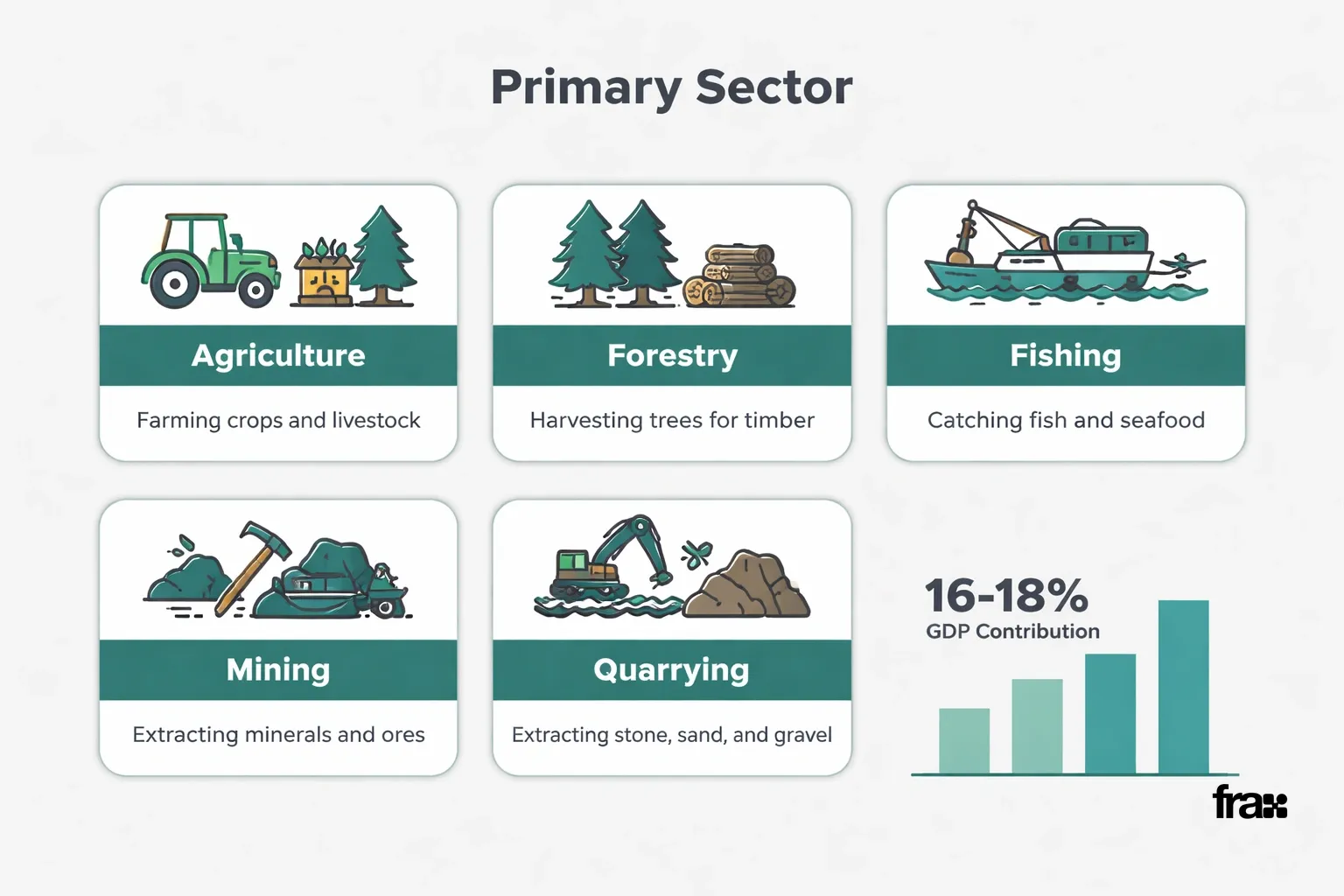
It includes agriculture, forestry, fishing, mining, and quarrying. Basically, anything that pulls raw materials directly out of nature. It employs the largest workforce share of any sector, even though its GDP contribution is smaller than services.
Agriculture makes up the bulk of it. Livestock and horticulture have actually been growing faster than traditional crop farming lately. Mining is a smaller piece, but it feeds the steel, cement, and energy industries. Without it, construction and infrastructure growth would stall.
This content is for informational purposes only and does not constitute financial, legal, or investment advice.
How much it contributes to GDP today
Based on recent government economic surveys and RBI commentary, the primary sector contributes an estimated 16 to 18 percent of gross value added as of FY26. That's down from over 40 percent at independence. It's a structural shift you expect as a country develops, not a sign that farming is dying.
Here is a look at sectoral shares over recent years.
Sector | FY22 Share | FY24 Share | FY26 Estimated Share |
|---|---|---|---|
Primary (Agriculture, Mining, Fishing) | ~18% | ~17% | ~16% |
Secondary (Manufacturing, Construction) | ~25% | ~26% | ~27% |
Tertiary (Services) | ~57% | ~57% | ~57% |
These numbers shift a bit depending on the data release, but the direction is clear. Services keep expanding, construction and manufacturing are rising, and the primary sector's slice of the pie keeps slowly shrinking.
If you want the deeper historical view, check out India's GDP growth journey from 1947 to 2026, which tracks how these shares evolved over seven decades.
This content is for informational purposes only and does not constitute financial, legal, or investment advice.
Agriculture's role in the economy
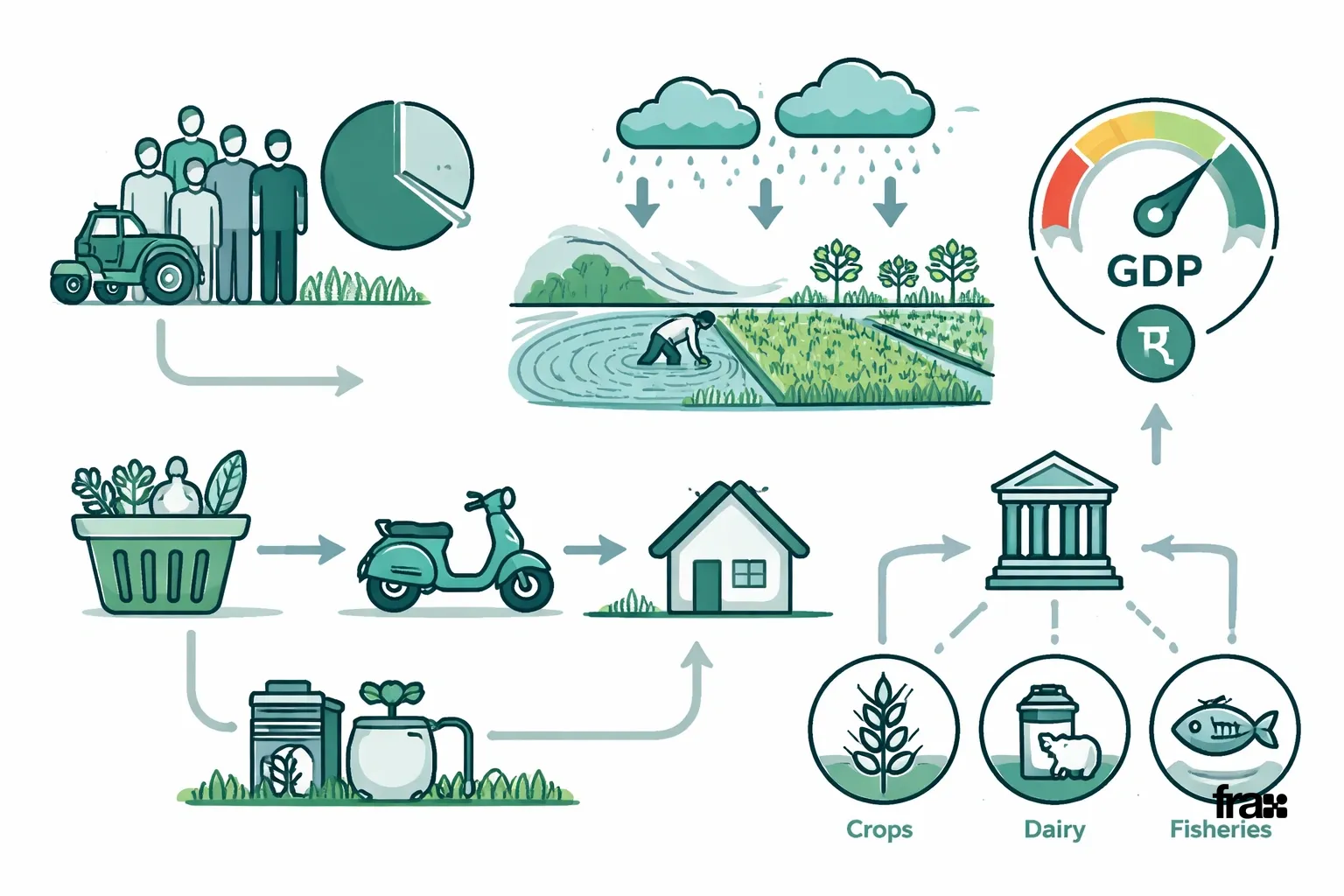
Agriculture is the biggest piece of the primary sector. It employs nearly half the country's workforce but contributes a much smaller share of output. That mismatch shows how low productivity per worker is compared to industry.
Monsoon performance swings agricultural output every year. A good monsoon lifts rural consumption, which trickles down into demand for consumer goods, two-wheelers, and even housing in tier-2 and tier-3 towns. Weak rainfall years squeeze rural incomes and slow overall GDP momentum.
Government policy keeps pushing farmers toward higher-value crops, dairy, and fisheries, along with better market access. The goal is raising farm incomes without necessarily growing the sector's GDP share.
This content is for informational purposes only and does not constitute financial, legal, or investment advice.
Explore how FraX turns economic trends into real estate opportunity
Mining and allied activities
Mining contributes a smaller but strategic share. Coal, iron ore, bauxite, and limestone extraction feed downstream industries like steel, cement, and power. If mining output drops, construction and manufacturing feel it.
Global commodity price cycles hit this subsector hard. High international coal or metal prices boost mining revenue temporarily, but price crashes squeeze margins for mining-dependent states. Odisha, Jharkhand, and Chhattisgarh rely heavily on mining royalties for state revenue and infrastructure spending.
Environmental clearances and sustainability norms have slowed some expansion lately. Balancing extraction with ecological limits is an ongoing policy fight that shapes how much this subsector can add to future GDP.
This content is for informational purposes only and does not constitute financial, legal, or investment advice.
Why primary sector trends shape the broader outlook
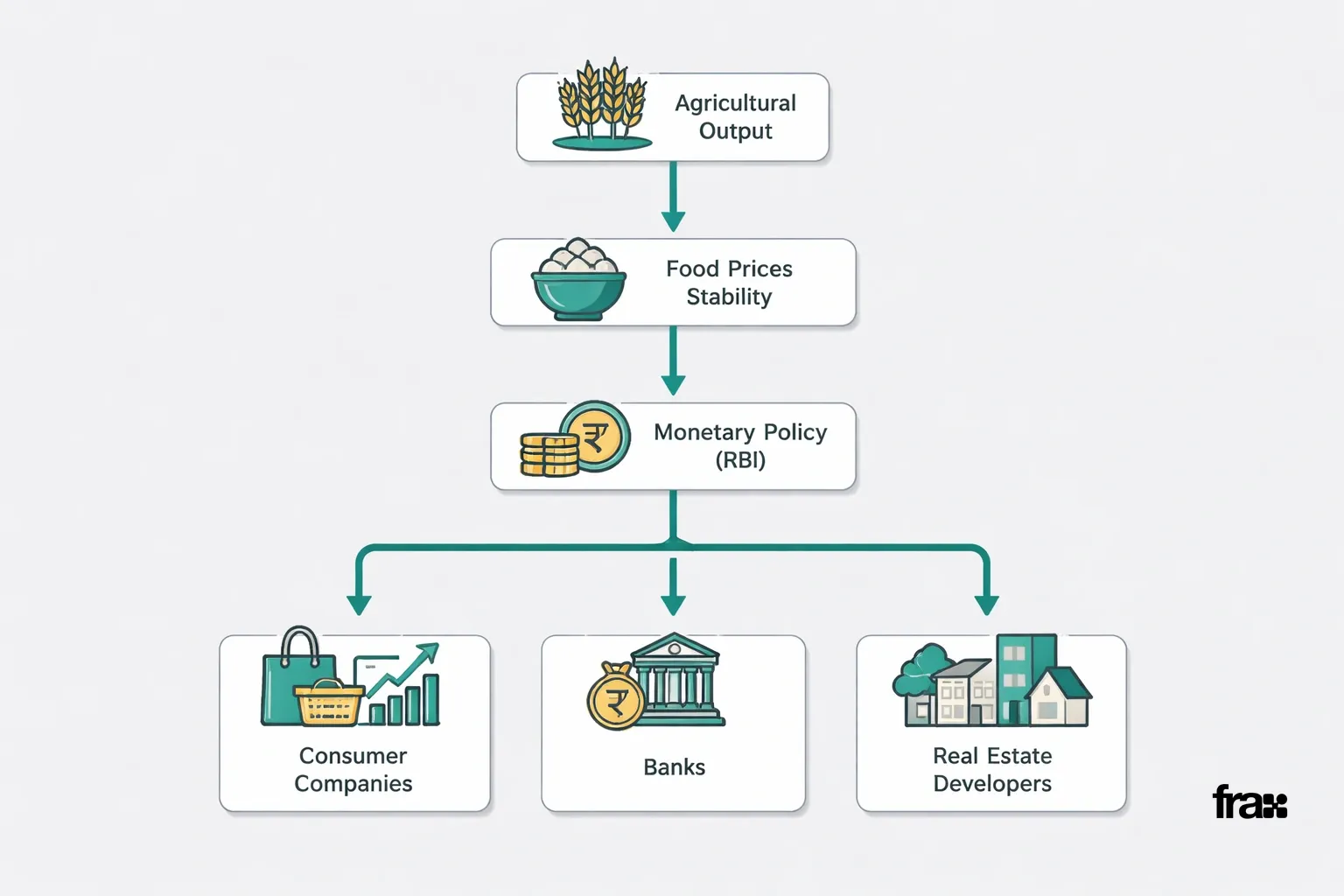
Primary sector performance acts as an early indicator for the overall economy. Strong agricultural output keeps food prices stable, which helps the Reserve Bank of India manage monetary policy. Weak primary sector years usually mean rural demand slowdowns that dampen broader consumption.
Rural consumption patterns matter a lot for consumer companies, banks, and real estate developers targeting semi-urban markets. When farm incomes rise, spending on housing improvements, vehicles, and durable goods usually follows within a few quarters.
Analysts tracking quarterly GDP releases watch agriculture numbers closely for this reason. For a closer look at a recent quarter, see the breakdown of India's Q1 FY27 GDP growth at 6.7 percent.
This content is for informational purposes only and does not constitute financial, legal, or investment advice.
Regional variations across states
Primary sector contribution varies sharply by state. Agriculture-heavy states like Punjab, Uttar Pradesh, and Madhya Pradesh get a much larger share of their state GDP from farming than Maharashtra or Karnataka, where services dominate.
Mining-dependent states show a different pattern. Jharkhand and Odisha rely on mineral royalties for a big chunk of state revenue. Their economies are sensitive to commodity price swings rather than monsoon patterns.
Punjab and Haryana lean heavily on wheat and rice. Odisha and Jharkhand depend on coal and minerals. Kerala and Tamil Nadu have smaller primary sector shares because services dominate. Gujarat manages to balance agriculture, industry, and mining fairly evenly.
These regional differences matter for anyone studying state-level growth. A detailed state-wise breakdown appears in India's state GDP growth 2026 report.
This content is for informational purposes only and does not constitute financial, legal, or investment advice.
Challenges facing the primary sector in 2026
This content is for informational purposes only and does not constitute financial, legal, or investment advice.
Climate volatility is the biggest challenge. Irregular monsoon patterns, heat waves, and unseasonal rainfall make crop planning harder for farmers across multiple states.
Fragmented land holdings also limit productivity. Average farm size in India is small, which restricts mechanization and economies of scale. Water scarcity in states like Punjab and Maharashtra adds pressure on traditional farming methods.
Mining faces its own constraints. Slower environmental clearances, logistics bottlenecks, and global price volatility limit expansion. Both issues feed into the broader conversation about economic resilience covered in the analysis of India's 2026 economic slowdown.
What this means going forward
India's economic outlook depends on managing this transition smoothly. Policymakers want rural incomes to rise even as the primary sector's GDP share shrinks. That requires productivity improvements, not just output expansion.
Better irrigation, warehousing, cold storage, and market access reforms aim to raise farm efficiency. These investments don't necessarily grow the primary sector's percentage share, but they stabilize rural incomes and reduce volatility in national GDP figures during weak monsoon years.
For a longer view of this transition, the analysis in India's GDP growth from 2014 to 2026 offers useful context.
Investors tracking macro indicators often look beyond raw GDP numbers to find opportunity. Diversified asset classes, including fractional exposure to real estate, offer a way to participate in India's growth story without depending on a single sector. Read more on fractional real estate investing in India to see how it works.
Start building a diversified portfolio with FraX today
For the full picture connecting macroeconomic trends to real estate, the parent guide on India's economic growth and real estate outlook ties together GDP data, sectoral shifts, and property market implications. Check out top cities for fractional real estate investment or learn about REIT investing in India. More perspectives are on the FraX blog, and the FraX homepage outlines how the platform approaches diversified investing.
This content is for informational purposes only and does not constitute financial, legal, or investment advice. Investors hold direct beneficial partnership interests in dedicated LLP SPVs, not direct individual property titles. Past performance and realized XIRR figures are historical and do not guarantee future property returns or rental yields.
Frequently Asked Questions
Q: What percentage of India's GDP comes from the primary sector in 2026? A: India's primary sector, covering agriculture, forestry, fishing, and mining, contributes roughly 16 to 18 percent of GDP based on recent estimates. This share has declined steadily over decades as services and industry expanded.
Q: Why has primary sector contribution to GDP declined over time? A: Structural transformation drives this decline. As India industrialized and its services sector grew rapidly, manufacturing and services began contributing a larger share of output even as primary sector employment remained high.
Q: Does a smaller primary sector share mean agriculture is shrinking? A: Not necessarily. Agricultural output has grown in absolute terms, but services and industry have grown faster, which reduces agriculture's relative percentage of total GDP without indicating an actual decline in farm production.
Q: How does the primary sector affect India's broader economic outlook? A: Primary sector performance influences inflation, rural consumption, and monetary policy decisions. A weak monsoon year can slow rural demand, which then affects consumer spending patterns across multiple industries nationwide.
Q: Which Indian states depend most on the primary sector? A: Agriculture-heavy states like Punjab and Uttar Pradesh rely significantly on farming, while mining-dependent states like Odisha and Jharkhand depend on mineral extraction revenue for a meaningful share of their state GDP.
Q: How does primary sector data connect to real estate investment decisions? A: Rural income trends, driven partly by primary sector output, influence consumption and housing demand in semi-urban markets. Investors studying macro trends often use this data alongside broader GDP indicators for context.
Learn more
Discover more from the latest posts.


