
Top Indian Cities for Real Estate Investment in 2026
Find top Indian cities for 2026 real estate investment. Choose high-growth, high-rental markets and start with ₹10,000 via fractional ownership.
This content is for informational purposes only and does not constitute financial, legal, or investment advice.
You make money in Indian real estate by picking the right city first, then the right neighborhood within it. Bengaluru, Pune, Hyderabad, and Gurugram are the ones to watch right now. They have the rental demand, the infrastructure spending, and the price appreciation that makes investment work.
Pick wrong, and your capital is stuck for years in a market where no one wants to buy. Pick right, and you get appreciation plus rental income that covers your costs. Here is where to put your money in late 2026, and what to check before you do.
What Makes a Location Work
This content is for informational purposes only and does not constitute financial, legal, or investment advice.
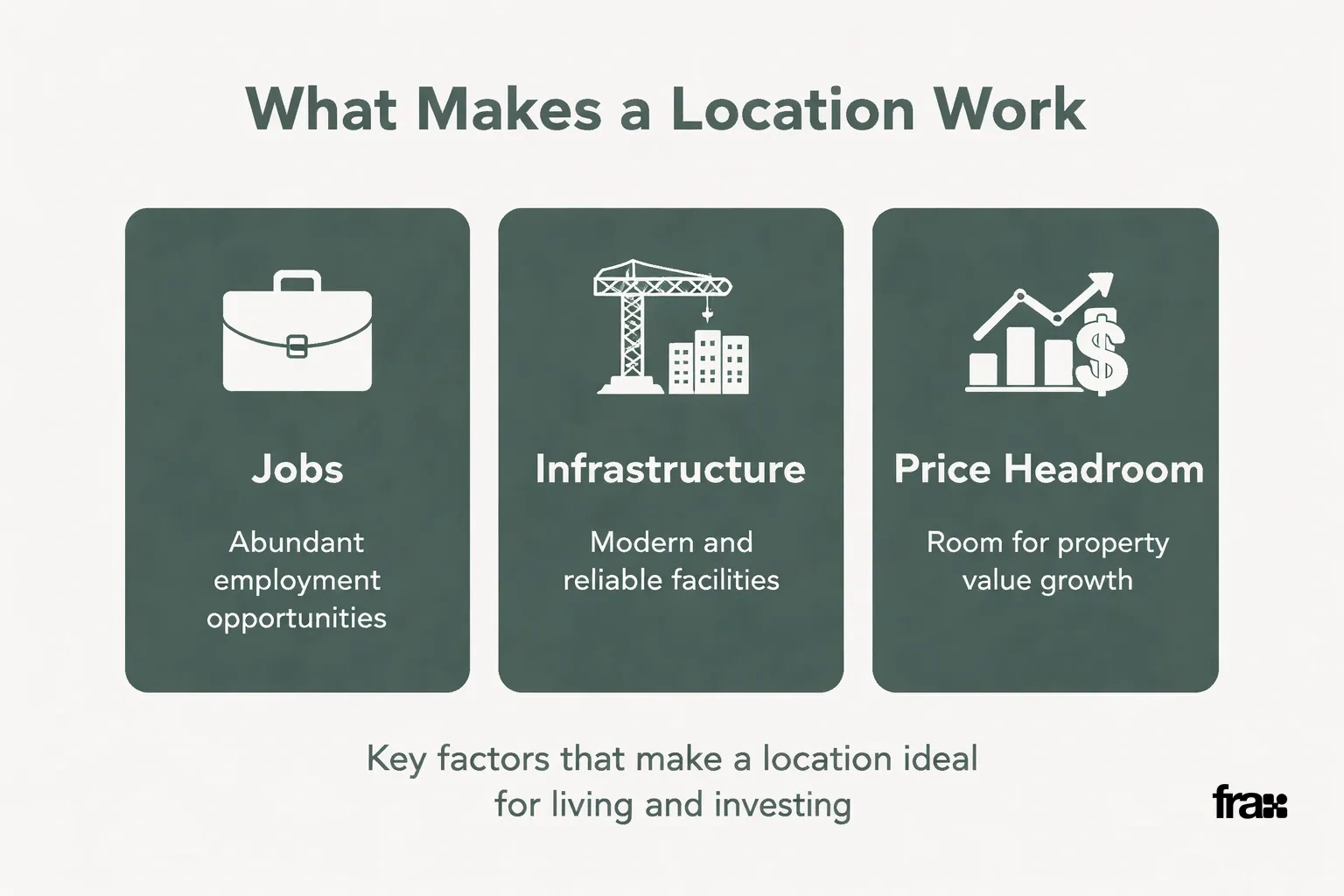
A location works for investment when three things happen at once: jobs appear, infrastructure gets built, and prices haven't already peaked.
Cities with growing IT, finance, or manufacturing hubs pull in professionals who need housing. That demand pushes rents up and keeps properties occupied. Infrastructure matters as much as jobs. A new metro line or expressway can turn a quiet suburb into a hot market in five years. Investors who bought in Pune's Hinjewadi before the metro extension did much better than those who waited.
Price headroom is the third piece. A location already priced at its ceiling has nowhere to go. You want areas where prices still lag behind the fundamentals.
Check these things before you buy:
Employment growth in the immediate area
Planned or under-construction infrastructure projects
Price appreciation history versus nearby areas
Rental yield compared to the city average
Clear land titles and zoning
Top Cities for Property Investment in India Right Now
This content is for informational purposes only and does not constitute financial, legal, or investment advice.
Bengaluru, Pune, Hyderabad, and Gurugram lead the pack in October 2026. Tech hiring, metro expansions, and commercial leasing drive them. Mumbai and Delhi NCR matter for premium commercial, but entry prices are much higher.
Here is how they compare:
City | Key Driver | Investor Appeal |
|---|---|---|
Bengaluru | IT and startup employment | High rental demand, steady appreciation |
Hyderabad | Tech parks, pharma corridor | Lower entry cost, strong growth trajectory |
Pune | IT, auto, education hubs | Balanced yield and appreciation |
Gurugram | Corporate offices, NCR proximity | Premium commercial and residential mix |
Mumbai | Finance, entertainment, trade | High value, limited new supply |
Chennai | Manufacturing, auto, IT | Steady, lower-volatility growth |
Bengaluru's tech corridors Whitefield, Sarjapur Road, Outer Ring Road keep pulling in renters and buyers. Hyderabad is the value play. Gachibowli and Kokapet have lower entry points and good upside.
Pune sits in the middle. Its IT and manufacturing base makes it resilient. Hinjewadi and Wagholi still have reasonable prices compared to Bengaluru. Gurugram is the spot for premium commercial near Delhi NCR.
For a deeper breakdown of neighborhoods and price trends, this guide covers the details: https://getfrax.com/blog/fractional-real-estate-investing-2026-fractional-real-estate-best-investment-cities-india
Explore Premium Properties Starting at ₹10,000
Emerging Micro-Markets Worth Watching
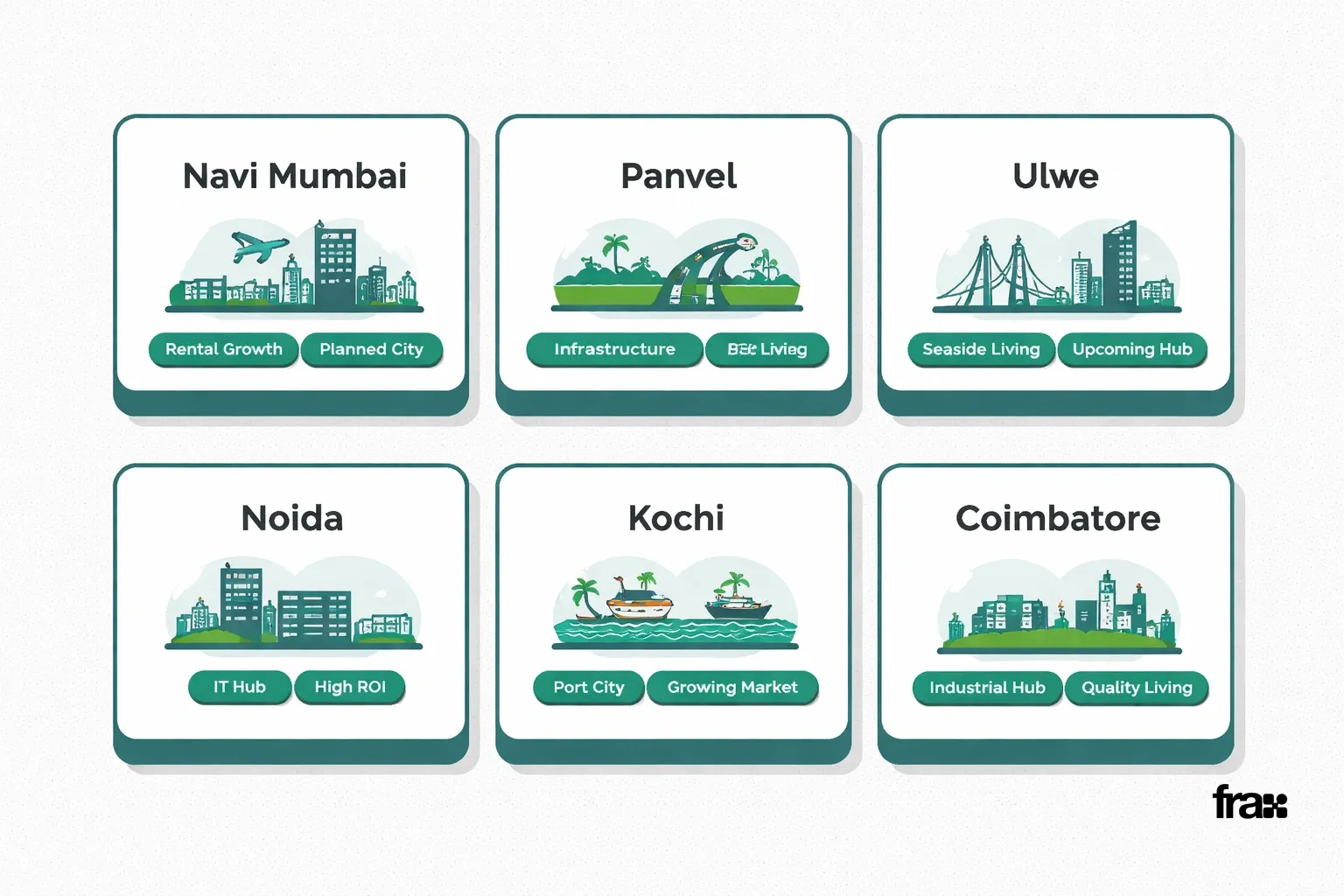
The biggest gains often come from areas just outside established hubs. These pockets benefit from spillover demand and new infrastructure before prices catch up.
Navi Mumbai is gaining ground as Mumbai's core becomes too expensive for many. The upcoming international airport has triggered interest in Panvel and Ulwe. Noida's expansion near the Jewar airport corridor shows a similar pattern, with land values climbing since construction began.
Kochi and Coimbatore are worth a look too. Both have lower living costs and growing IT and manufacturing bases. Investors willing to look beyond the usual metros often find better yields in these second-tier cities.
Other micro-markets gaining traction:
Devanahalli, Bengaluru (airport proximity, upcoming infrastructure)
Shamshabad, Hyderabad (airport corridor expansion)
Wagholi, Pune (affordable entry, strong rental pool)
Sohna Road, Gurugram (improving connectivity, newer developments)
State-level economic trends shape which micro-markets perform. For a look at how state GDP growth connects to real estate demand, check this analysis: https://getfrax.com/blog/economic-growth-real-estate-india-gdp-growth-2026-state-wise-real-estate-impact
This content is for informational purposes only and does not constitute financial, legal, or investment advice.
Factors to Evaluate Before You Invest
Due diligence separates good investments from expensive mistakes. Check legal title clarity, builder track record, and local rental demand data. Skipping this is how first-time investors lose money.
Legal clarity comes first. Confirm the property has a clean title, proper approvals, and no pending litigation. Builder reputation is next. A developer known for delayed possession or quality issues is a risk regardless of location.
Rental demand data tells you if the location supports your thesis. A city might look promising on infrastructure news, but high vacancy rates will hurt your returns. Check rental listings, occupancy trends, and talk to local brokers.
Liquidity matters too. Traditional property investment in India can take months or years to sell. That illiquidity traps your capital when you need it. Newer structures focused on flexibility have gained attention for this reason. Compare approaches here: https://getfrax.com/blog/which-is-the-best-way-to-invest-in-real-estate-comparing-fractional-reits-direct-ownership
This content is for informational purposes only and does not constitute financial, legal, or investment advice.
How to Invest Without Crores
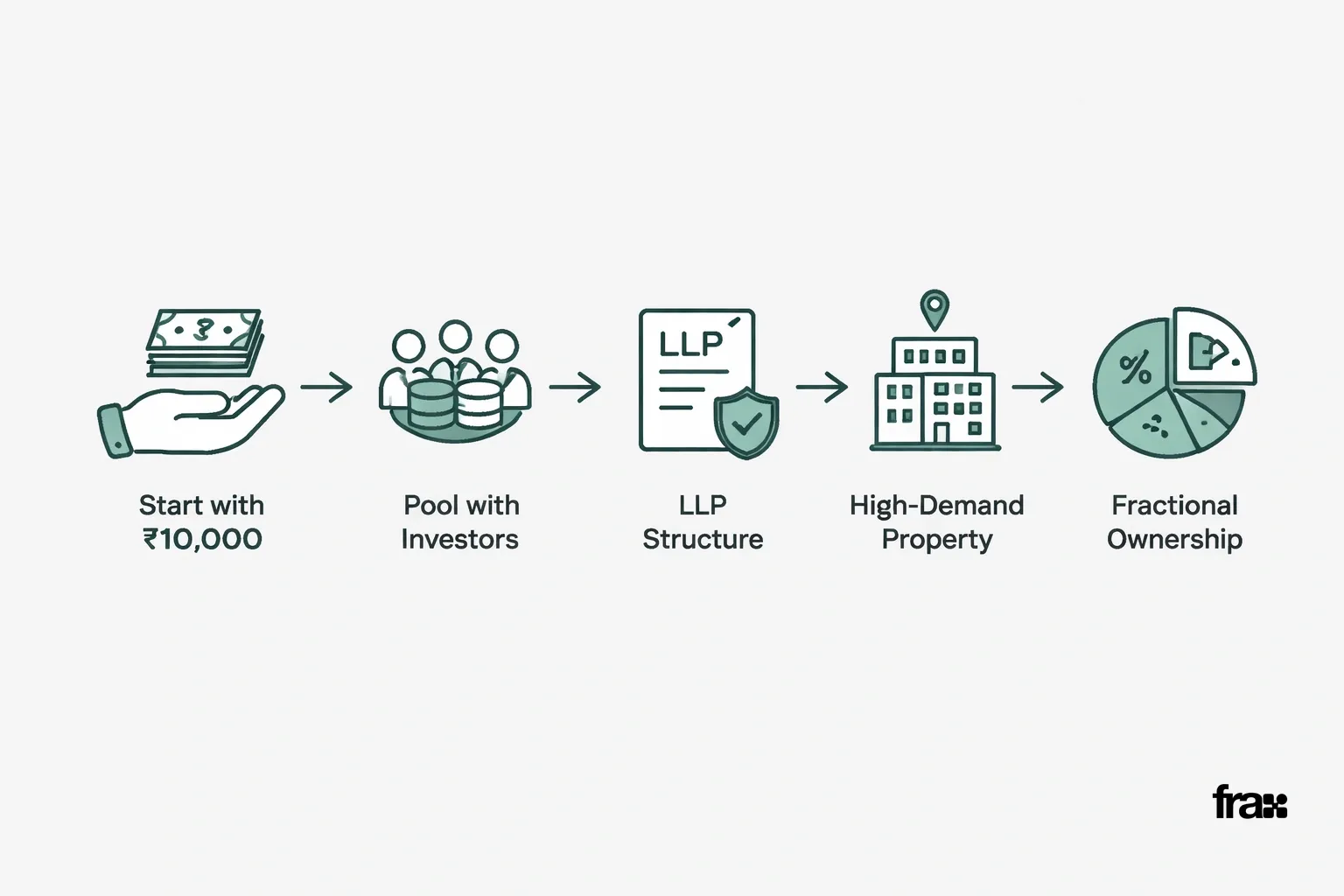
Most investors cannot buy a full property in Bengaluru or Gurugram outright. Fractional investment structures let individuals enter these markets starting at ₹10,000. The crore-level barrier is gone.
This approach pools capital from multiple investors into an LLP for a single property. You own a proportional stake in a high-demand micro-market property. Platforms like FraX use ICICI Bank escrow oversight and legal documentation for a clear paper trail.
FraX has deployed over ₹3 crore in investor capital since its November 2025 founding. The app has over 40,000 downloads and a 4.8-star rating. It lets investors buy and sell holdings digitally without the long lock-in periods of direct ownership.
For a walkthrough of the first steps, this beginner's guide helps: https://getfrax.com/blog/your-first-fractional-real-estate-investment-a-step-by-step-beginner-s-guide
For a full breakdown of starting with ₹10,000, this parent guide covers it: https://getfrax.com/blog/fractional-real-estate
Professionals earning ₹15-20 lakh annually find this route useful. It opens cities and neighborhoods previously reserved for high-net-worth buyers. See the breakdown here: https://getfrax.com/blog/how-young-professionals-earning-%E2%82%B915-20-lakhs-can-finally-access-premium-real-estate-in-india
Start Your Property Investment Journey Today
Balancing Risk Across Locations
Risk management matters as much as picking the right spot. No city is immune to slowdowns, regulatory shifts, or oversupply. Spreading capital across cities and property types reduces exposure to any single market's downturn.
Investors who put everything in one city take on concentrated risk. A regulatory change or infrastructure delay can hurt returns. Diversifying across Bengaluru, Hyderabad, and Pune spreads that risk across different economic drivers.
Smaller ticket sizes make diversification realistic. Instead of saving for one property, investors can spread smaller amounts across locations and types. This guide explains the tradeoffs: https://getfrax.com/blog/risk-and-reward-a-smart-investor-s-guide-to-fractional-real-estate
For terminology used in fractional structures, this glossary helps: https://getfrax.com/blog/fractional-real-estate-investment-india-a-beginner-s-glossary
For how this model changes access for younger, salaried investors: https://getfrax.com/blog/fractional-real-estate-for-young-investors-5-ways-it%E2%80%99s-changing-the-game
Investors hold direct beneficial partnership interests in dedicated LLP SPVs, not direct individual property titles. Past performance and realized XIRR figures are historical and do not guarantee future property returns or rental yields.
This content is for informational purposes only and does not constitute financial, legal, or investment advice.
Frequently Asked Questions
This content is for informational purposes only and does not constitute financial, legal, or investment advice.
Q: What is the best place to invest in real estate in India? A: Bengaluru, Pune, Hyderabad, and Gurugram lead due to job creation, infrastructure projects, and demand for residential and commercial space.
Q: How much do I need to start property investment in India? A: Traditional purchases require lakhs or crores. Fractional platforms lower the threshold, some to ₹10,000.
Q: Are emerging micro-markets riskier than established cities? A: They offer higher upside but carry more uncertainty around infrastructure timelines and demand growth. Established cities are more predictable.
Q: Can I invest in multiple cities without buying full units? A: Yes. Fractional ownership lets you hold proportional stakes across cities, making geographic diversification possible without crore-level capital. Investors hold direct beneficial partnership interests in dedicated LLP SPVs, not direct individual property titles.
Q: What should I check before choosing a city? A: Employment growth, infrastructure development, price trends, rental demand, and legal clarity on the property.
Q: Does FraX allow investment in these cities directly? A: FraX offers access to properties in high-demand cities through fractional investment, with ICICI Bank escrow oversight and legal documentation.
Learn more
Discover more from the latest posts.