
REITs vs InvITs: Key Differences & Investment Insights
Compare REITs vs InvITs-structures, risks, and the rise of fractional real estate. Find the right fit for your portfolio.
REITs and InvITs are vehicles that let you own a slice of large assets, such as office parks, highways, or power lines, without buying the whole thing. REITs hold real estate that is already renting. InvITs hold infrastructure. The main difference is what is underneath the hood.
If you are earning ₹15-20 lakh a year, this is not just trivia. The choice dictates how you handle interest rate swings, occupancy risk, and regulatory shifts. Here is the breakdown on structure, distributions, and risk, plus how fractional real estate fits in.
This content is for informational purposes only and does not constitute financial, legal, or investment advice. Investors hold direct beneficial partnership interests in dedicated LLP SPVs, not direct individual property titles. Past performance and realized XIRR figures are historical and do not guarantee future property returns or rental yields.
What Is REIT and InvIT: The Basics
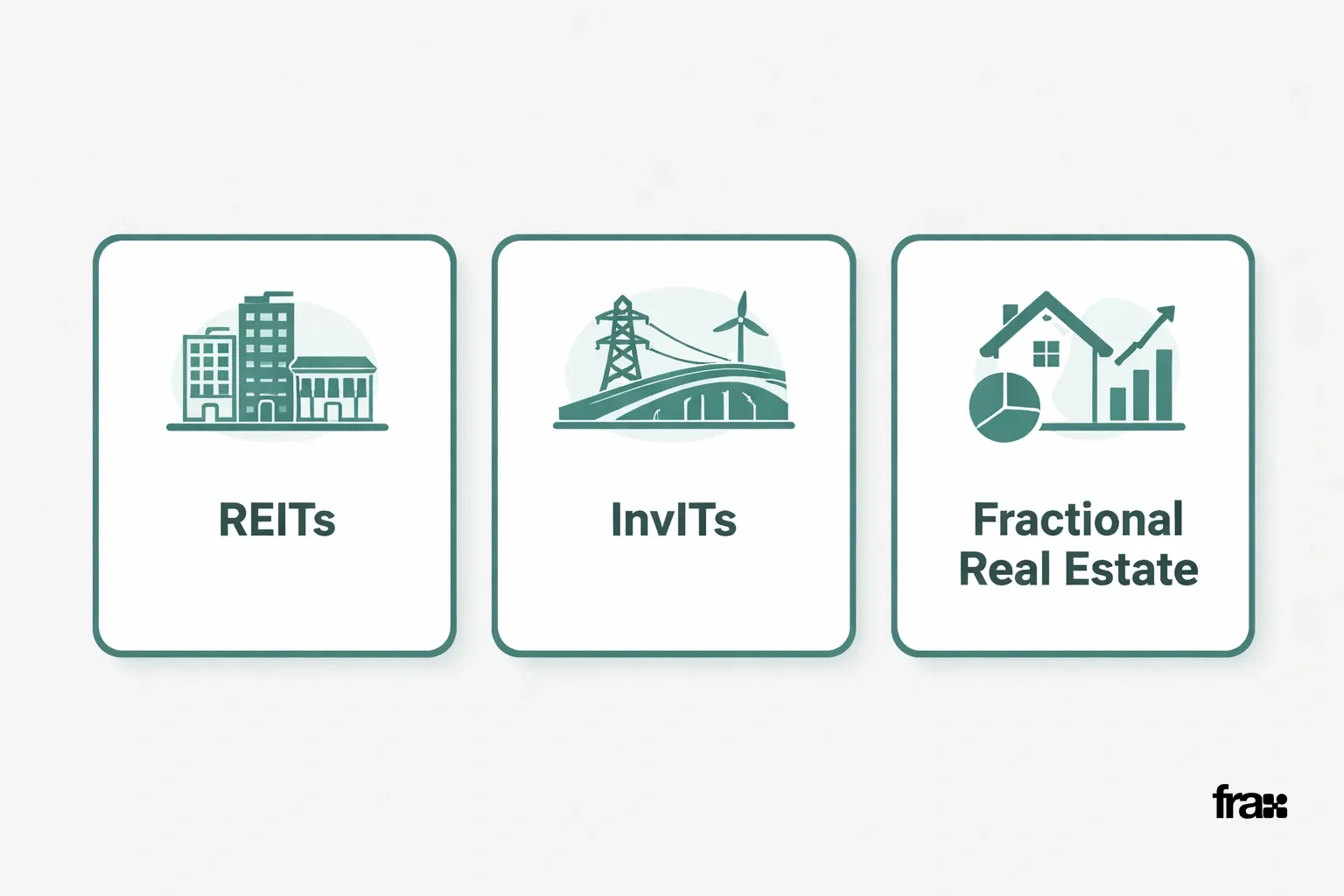
A REIT (Real Estate Investment Trust) pools money for commercial property. An InvIT (Infrastructure Investment Trust) does the same for infrastructure projects. Both are trusts listed on exchanges.
Think of them as mutual funds for physical assets. You buy units in a trust, and that trust owns the towers or toll roads through holding companies.
Indian REITs mostly hold Grade A offices and IT parks Embassy, Brookfield, Mindspace. InvITs cover roads, power transmission, and pipelines. If you want the full mechanics, our REIT investment options guide covers eligibility and how to buy units.
This content is for informational purposes only and does not constitute financial, legal, or investment advice.
How They Are Structured
This content is for informational purposes only and does not constitute financial, legal, or investment advice.
Both use a three-tier setup: sponsor, trustee, manager. The sponsor contributes assets. The trustee holds them for unit holders. The manager runs operations.
Certain regulatory frameworks require investments in completed, revenue-generating properties and the distribution of net cash flows to unit holders. That distribution requirement is why income investors pay attention.
Pricing is influenced by market sentiment and interest rates.
Difference Between REITs and InvITs: Side by Side
This content is for informational purposes only and does not constitute financial, legal, or investment advice.
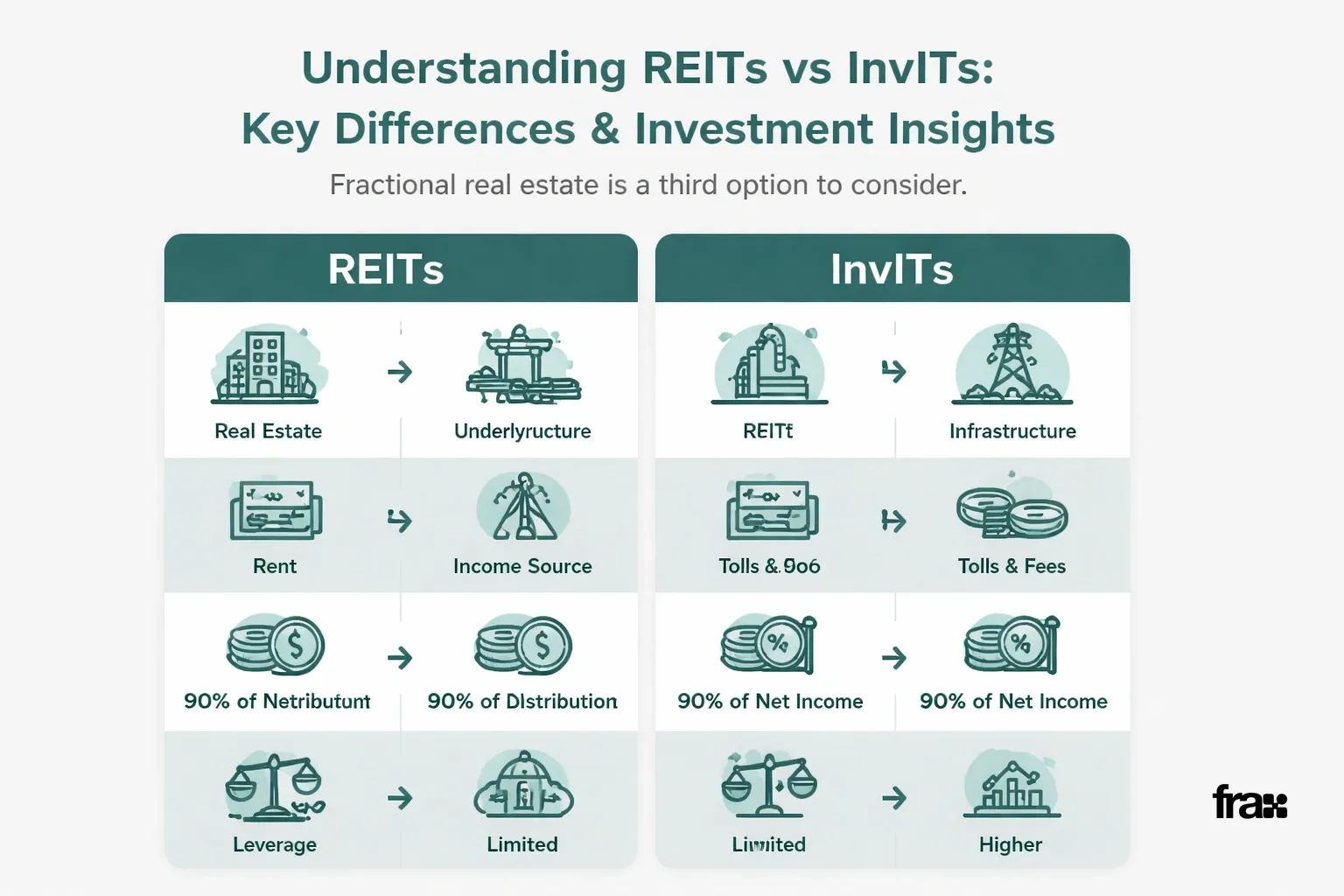
The core difference is the asset and cash flow source. REITs earn rent. InvITs earn tolls or tariffs. That changes the risk.
Feature | REITs | InvITs |
|---|---|---|
Underlying asset | Office, retail, warehousing real estate | Roads, power transmission, pipelines, renewable energy |
Income source | Rental and lease income | Toll collections, tariffs, annuity payments |
Minimum investment | Market determined, typically a few thousand rupees per lot | Market determined, typically a few thousand rupees per lot |
Mandatory distribution | At least 90% of net distributable cash flows | At least 90% of net distributable cash flows |
Leverage limit | Up to 49% of asset value | Up to 70% of asset value for rated InvITs |
Primary risk drivers | Occupancy rates, lease renewals, office demand cycles | Traffic volumes, regulatory tariff changes, project concession terms |
Exchange listing | Mandatory on recognized stock exchanges | Mandatory on recognized stock exchanges |
InvITs can carry more debt because their cash flows like government annuities are often locked in. REITs rely on market rent. Investors tracking India's growth story may find our piece on economic growth and real estate useful context for how GDP trends ripple into both asset classes.
Distribution Mix and Yield Expectations
Distributions are a mix of dividend, interest, and capital repayment. The split depends on the SPV's funding structure.
Neither guarantees a fixed payout. It depends on cash flow.
This content is for informational purposes only and does not constitute financial, legal, or investment advice.
Risk Factors You Cannot Ignore
This content is for informational purposes only and does not constitute financial, legal, or investment advice.
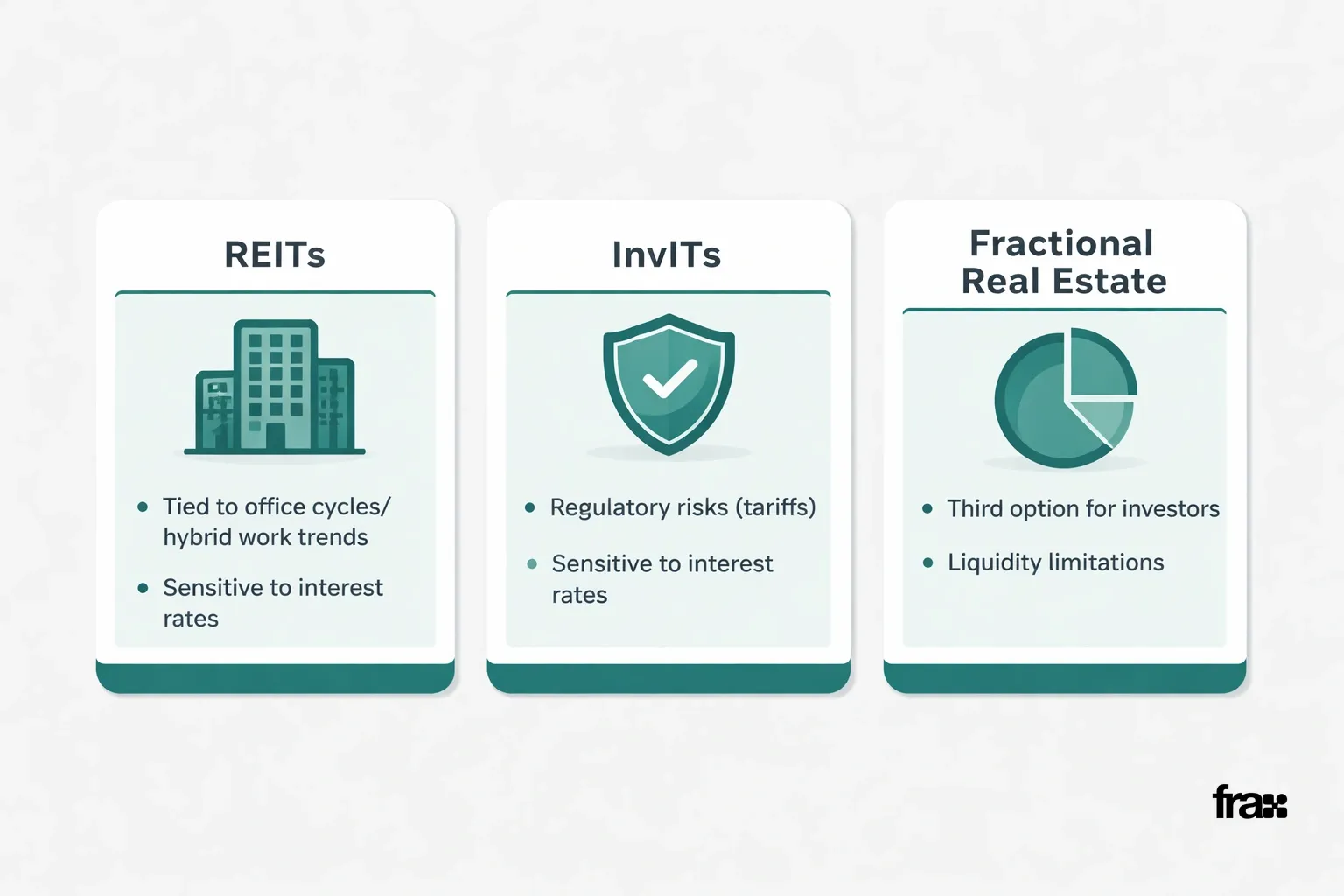
REITs are tied to the office cycle and hybrid work trends. InvITs face regulatory risk tariffs are often government-set. Both are sensitive to interest rates. When rates rise, prices often fall.
Liquidity is real but not unlimited. Trading volumes can be thin, widening spreads.
For a broader primer on terminology used across these structures, our fractional real estate glossary explains terms like SPV, yield and distribution in plain language.
Where Fractional Real Estate Fits as a Third Option
This content is for informational purposes only and does not constitute financial, legal, or investment advice.
Fractional ownership is a third path. Instead of a pooled trust, you invest in a specific property through a dedicated LLP.
FraX, for example, maps one property to one LLP. You start at ₹10,000. Universal Trustees oversees the escrow with ICICI Bank. It is for investors who want to know exactly what building they own, rather than a basket chosen by a manager. FraX charges 1% to buy and 1% to sell. The platform has crossed ₹3 crore in deployed capital.
Founded in November 2025 by Prabhav Tanay and Tushar Chaudhary (IIT-BHU), FraX has over 40,000 downloads. Investors hold direct beneficial partnership interests in dedicated LLP SPVs, not direct individual property titles.
Explore Fractional Property Options Starting at ₹10,000
If you are comparing all three paths, read up on how fractional real estate ownership works mechanically. Our guide on commercial real estate in India also lays out why office and retail assets remain a preferred category.
Making the Call
This content is for informational purposes only and does not constitute financial, legal, or investment advice.
Choosing between REITs, InvITs, and fractional ownership depends on how much control and diversification you want. REITs give broad, exchange-traded exposure. InvITs give infrastructure income. Fractional lets you pick a specific building. Investors hold direct beneficial partnership interests in dedicated LLP SPVs, not direct individual property titles.
Many investors in the ₹15-20 lakh bracket use a mix. Some capital goes to REITs for diversity. Some goes to InvITs for income. The rest goes into fractional ownership of a specific property they’ve researched.
Before deciding, read our risk and reward guide to fractional real estate. Past performance and realized XIRR figures are historical and do not guarantee future property returns or rental yields.
Download FraX and Build Your Real Estate Portfolio Today
Start by matching the asset class to your own time horizon and risk appetite. You can browse live opportunities on the FraX blog, or head to the FraX homepage to see current listings.
Frequently Asked Questions
What is REIT and InvIT in simple terms? A REIT is a trust that pools investor money to own income generating commercial real estate like offices and malls. An InvIT is a trust that pools money to own infrastructure assets like roads, power lines and pipelines. Both distribute income to unit holders and trade on stock exchanges.
What is the main difference between REITs and InvITs? The main difference is the underlying asset and income source. REITs earn rental income from commercial real estate. InvITs earn toll, tariff or annuity income from infrastructure projects, and typically carry higher permitted leverage.
Can I lose money investing in REITs or InvITs? Yes. Unit prices for both can fall due to interest rate changes, occupancy drops, regulatory tariff revisions or broader market sentiment. Distributions are also not fixed and depend on actual cash flow performance each period.
How is fractional real estate different from REITs and InvITs? Fractional real estate lets you invest in a specific, identifiable property through a dedicated LLP SPV, rather than a diversified trust portfolio. Platforms like FraX allow entry from ₹10,000 per property, compared to broader trust based exposure in REITs and InvITs.
Is fractional real estate as liquid as REITs or InvITs? REIT and InvIT units trade on stock exchanges, though trading volumes can be thin at times. Fractional real estate platforms typically offer a buy and sell model without lock in periods, but liquidity depends on buyer availability within the platform.
Should I choose only one of REITs, InvITs or fractional ownership? Not necessarily. Many investors combine REITs for diversified real estate exposure, InvITs for infrastructure income, and fractional ownership for targeted exposure to specific properties they have personally researched.
This content is for informational purposes only and does not constitute financial, legal, or investment advice. Investors hold direct beneficial partnership interests in dedicated LLP SPVs, not direct individual property titles. Past performance and realized XIRR figures are historical and do not guarantee future property returns or rental yields.
Learn more
Discover more from the latest posts.