
7 Modern Real Estate Investment Routes in India 2026
Explore 7 modern Indian real estate investment options-from ₹10k fractional ownership to REITs and direct purchases. Perfect for beginners.
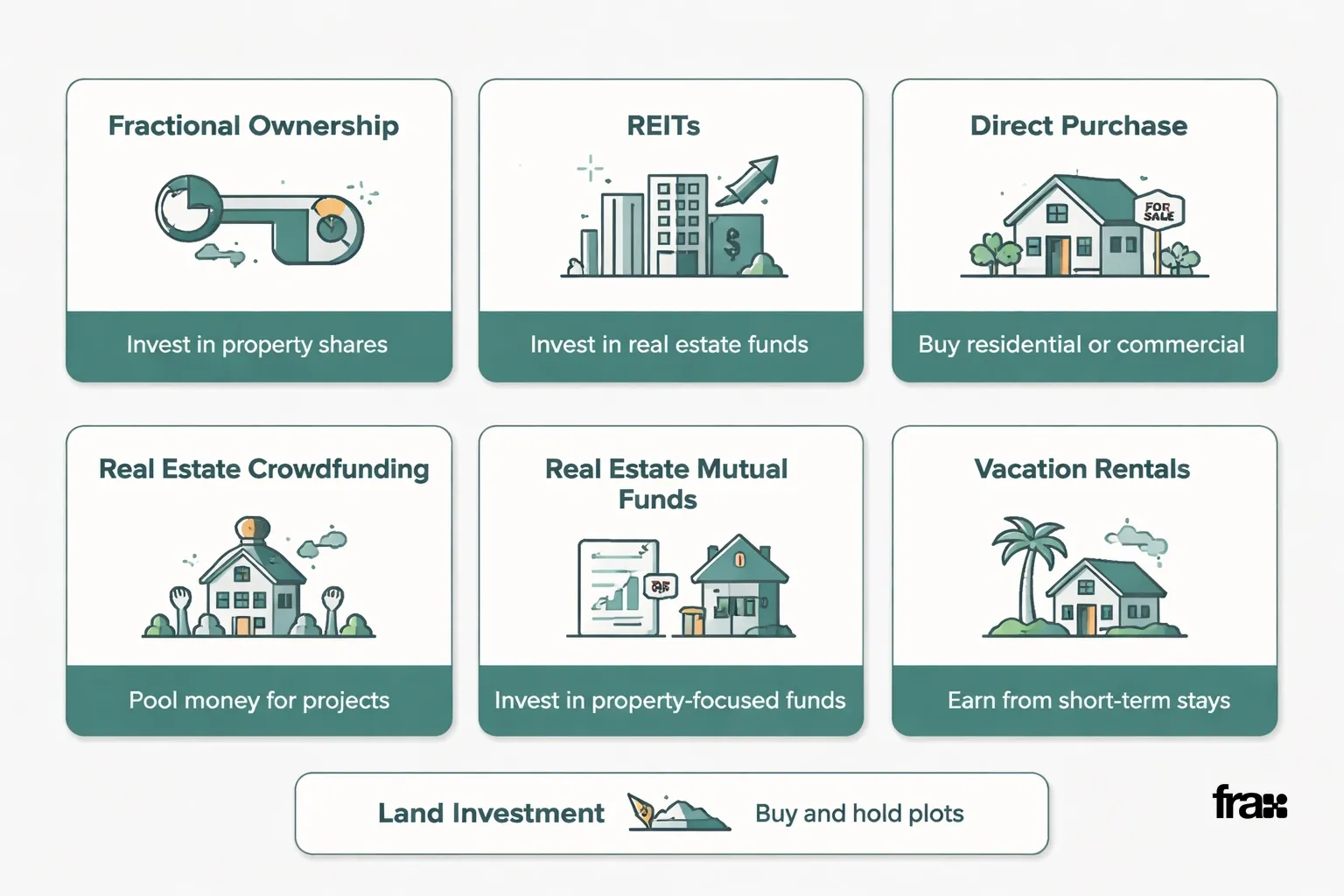
Real estate investing in India used to mean one thing: save for a decade, take a loan, buy a flat. That version is outdated in 2026. Fintech has changed the entry points. Beginners now have seven distinct routes, ranging from direct purchase (requiring lakhs) to fractional ownership platforms like FraX starting at just ₹10,000.
Most Indians still assume real estate means saving for years and buying a flat with a home loan. That assumption is outdated. Fintech has restructured how property investment works, and beginners with modest salaries can now build genuine real estate exposure without crores sitting idle.
This content is for informational purposes only and does not constitute financial, legal, or investment advice.
Why Real Estate Still Belongs in Your Portfolio
This content is for informational purposes only and does not constitute financial, legal, or investment advice.
Real estate offers rental income and appreciation, but the real value is diversification. It doesn't move in lockstep with equities. For someone earning ₹15-20 lakh a year, it also feels tangible: you can see it, unlike a mutual fund portfolio.
Property acts as an inflation hedge because rents and values tend to rise with the cost of living. It also forces patience; you can't panic-sell a building because the market dipped on a Tuesday. But traditional buying comes with illiquidity and maintenance headaches, which is why newer models are gaining ground. Before picking a route, it helps to understand what fractional real estate investing in India actually changes.
1. Direct Property Purchase
This is buying a full unit in your name. It requires the most capital, from ₹40 lakh to several crores depending on the city.
You get straightforward ownership. You hold the deed, you choose tenants, and you renovate. But for beginners, the friction is high:
Down payments of 20-25%
Stamp duty and brokerage add 7-10%
Illiquid assets that take months to sell
Active management required
For a salaried professional, saving for a down payment in Mumbai or Bangalore can take a decade. That is a long wait to start investing.
This content is for informational purposes only and does not constitute financial, legal, or investment advice.
2. REITs: Real Estate Investment Trusts
REITs let you buy units of a trust that owns commercial properties. Traded on stock exchanges, they start at a few thousand rupees.
Think of them as mutual funds for real estate. A trust owns office parks or malls; you earn a share of the rent plus appreciation. You can read more about REITs in India and the options available in 2026 for a deeper breakdown.
The catch is control. You own units, not the building. Most Indian REITs focus on commercial office space in major metros, creating concentration risk. Returns also fluctuate with market sentiment, not just property fundamentals. For a side-by-side look, our piece on REITs vs InvITs covers the key differences.
This content is for informational purposes only and does not constitute financial, legal, or investment advice.
3. REIT Mutual Funds
These funds pool money across multiple REITs. You can start a SIP at ₹500-1,000 per month.
This works if you want exposure without researching individual REITs. Fund managers handle the picks. The downside? Fees stack up fund management fees on top of REIT-level costs. Returns are essentially a diluted version of the underlying REITs.
This content is for informational purposes only and does not constitute financial, legal, or investment advice.
4. Fractional Ownership: The ₹10,000 Entry Point
This content is for informational purposes only and does not constitute financial, legal, or investment advice.
Fractional ownership lets multiple investors co-own a specific property through a legal structure. On FraX, this starts at ₹10,000.
You invest in a named office building or residential project. FraX uses a dedicated LLP SPV structure for each property: one property equals one LLP. Investors hold direct beneficial partnership interests in dedicated LLP SPVs, not direct individual property titles.
The model is growing fast. FraX has over 40,000 app downloads (4.8 star rating) and has deployed over ₹3 crore in investor capital. Security runs through an ICICI Bank escrow account, overseen by Universal Trustees. Fees are 1% buy and sell, with no rigid lock-ins thanks to the "Buy & Sell Anytime" model.
For the mechanics, this guide on fractional real estate ownership covers the legal basics.
Start Your First ₹10,000 Investment on FraX
5. Real Estate AIFs
AIFs (Alternative Investment Funds) pool capital from HNIs into curated portfolios. The minimum is usually ₹1 crore.
This is for established investors. Funds target specific strategies like distressed assets or pre-leased buildings. They offer sophisticated structuring but lock you in for 5-7 years. It's included here so beginners know the full ladder, do not mistake this for an accessible option.
This content is for informational purposes only and does not constitute financial, legal, or investment advice.
6. Commercial Property Fractional Investment
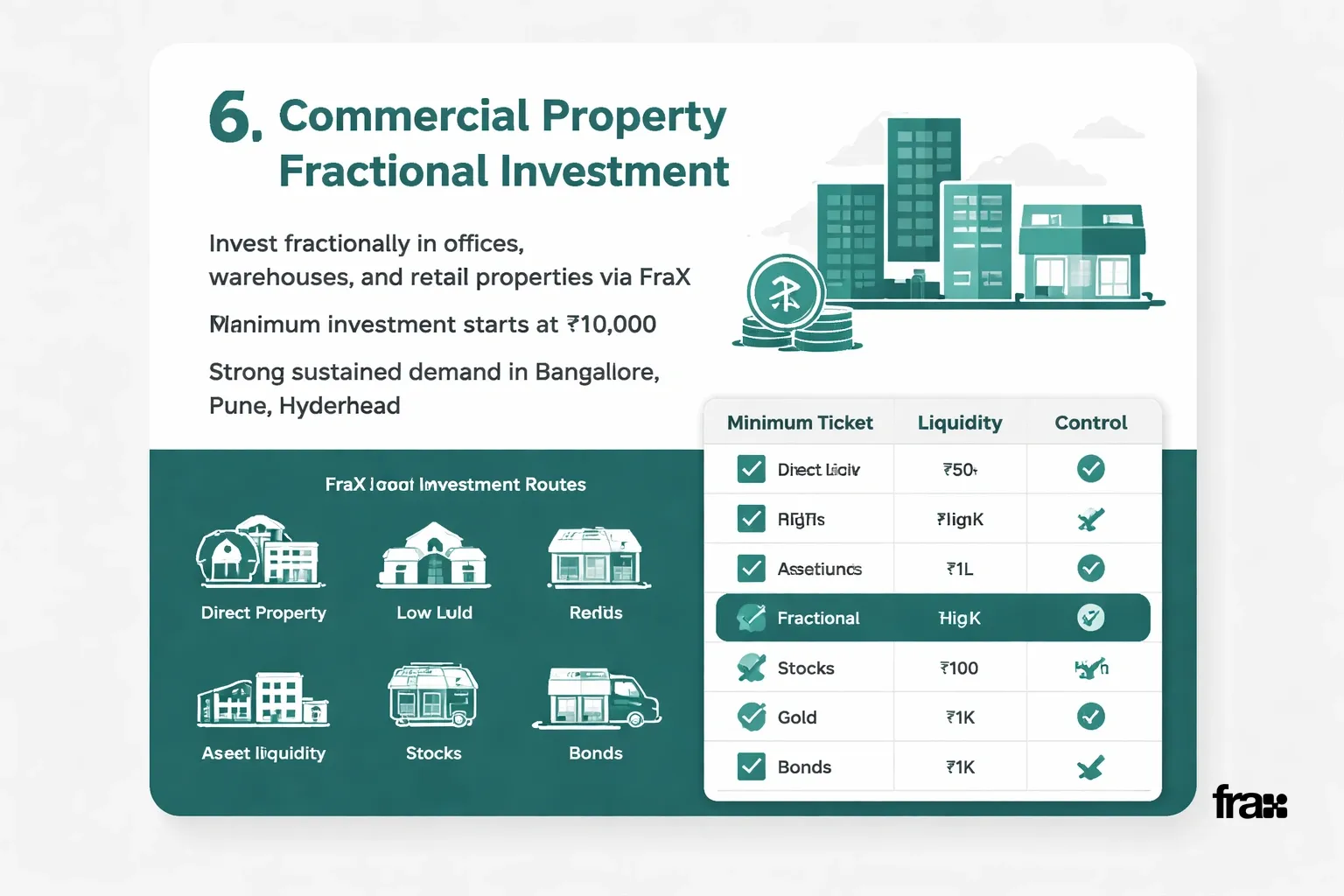
This applies fractional ownership specifically to offices, warehouses, and retail. These assets often yield better rents than residential.
Commercial real estate in India has matured. Grade A office space in Bangalore, Pune, and Hyderabad has sustained demand from IT tenants. Platforms like FraX let retail investors access this institutional-grade asset class.
FraX's model lets you invest in commercial property in India from ₹10,000. For more context, check out commercial real estate in India for 2026.
Comparing the Seven Routes
Route | Minimum Ticket | Liquidity | Control Level |
|---|---|---|---|
Direct Property | ₹40L+ | Low | High |
REITs | ₹5,000-10,000 | Medium | None |
REIT Mutual Funds | ₹500-1,000 SIP | Medium | None |
Fractional Ownership | ₹10,000 | Medium-High | Partial |
Real Estate AIFs | ₹1 crore | Low | Low |
Commercial Fractional | ₹10,000 | Medium-High | Partial |
REITs vs InvITs | Varies | Medium | None |
7. How to Invest in Real Estate With No Money (Or Very Little)
"How can I invest with no money?" has a more realistic answer now. You can't invest zero, but ₹10,000 gets you into the game: essentially the price of a smartphone.
A decade ago, the question "how much do you need to invest in real estate" was answered in lakhs. Today, the floor has dropped.
For someone starting small:
Start with ₹10,000 in fractional property to learn the mechanics
Reinvest returns
Diversify across properties
Use liquidity features to manage needs as they arise
This is relevant for FraX's demographic: 80% of users are under 35, testing real estate for the first time. No brokers, no paperwork stacks, no decade-long saving requirement.
This content is for informational purposes only and does not constitute financial, legal, or investment advice.
Explore Fractional Properties on FraX Today
Choosing the Right Route for Your Capital
Three factors matter: capital, liquidity, and appetite for exposure. Under ₹1 lakh? Look at REITs, REIT funds, or fractional. Larger reserves? Direct property or AIFs.
There is no "best" answer, only the best fit. Someone earning ₹15-20 lakh annually will likely find more value in fractional ownership than waiting years for a direct purchase down payment. Investors hold direct beneficial partnership interests in dedicated LLP SPVs, not direct individual property titles.
Diversification matters within real estate, too. Spreading smaller amounts across a few fractional properties reduces the risk of betting everything on one direct purchase. For ideas on markets, check top Indian cities for real estate investment in 2026.
This content is for informational purposes only and does not constitute financial, legal, or investment advice.
A Quick Word on Platform Trust
This content is for informational purposes only and does not constitute financial, legal, or investment advice.
Trust is critical here. FraX was founded in November 2025 by Prabhav Tanay (CEO) and Tushar Chaudhary, both IIT-BHU alumni, under FraX Digital Private Limited.
The platform uses ICICI Bank escrow overseen by Universal Trustees and dedicated LLP SPVs for each property. Investors hold direct beneficial partnership interests in dedicated LLP SPVs, not direct individual property titles. This brings structure to a historically chaotic asset class. Read more on how FraX is digitising real estate investing.
Past performance and realized XIRR figures are historical and do not guarantee future property returns or rental yields. Every route has risks.
Final Thoughts for First-Time Investors
Real estate for beginners no longer means choosing between "save for a decade" or "do nothing." Seven paths exist. Fractional ownership has reshaped what's possible for salaried professionals.
Starting small and understanding the structure matters more than chasing returns. FraX lets you begin with ₹10,000, a fraction of the old cost.
This content is for informational purposes only and does not constitute financial, legal, or investment advice.
Frequently Asked Questions
Q: What is the minimum amount needed to start investing in real estate in India? A: It depends on the route. REIT mutual funds start with SIPs of ₹500-1,000. Fractional ownership like FraX starts at ₹10,000. Direct purchase usually needs ₹40 lakh+.
Q: Can I really invest in real estate with no money at all? A: Not with zero capital. But the barrier is much lower. ₹10,000 now opens doors that previously required lakhs.
Q: Is fractional real estate the same as owning a REIT? A: No. REITs are trusts owning multiple properties; you buy units on an exchange. Investors hold direct beneficial partnership interests in dedicated LLP SPVs, not direct individual property titles.
Q: What are the main benefits of investing in real estate compared to other assets? A: Diversification, tangible asset base, and inflation resilience. It behaves differently from equities and bonds.
Q: How does FraX protect investor money? A: Transactions go through an ICICI Bank escrow account overseen by Universal Trustees. Each property has its own LLP SPV, separating assets for transparency.
Q: Are returns from fractional real estate guaranteed? A: No. Past performance and realized XIRR figures are historical and do not guarantee future property returns or rental yields. All real estate investments carry market risk.
Learn more
Discover more from the latest posts.