

India's 2026 Economic Slowdown: Real Estate Insights & Strategies
Explore India's 2026 economic slowdown effects on real estate. Learn how investors can adapt with smart strategies and diversification.
I keep seeing headlines about an "Indian economy slowdown" for late 2026, and honestly, it's making people nervous. But let's get real: we're looking at GDP growth settling around 6-6.5%, down from the crazy 8%+ post-pandemic highs. That's not a collapse. It’s just cooler growth driven by global trade friction, tighter liquidity, and urban consumers spending a bit less. It’s not a crisis, but it does mean you need to be smarter about where your money goes.
People are right to pay attention to the slowdown talk because it hits everything from job security to asset prices. But if you're a real estate investor, you can't just look at the headlines. Property markets don't react to slowdowns the same way stocks or bonds do. Here's what the current climate actually means for your investments.
This content is for informational purposes only and does not constitute financial, legal, or investment advice.
What Does "Slowdown" Actually Mean for India's Economy in 2026?
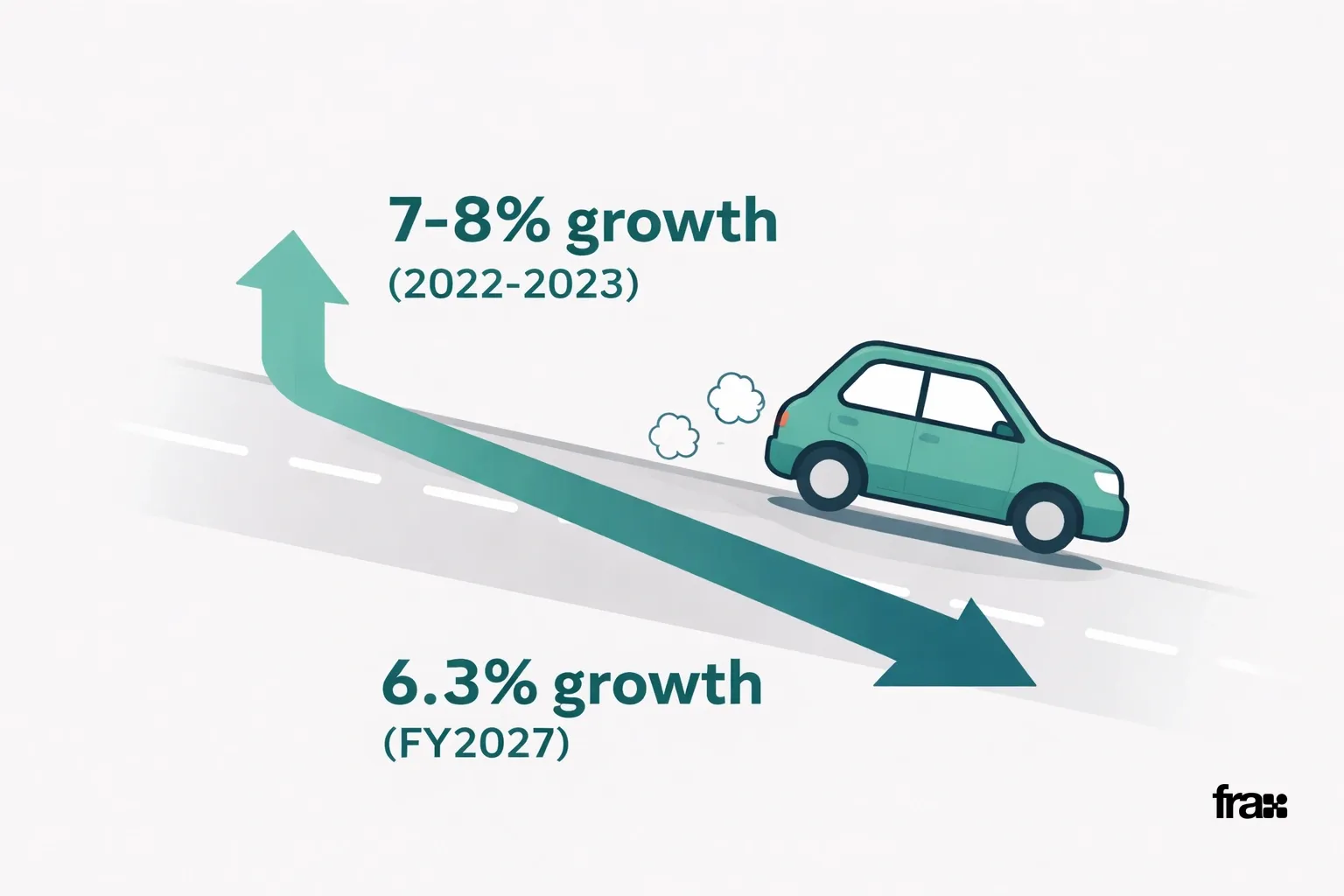
First, let's clear up what "slowdown" actually means here. It’s a deceleration in the GDP growth rate, not the economy shrinking. We’re still growing, just not at the 7-8% clip we saw in 2022-2023. Estimates for FY2027 hover around 6.3%, which is still among the fastest globally, just noticeably cooler.
That distinction is massive. A recession means the economy actually shrinks quarter over quarter, and India hasn't seen that since the pandemic-driven contraction of 2020. A slowdown just means expansion continues with less momentum behind it.
So what's causing the friction? It’s mostly global trade tensions hitting export-oriented sectors, elevated interest rates squeezing borrowing, and softer rural demand thanks to uneven monsoon patterns. Corporate capex cycles are taking longer to materialize, and global commodity price volatility is making input costs unpredictable. If you want the fuller historical picture of how India's GDP has evolved since 2014, our deep dive on India's GDP Growth 2014-2026: Real Estate Insights & Ops covers the decade-long trajectory in detail.
This content is for informational purposes only and does not constitute financial, legal, or investment advice.
Key Indicators Investors Are Watching Right Now
Headline GDP numbers don't tell the whole story. If you're tracking India's economic outlook in September 2026, you need to watch inflation, manufacturing PMI, credit growth, and consumer sentiment indices. Together, these metrics tell you what's actually happening on the ground.
Indicator | 2024 Level | 2026 Level | Trend |
|---|---|---|---|
GDP Growth Rate | 7.2% | ~6.3% | Slowing |
Retail Inflation (CPI) | 5.1% | 4.6% | Stabilizing |
Manufacturing PMI | 58.2 | 54.8 | Softening |
Repo Rate | 6.5% | 5.75% | Easing |
Credit Growth | 16% | 11% | Slowing |
The silver lining here is inflation moderation and a gradual rate-cutting cycle. The Reserve Bank of India has trimmed rates through 2025 and 2026 to prop up growth, which is generally good news for borrowing-cost-sensitive assets like real estate.
This content is for informational purposes only and does not constitute financial, legal, or investment advice.
See How Real Estate Can Anchor Your Portfolio
Why Real Estate Often Holds Steady When GDP Growth Cools
Real estate doesn't usually care as much about short-term GDP dips as equity markets do. Property values are driven by localized supply-demand dynamics, urbanization trends, and infrastructure things that move independently of quarterly growth numbers. That's exactly why real estate comes up so much in diversification conversations during slowdown periods.
Urban housing demand in cities like Bengaluru, Pune, and Hyderabad is holding up fine, even as broader consumption metrics soften. Premium and mid-segment residential and commercial real estate are still attracting capital because they're tied to structural trends: people migrating to cities, rising disposable incomes among the salaried class, and just not enough quality supply. Our detailed breakdown on India's State GDP Growth 2026: Real Estate Insights explores exactly which states are outperforming national averages and why that matters for property investors.
It's worth remembering that real estate doesn't move in lockstep with stock indices. During the 2019 slowdown, equities saw sharp corrections while premium real estate in top metros held relatively steady.
This content is for informational purposes only and does not constitute financial, legal, or investment advice.
Sector-by-Sector Outlook: India's Economy in September 2026
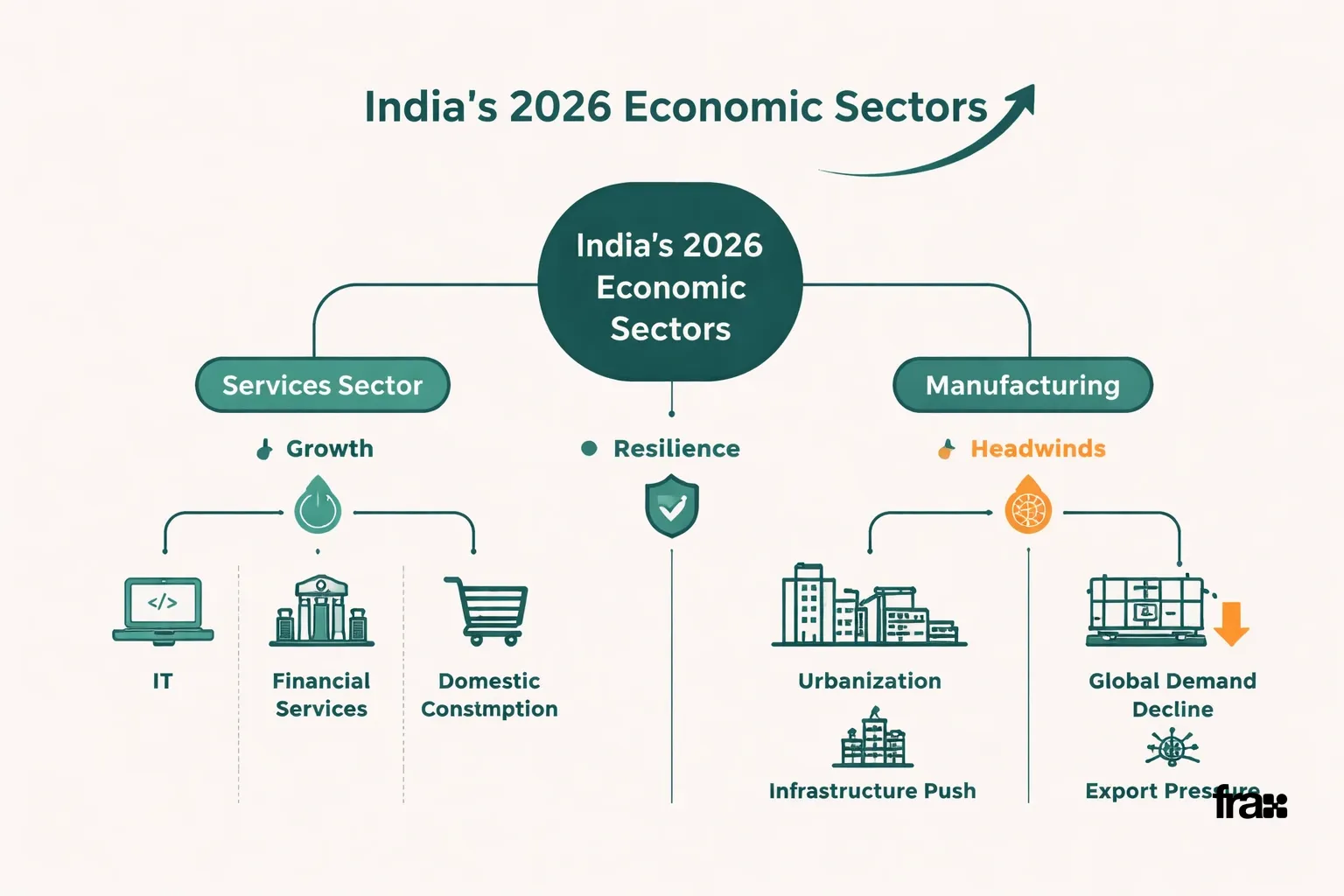
When you look sector-by-sector, the performance is uneven. Services and real estate are outpacing manufacturing and exports. The services sector (nearly 55% of GDP) is still expanding at a healthy clip, driven by IT, financial services, and domestic consumption. Manufacturing, however, is facing headwinds from soft global demand.
The quick snapshot looks like this: Services are growing steadily, supported by domestic demand and the digital economy. Real estate and construction are resilient, benefiting from urbanization and the infrastructure push. Manufacturing is facing export pressure and slower order books. Agriculture is a mixed bag depending heavily on monsoon performance. Financial services are stable, aided by the RBI's easing cycle. If you're curious about the longer arc of how these sectors shifted since independence, the historical analysis in India's GDP Growth Journey 1947-2026 & Real Estate Insights offers valuable context on how India's economy has weathered previous slow periods.
This content is for informational purposes only and does not constitute financial, legal, or investment advice.
How a Cautious Economic Outlook Changes Investment Strategy
A cautious economic outlook usually pushes investors toward assets that offer stability, tangible backing, and lower volatility. That explains the renewed interest in real estate, particularly structured, transparent formats that don't require massive upfront capital. People are prioritizing liquidity and diversification over chasing high-risk bets during uncertain periods.
But let's be honest: traditional real estate, requiring crores of rupees per property, isn't practical for most working professionals right now. That's why fractional models have gained so much traction. Platforms enabling smaller ticket sizes let you spread capital across multiple properties rather than concentrating risk in one asset. If you're new to how fractional ownership actually works mechanically, our guide on Fractional Real Estate Investing in India: How It Works explains the structure in plain language.
This content is for informational purposes only and does not constitute financial, legal, or investment advice.
Start Building a Resilient Portfolio Today
Diversification: The Smartest Response to an Uncertain Outlook
Diversification remains the most reliable strategy when India's economic outlook carries uncertainty. Spreading capital across cities, property types, and asset classes reduces exposure to any single market's downturn. This applies whether you're investing ₹10,000 or ₹10 lakh.
If you're looking at the current climate, it makes sense to split capital across multiple cities instead of just one metro, and balance residential and commercial property exposure. It's also worth combining real estate with REITs for liquidity flexibility, and definitely avoiding concentration in a single developer or project. Our comparison piece on REITs versus fractional ownership walks through how these two vehicles complement each other during cautious economic phases. Meanwhile, the list of Top Real Estate Companies in India & Investment Options 2026 can help you evaluate credible platforms before committing capital.
This content is for informational purposes only and does not constitute financial, legal, or investment advice.
What History Tells Us About India's Past Slowdowns
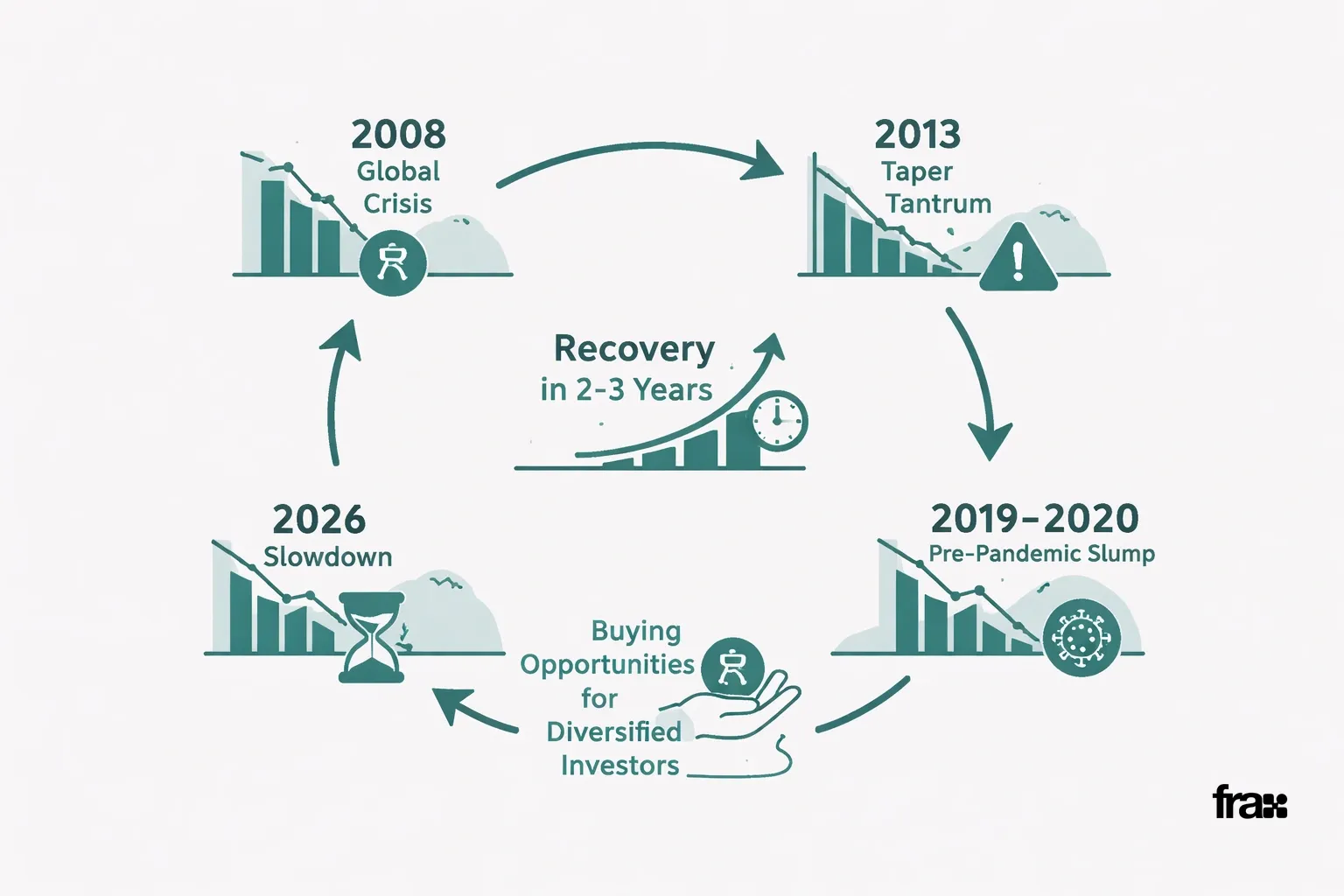
India's economy has navigated multiple slowdown cycles since liberalization, each followed by recovery phases. The 2008 global financial crisis, the 2013 taper tantrum, and the 2019-2020 pre-pandemic slump all triggered similar concerns about a prolonged downturn. Each time, growth eventually rebounded within two to three years.
If you're feeling anxious about current headlines, keep this pattern in mind. Slowdowns are cyclical, not permanent, and they've historically created buying opportunities for patient, diversified investors. Real estate, in particular, has shown resilience across these cycles because underlying demand for housing and commercial space doesn't disappear during temporary growth dips. For a comprehensive look at how growth cycles have shaped property markets over decades, revisit our cornerstone piece on India's Economic Growth and Real Estate Outlook, which ties together the broader trends underpinning this entire cluster of analysis.
This content is for informational purposes only and does not constitute financial, legal, or investment advice.
Practical Steps for Investors Watching the Economic Outlook
Investors should focus on fundamentals rather than reacting to every headline about India's economic outlook. Practical steps include maintaining liquidity, avoiding over-leverage, and choosing investment vehicles that offer flexibility without long lock-in periods. These principles hold true regardless of short-term GDP fluctuations.
Right now, it's smart to keep some capital liquid rather than locking everything into illiquid assets. Prioritize platforms with transparent legal and escrow structures, diversify across property types and geographies, and track quarterly indicators like inflation and PMI rather than reacting emotionally to news cycles. It's also a good idea to revisit your portfolio allocation every six months as conditions evolve. For those exploring how fractional real estate has performed relative to expectations, our article on Fractional Real Estate Returns: Appreciation vs Rental Yield breaks down the two components of returns in this asset class. And if risk management is top of mind, Risk and Reward: A Smart Investor's Guide to Fractional Real Estate is worth reading before allocating fresh capital.
Ultimately, India's economic outlook for late 2026 calls for measured optimism, not panic. Growth is slower, but the fundamentals supporting urban real estate, income growth among salaried professionals, and infrastructure investment remain largely intact. Investors who stay diversified and informed are best positioned to navigate whatever comes next.
You can explore more analysis like this on the FraX blog, or visit the FraX homepage to see how fractional real estate investing fits into a diversified strategy during uncertain economic phases.
Investors hold direct beneficial partnership interests in dedicated LLP SPVs, not direct individual property titles. Past performance and realized XIRR figures are historical and do not guarantee future property returns or rental yields. This content is for informational purposes only and does not constitute financial, legal, or investment advice.
Frequently Asked Questions
This content is for informational purposes only and does not constitute financial, legal, or investment advice.
Q: Is India's economy actually slowing down in 2026? Yes, but it's a deceleration, not a contraction. GDP growth has moderated to roughly 6.3% from the 7-8% highs of 2022-2023. The economy is still growing, just slower.
Q: How does a slower economic outlook affect real estate prices? Real estate tends to be less correlated with short-term GDP swings than equities. Urban housing demand in cities like Bengaluru and Pune has remained relatively resilient during past slowdown phases.
Q: Should I avoid investing during an economic slowdown? No, slowdowns are cyclical and have historically been followed by recovery within two to three years. Past performance and realized XIRR figures are historical and do not guarantee future property returns or rental yields. Many investors use these phases to diversify rather than exit markets entirely.
Q: What indicators should I track to understand India's economic outlook? Focus on GDP growth rate, retail inflation, manufacturing PMI, repo rate trends, and credit growth. Together, they offer a clearer picture than headline GDP figures alone.
Q: Is fractional real estate a good option during uncertain economic times? Yes, fractional models allow smaller ticket sizes starting at ₹10,000, making diversification across cities and property types more accessible. This can help spread risk during cautious growth periods. Investors hold direct beneficial partnership interests in dedicated LLP SPVs, not direct individual property titles.
Q: How long do typical economic slowdowns in India last? Historically, India's slowdown cycles, including 2008, 2013, and 2019-2020, have lasted roughly two to three years before growth rebounded.
Learn more
Discover more from the latest posts.


