
Invest in Commercial Property in India from ₹10K with FraX
Invest in Indian commercial property with low entry: REITs, fractional ownership or direct purchase. Start from ₹10,000 with FraX.
Commercial property investment in India means buying office spaces, retail shops, or warehouses to earn rental income from business tenants. In 2026, you can enter this market through direct purchase, REITs, or fractional ownership platforms starting at just ₹10,000. This finally makes Grade-A commercial assets accessible without needing crores of upfront capital.
Commercial real estate has historically delivered stronger rental yields than residential property, but steep entry costs kept most salaried professionals locked out for decades. Past performance and realized XIRR figures are historical and do not guarantee future property returns or rental yields. This guide breaks down the types of commercial assets, how their yields and risks compare to residential property, and every route available to invest in 2026. We also cover how a platform like FraX lets you invest in fractions of premium commercial buildings and earn proportional rental income without the traditional hassle. Investors hold direct beneficial partnership interests in dedicated LLP SPVs, not direct individual property titles.
This content is for informational purposes only and does not constitute financial, legal, or investment advice.
What Is Commercial Property? Office, Retail and Warehousing Explained
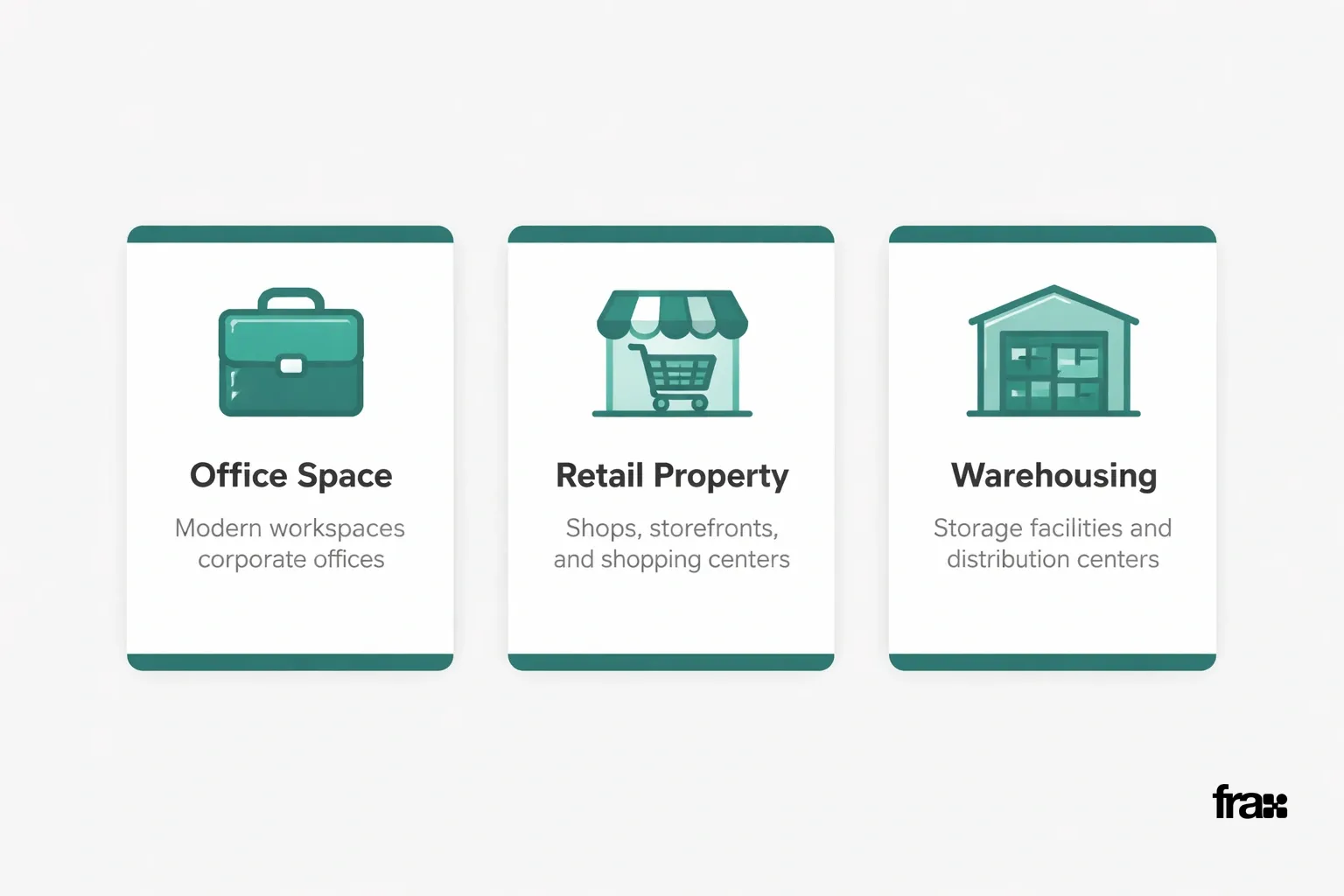
Commercial property is real estate used for business. It covers office buildings, retail shops and malls, and industrial warehousing or logistics parks. Each category attracts a different tenant profile and earns rental income through lease agreements signed with businesses, not individuals.
The three major categories break down like this:
Office Space: Grade-A buildings in business districts like Gurugram, Bengaluru, and Hyderabad. These are usually leased to IT firms, MNCs, and corporate occupiers for 3 to 9 years with periodic rent escalations.
Retail Property: High street shops, standalone stores, and mall units leased to retail brands. Rental income here is tied closely to footfall and consumer spending patterns.
Warehousing and Logistics: Industrial sheds and fulfillment centers near highways and transport corridors, leased to e-commerce and logistics companies as supply chains expand across India.
Each type behaves differently across market cycles. Office demand tracks corporate hiring trends, retail tracks consumer spending, and warehousing tracks e-commerce growth. You can read more about how these segments are evolving in our detailed breakdown of commercial real estate in India for 2026.
This content is for informational purposes only and does not constitute financial, legal, or investment advice.
Difference Between Residential and Commercial Property
The difference isn't just the building type: it's the math. Residential property is leased to individuals or families for living, typically yielding 2 to 3 percent annually. Commercial property is leased to businesses under longer contracts, often yielding 6 to 10 percent, though it carries higher vacancy risk. Past performance and realized XIRR figures are historical and do not guarantee future property returns or rental yields. This content is for informational purposes only and does not constitute financial, legal, or investment advice.
Factor | Residential Property | Commercial Property |
|---|---|---|
Tenant type | Individuals, families | Businesses, corporates |
Typical lease tenure | 11 months | 3 to 9 years |
Rental yield | 2% to 3% | 6% to 10% |
Entry cost | Comparatively lower | Significantly higher |
Vacancy risk | Lower, easy to re-let | Higher, longer vacancy gaps |
Rent escalation | Rare, minor | Built into lease, 5% to 15% |
This gap in yield is exactly why commercial property has traditionally attracted institutional investors and HNIs, while retail investors stuck to residential flats. Fractional ownership platforms now close this gap for everyday earners. You can explore the mechanics of this shift in our guide on fractional commercial property investment for Indian investors.
Is Commercial Real Estate a Good Investment? Yields and Risks
Commercial real estate can be a solid investment if you're chasing higher rental yields than residential property offers. Grade-A office and retail assets in metro cities have historically delivered stronger lease income and longer tenant commitments. However, commercial property also carries concentration risk, longer vacancy periods, and higher capital requirements. Outcomes depend heavily on location, tenant quality, and market timing.
A few things shape whether a commercial asset performs well:
Micro-location: A Grade-A building in a business corridor behaves very differently from a similar building in a secondary location.
Tenant quality: A single large corporate tenant on a long lease reduces turnover risk compared to multiple small tenants.
Asset grade: Grade-A properties with modern infrastructure and amenities typically command premium rents and attract stable occupiers.
Economic cycles: Office absorption and warehousing demand both move with India's broader GDP trajectory. We've tracked this closely in our coverage of India's Q1 GDP growth and its real estate implications.
Commercial property is not a one-size-fits-all answer. It suits investors who understand lease cycles and are comfortable with longer holding periods compared to residential flats.
This content is for informational purposes only and does not constitute financial, legal, or investment advice.
Rental Income From Commercial Property: What to Expect
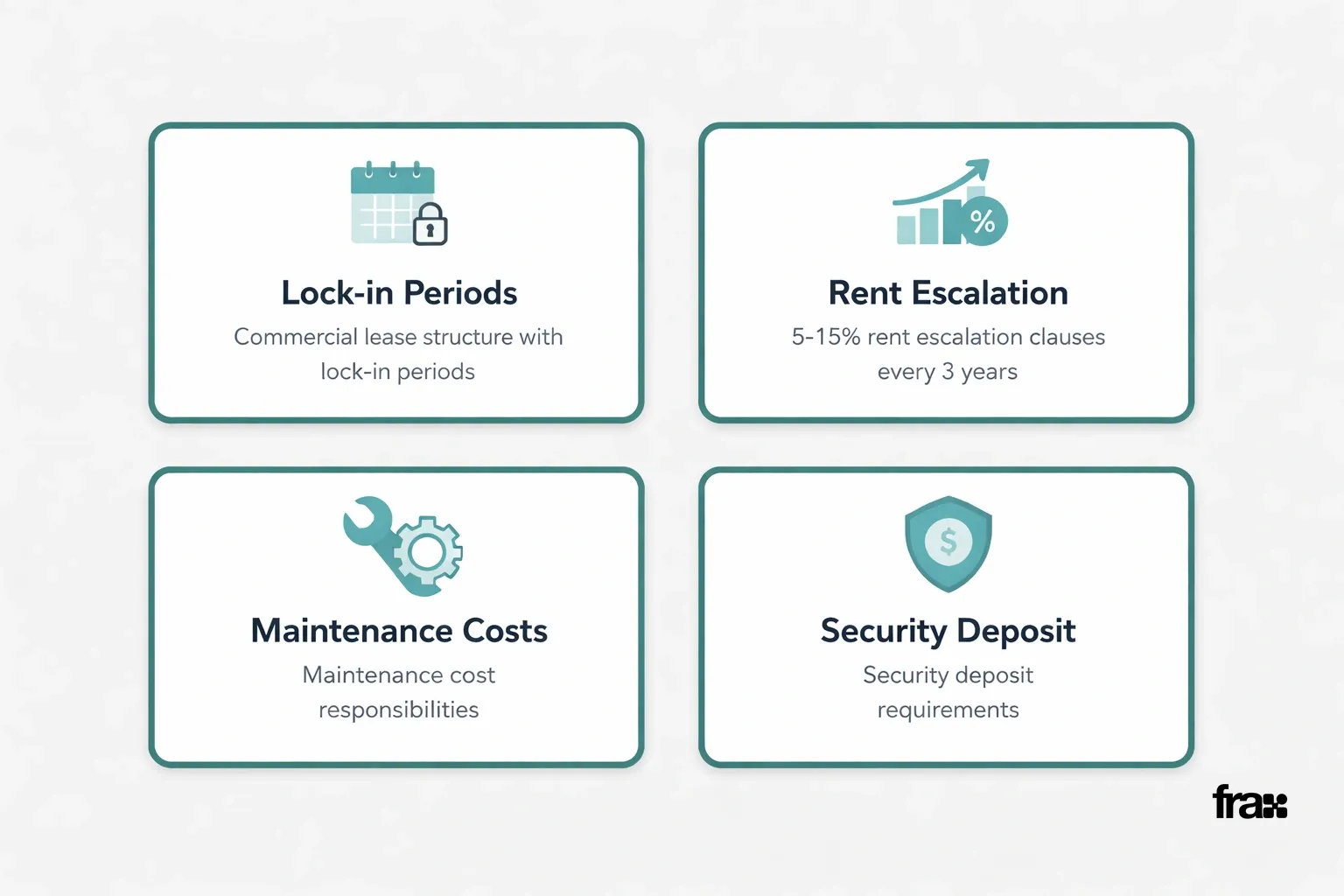
Rental income from commercial property comes from lease agreements signed with business tenants, often for three to nine years. This content is for informational purposes only and does not constitute financial, legal, or investment advice. These leases typically include built-in rent escalations of 5 to 15 percent every few years, giving investors more predictable income growth than short-term residential leases. Past performance and realized XIRR figures are historical and do not guarantee future property returns or rental yields.
Most commercial leases in India follow a structure like this:
A lock-in period during which the tenant cannot vacate without penalty.
A fixed escalation clause, commonly every 3 years.
Maintenance costs often shared or borne by the tenant, depending on the lease type.
Security deposits that cover several months of rent upfront.
This structure is why commercial assets are often viewed as more income-predictable than residential units. However, income still depends on occupancy. A vacant commercial unit earns nothing until re-leased, and re-leasing a large office floor can take longer than finding a residential tenant. Rental income is proportional to ownership share when held through fractional structures, and distributions follow the underlying lease terms of each property. Investors hold direct beneficial partnership interests in dedicated LLP SPVs, not direct individual property titles.
Benefits of Investing in Commercial Real Estate
This content is for informational purposes only and does not constitute financial, legal, or investment advice.
Commercial real estate offers several advantages over residential property for investors chasing income and diversification. Higher rental yields, longer lease tenures, and built-in rent escalations make commercial assets attractive for long-term wealth building. These benefits, however, come with higher entry barriers that historically excluded smaller investors.
Here's a quick rundown of the core benefits:
Higher yield potential: Commercial rental yields of 6 to 10 percent typically outpace residential yields of 2 to 3 percent. Past performance and realized XIRR figures are historical and do not guarantee future property returns or rental yields.
Longer lease stability: Multi-year leases mean fewer tenant turnovers and more predictable occupancy.
Rent escalation clauses: Built-in rent hikes protect income against inflation over time.
Portfolio diversification: Real estate behaves differently from equities and debt, reducing overall portfolio volatility. We go deeper into this in our piece on how fractional real estate reduces portfolio volatility.
Exposure to business growth: Commercial assets benefit directly from corporate expansion, retail growth, and the logistics boom driven by e-commerce.
None of this guarantees returns. Every benefit above is a tendency observed across market cycles, not a fixed outcome for every property.
How to Invest in Commercial Property in India: Three Routes
This content is for informational purposes only and does not constitute financial, legal, or investment advice.
Investors can access commercial property in India through direct purchase, REITs, or fractional ownership platforms. Each route differs significantly in minimum investment, liquidity, and the level of control an investor holds over the asset. Choosing between them depends on capital availability, risk appetite, and how hands-on an investor wants to be.
Route | Minimum Capital | Liquidity | Paperwork & Effort | Control |
|---|---|---|---|---|
Direct Purchase | Usually ₹1 crore+ | Low, resale can take months or years | High, legal due diligence needed | Full ownership and decision-making |
REITs | Market-linked unit price | Exchange-listed units | Low, no property management needed | No direct say in asset selection |
Fractional Ownership (FraX model) | ₹10,000 | Buy & sell anytime, no lock-in period | Minimal, platform handles legal and compliance | Proportional beneficial interest in the LLP SPV |
Investors hold direct beneficial partnership interests in dedicated LLP SPVs, not direct individual property titles.
Direct purchase remains the traditional route but demands significant capital and ongoing management effort. REITs offer a more liquid, publicly traded way to gain diversified commercial exposure, but investors don't choose individual properties. Fractional ownership platforms sit between the two, letting you pick specific Grade-A assets while removing the capital barrier. For a side-by-side look at how these three models stack up, read our detailed comparison on fractional ownership versus REITs versus direct ownership.
If you're still deciding which commercial markets to focus on, our city-wise breakdown of top fractional real estate investment cities in India is a useful next read.
Risks to Watch Before You Invest in Commercial Property
This content is for informational purposes only and does not constitute financial, legal, or investment advice.
Commercial property carries distinct risks that differ from residential real estate. Vacancy periods tend to be longer, tenant concentration can create income gaps, and liquidity remains limited compared to listed instruments. Understanding these risks upfront helps set realistic expectations.
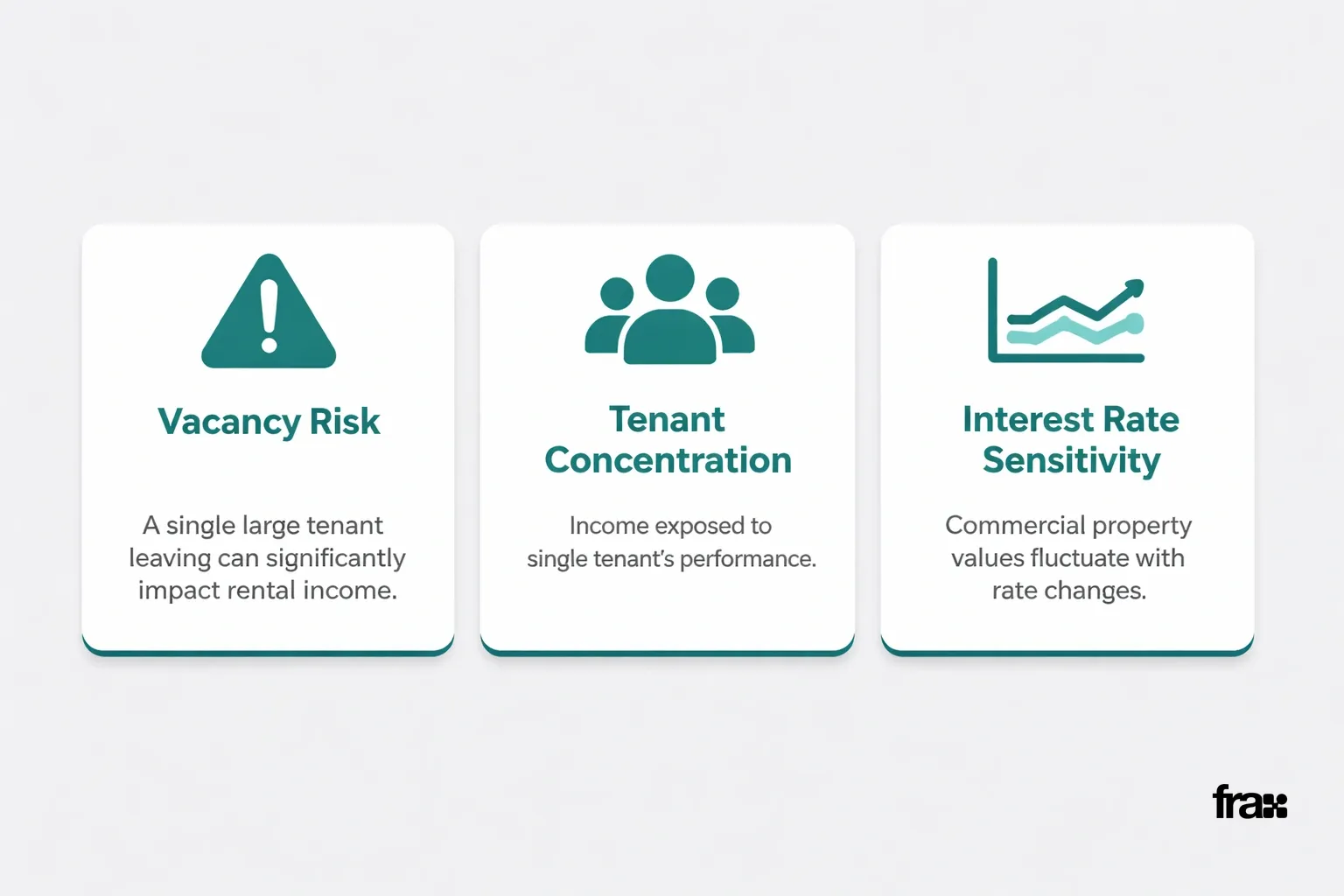
Key risks to keep in mind:
Vacancy risk: A single large tenant leaving can significantly impact rental income until a replacement is found.
Tenant concentration: Fewer, larger tenants mean income is more exposed to any single tenant's business performance.
Interest rate sensitivity: Commercial property valuations can be affected by borrowing cost changes in the broader economy.
Liquidity constraints: Direct commercial property is harder to exit quickly compared to listed securities.
Market cycle risk: Office and retail demand can soften during economic slowdowns. We covered this in our analysis of India's 2026 economic slowdown and real estate strategies.
For a broader framework on managing these risks responsibly, our guide on risk and reward in fractional real estate is worth bookmarking before you invest.
How FraX Makes Commercial Property Investment Accessible From ₹10,000
This content is for informational purposes only and does not constitute financial, legal, or investment advice.
FraX is an investment platform that lets investors own fractions of Grade-A commercial properties starting at ₹10,000. Each property is held through a dedicated LLP SPV, giving investors proportional beneficial interest rather than requiring crores of capital or direct title ownership. This structure brings institutional-grade commercial assets within reach of everyday salaried professionals.
FraX Digital Private Limited was founded in November 2025 by Prabhav Tanay and Tushar Chaudhary, both IIT-BHU alumni. The platform has crossed 40,000+ app downloads with a 4.8 star rating across the App Store and Play Store, and has deployed over ₹3 crore in cumulative investor capital so far. Every transaction runs through an ICICI Bank escrow account, independently overseen by Universal Trustees.
Here's what makes the FraX model distinct:
Low entry barrier: Start with ₹10,000 instead of needing crores for a single commercial unit.
Grade-A assets: Access premium developments, including projects from names like DLF and Max Estate.
Buy & Sell Anytime model: Exit your investment digitally without the rigid lock-in periods common in direct property.
Simple fee structure: A straightforward 1% buy fee and 1% sell fee, with no hidden brokerage layers.
Proportional rental income: Earn rental income distributions proportional to your ownership share in the underlying LLP SPV.
FraX also highlights potential returns of up to 92% over a five-year holding period on select properties. Past performance and realized XIRR figures are historical and do not guarantee future property returns or rental yields. If you're new to how this process works, our step-by-step beginner's guide to your first fractional real estate investment walks through it in detail.
Own a Fraction of Grade-A Commercial Property from ₹10K
Commercial Property for Sale With Rental Income: What to Look For on FraX
Commercial property listings with rental income on FraX show expected yield, lease status, and tenant details upfront before you invest. This transparency lets you evaluate a property's income potential without needing to negotiate directly with brokers or developers. Every listed asset comes with structured legal documentation. This content is for informational purposes only and does not constitute financial, legal, or investment advice.
Before putting money into any commercial listing, run through this quick checklist:
Check the asset grade and location. Grade-A buildings in strong business corridors tend to attract more stable tenants.
Review the lease tenure and escalation clauses tied to the specific property.
Understand the minimum holding expectations, even though FraX supports a buy and sell anytime model.
Look at how rental income is distributed proportionally based on your ownership share in the LLP SPV. Investors hold direct beneficial partnership interests in dedicated LLP SPVs, not direct individual property titles.
Factor in the 1% buy fee and 1% sell fee while calculating expected net returns.
This approach mirrors how institutional investors evaluate commercial deals, just scaled down to a ticket size that fits a 15 to 20 lakh salary bracket. If terms like SPV, escrow, or beneficial interest feel unfamiliar, our beginner's glossary for fractional real estate investment breaks each one down simply.
Explore Live Commercial Property Listings on FraX
Final Thoughts: Is Commercial Property Right for You in 2026?
Commercial property investment suits investors who want higher rental yields and are comfortable with the risks that come alongside them. The traditional barriers crores in capital, paperwork, and broker dependency kept this asset class out of reach for most salaried professionals. Fractional ownership platforms are now changing that equation.
Whether you choose direct purchase, REITs, or fractional ownership, the principle stays the same: commercial real estate rewards patience, due diligence, and realistic expectations. For investors who want exposure to Grade-A commercial assets without the traditional capital and legal burden, platforms built around structured SPVs and escrow-backed transactions offer a practical starting point. You can also explore how safeguards are built into this process in our piece on how FraX protects investor money at every stage.
Investors hold direct beneficial partnership interests in dedicated LLP SPVs, not direct individual property titles. This content is for informational purposes only and does not constitute financial, legal, or investment advice.
Frequently Asked Questions
This content is for informational purposes only and does not constitute financial, legal, or investment advice.
Q: Is commercial real estate a good investment compared to residential property?
A: Commercial real estate typically offers higher rental yields, around 6 to 10 percent, compared to 2 to 3 percent for residential property. It also carries higher vacancy risk and larger capital requirements, so the decision depends on your risk appetite and investment horizon.
Q: What is the difference between residential and commercial property?
A: Residential property is leased to individuals for living, usually on 11 month contracts with lower yields. Commercial property is leased to businesses for 3 to 9 years, typically offering higher yields along with built-in rent escalation clauses.
Q: How can I start investing in commercial property with a small budget?
A: Fractional ownership platforms like FraX let you invest in Grade-A commercial assets starting from ₹10,000. This removes the traditional requirement of crores in capital needed for direct commercial property purchase.
Q: How is rental income from commercial property distributed through FraX?
A: Rental income is distributed proportionally based on your ownership share in the dedicated LLP SPV holding the property. Income depends on the property's occupancy and lease terms.
Q: What risks should I consider before investing in commercial property?
A: Key risks include vacancy periods, tenant concentration, interest rate sensitivity, and limited liquidity compared to listed securities. Reviewing lease terms, tenant quality, and asset grade can help manage these risks.
Q: Does FraX offer direct ownership of commercial property?
A: No, investors hold direct beneficial partnership interests in dedicated LLP SPVs, not direct individual property titles. This structure allows proportional ownership and rental income without the paperwork of traditional property registration.
Learn more
Discover more from the latest posts.