

Understanding SPVs in Real Estate: A Guide for Investors
Discover SPV basics in real estate, investor benefits, differences from traditional ownership, structures, governance, and exit strategies.
SPV stands for Special Purpose Vehicle. It's a separate legal entity created to hold one specific asset, usually a single property. In real estate, an SPV isolates that property's ownership, cash flow, and liabilities from everything else. Investors hold direct beneficial partnership interests in dedicated LLP SPVs, not direct individual property titles.
Group real estate investing has existed for decades, but the legal wrapper around it decides whether your money is actually protected. A poorly structured pool can leave investors exposed to a developer's debts, disputes, or mismanagement. How an SPV works, who governs it, and how exits happen matters just as much as picking the right property.
This content is for informational purposes only and does not constitute financial, legal, or investment advice.
What is a special purpose vehicle in real estate?
This content is for informational purposes only and does not constitute financial, legal, or investment advice.
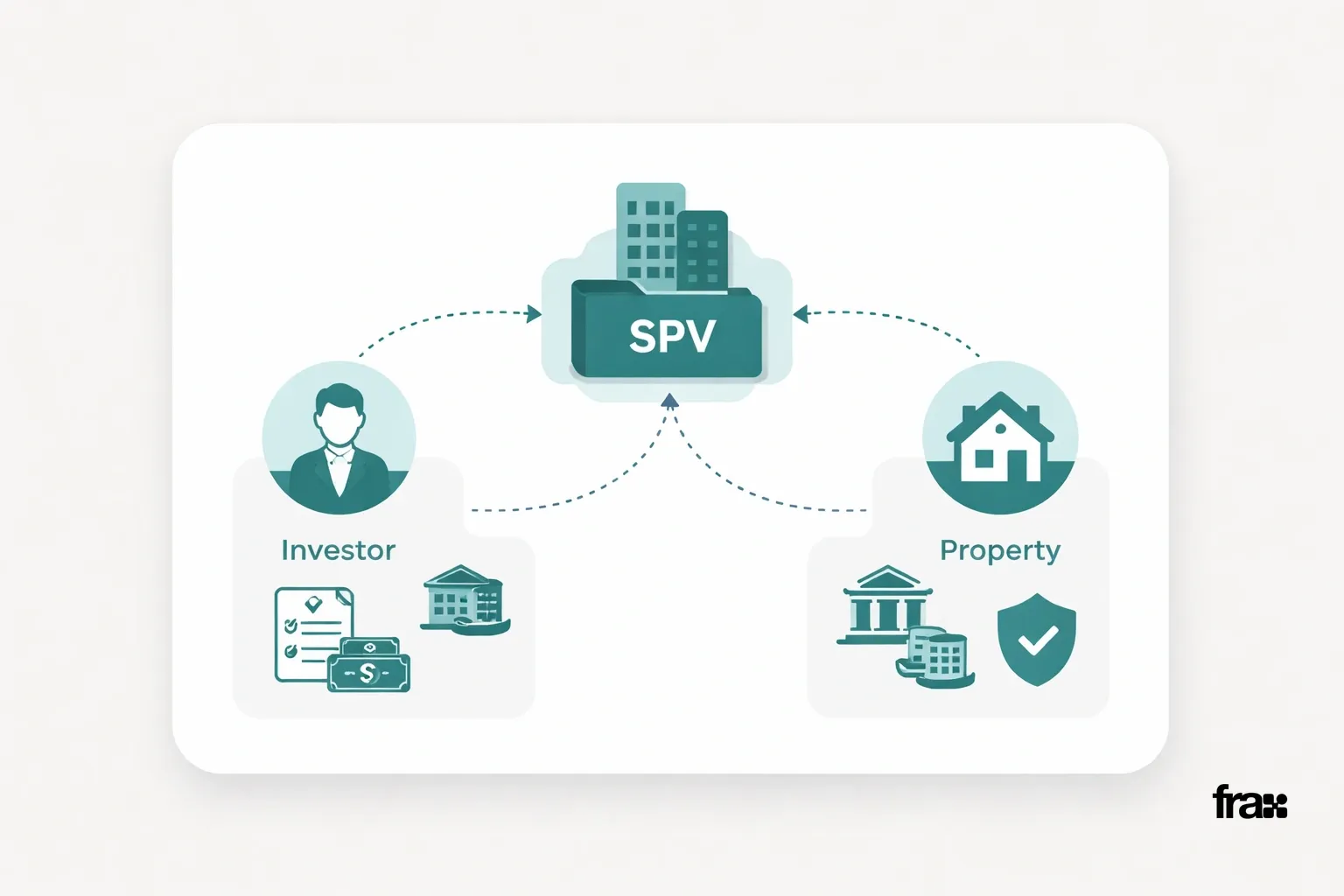
An SPV is a standalone legal entity formed to own one defined asset and nothing else. It is typically structured as a private limited company or a Limited Liability Partnership, each with its own PAN, bank account, and compliance obligations. The SPV, not the individual investor, holds the legal interest in the property.
This separation matters for a few practical reasons. It ring-fences risk, meaning liabilities tied to one SPV cannot spill over into another property or into the sponsor's broader business. It also simplifies ownership transfer. Instead of registering a new sale deed every time an investor exits, shares or partnership units in the SPV change hands. Plus, it creates a clean audit trail for every rupee that flows in or out of that specific asset.
In India, many platforms use a private limited company SPV for each project. Others, including FraX, use a dedicated LLP SPV per property, meaning one property equals one LLP. This LLP structure gives investors a defined partnership interest in that specific asset, governed by a partnership agreement rather than company shareholding rules.
Investors hold direct beneficial partnership interests in dedicated LLP SPVs, not direct individual property titles.
See How FraX Structures Each Property as a Dedicated SPV
Why investors use SPVs for group real estate investing
Group real estate investing works because an SPV turns one expensive asset into many affordable units. A commercial office floor worth crores gets divided into partnership interests, each priced low enough for an individual investor to buy with a modest ticket size.
Without an SPV, pooling money for one property gets messy fast. Informal partnerships rely on personal trust, side agreements, and unclear documentation. If one partner wants out, or a dispute arises, there is often no clean legal mechanism to resolve it.
An SPV fixes this by giving every investor a documented, proportional stake recorded against the entity itself. Consider the practical differences:
Approach | Legal Clarity | Liability Protection | Exit Process |
|---|---|---|---|
Informal pooling with friends | Weak, often verbal | None, personal liability | Difficult, needs consensus |
Co-ownership on one title deed | Moderate, but complex to transfer | Shared property-level risk | Requires fresh registration |
SPV-based fractional structure | Strong, documented partnership interest | Isolated to that one asset | Transfer of units, no re-registration |
This is why fractional real estate ownership in India increasingly relies on SPVs rather than joint title deeds. You can read more about how this model works on the platform's dedicated guide to fractional real estate ownership.
Investors hold direct beneficial partnership interests in dedicated LLP SPVs, not direct individual property titles.
This content is for informational purposes only and does not constitute financial, legal, or investment advice.
SPV governance: how decisions get made

SPV governance determines who manages the property, who approves major decisions, and how investor interests stay protected day to day. Most SPVs appoint a manager or managing partner, often the platform or sponsor, who handles leasing, maintenance, and compliance on behalf of all investors.
Governance documents, whether a company's Articles of Association or an LLP agreement, spell out decision rights clearly. Routine matters like tenant renewals or minor repairs usually sit with the manager. Larger decisions, such as a sale of the underlying property, typically require investor approval beyond a defined threshold.
Transparency is the other pillar of good governance. Investors should expect regular updates on occupancy, rental collection, and expenses. They need access to the SPV's financial statements, clear disclosure of fees charged by the manager, and a defined process for voting on major decisions.
Weak governance is where group real estate investing often fails. It is rarely because the property underperformed: it is usually because investors never knew what was happening until it was too late. This is why evaluating governance quality matters as much as evaluating the asset itself. For a deeper breakdown of how risk shows up across different fractional structures, the risk and reward guide to fractional real estate walks through this in detail.
This content is for informational purposes only and does not constitute financial, legal, or investment advice.
Exit mechanics: getting your money out
This content is for informational purposes only and does not constitute financial, legal, or investment advice.
Exit mechanics describe how an investor converts their SPV interest back into cash. Since there is no public stock exchange for these units, exits generally happen through transfer of partnership or shareholding interest to another buyer, facilitated by the platform, or through a sale of the underlying property itself.
Two broad exit routes exist across the industry. The first is a secondary transfer, where an existing investor sells their SPV units to a new investor through the platform's marketplace. The second is a full property sale, where the SPV disposes of the asset and distributes proceeds proportionally to all unit holders.
Liquidity in fractional real estate is meaningfully better than traditional direct property ownership, where selling can take months of broker negotiations and paperwork. Platforms built around a buy-and-sell model aim to shorten that cycle considerably. Still, it is important to understand this is not comparable to instant exchange-traded liquidity. Transfers depend on finding a counterparty or completing documentation, which takes time even when the process is digital.
It helps to compare this against appreciation-driven versus income-driven exit expectations, something covered in detail in the piece on fractional real estate returns, appreciation versus rental yield.
SPVs vs US real estate syndication investment opportunities

Real estate syndication investment in the United States follows similar logic to SPVs in India, but the legal and regulatory wrapper differs. A US syndication typically pools investor capital into an LLC, with a sponsor, or "general partner," managing the asset and passive investors holding "limited partner" interests.
Real estate syndication investment opportunities in the US are usually offered under specific securities exemptions, often restricted to accredited investors with high income or net worth thresholds. Minimum checks can run into tens of thousands of dollars, putting syndications out of reach for many retail investors.
India's SPV-based fractional model takes a different path. Entry tickets start far lower, often from ₹10,000, which opens premium real estate to a much broader base of working professionals rather than only high-net-worth accredited investors. The underlying principle, pooling capital into a dedicated legal entity holding one asset, is shared across both markets. What differs is accessibility, minimum ticket size, and the regulatory framework wrapped around the structure.
For readers curious about international exposure alongside domestic fractional options, the guide on investing in Dubai property from India covers how cross-border routes compare to local SPV structures.
This content is for informational purposes only and does not constitute financial, legal, or investment advice.
Start Your Fractional Real Estate Journey With ₹10,000
Trust for real estate investment: where trustees fit in
A trust for real estate investment adds an independent layer of oversight between investor money and how it moves. Rather than trusting the platform or sponsor alone to handle funds correctly, an independent trustee monitors the escrow account where investor capital sits before and during deployment.
This matters because capital pooling without oversight creates a single point of failure. If the platform controls funds directly with no external check, investors must rely entirely on that one party's integrity. An independent trustee changes this dynamic by acting as a neutral overseer of the escrow mechanism.
On FraX, investor funds flow through an ICICI Bank escrow account, overseen by Universal Trustees as the independent trustee. This structure means capital movement is monitored by a party separate from the platform itself, adding a layer of accountability before funds reach the property-specific SPV. Combined with proper legal documentation at the SPV level, this creates a two-part safeguard: trustee oversight of cash movement, and a dedicated legal entity holding the asset itself.
This content is for informational purposes only and does not constitute financial, legal, or investment advice.
How FraX structures its LLP SPVs
This content is for informational purposes only and does not constitute financial, legal, or investment advice.
FraX structures every property investment through a dedicated LLP SPV, meaning each property sits inside its own Limited Liability Partnership. One property equals one LLP, with no mixing of assets or liabilities across different properties on the platform.
Investors hold direct beneficial partnership interests in dedicated LLP SPVs, not direct individual property titles. This distinction is important to understand clearly before investing. The LLP structure defines your partnership interest, your share of rental income or sale proceeds, and your rights within that specific entity, governed by the LLP agreement rather than a joint title deed.
This model lets FraX offer a low entry ticket of ₹10,000, a buy-and-sell approach aimed at easier exits compared to traditional direct ownership, and a 1% buy fee plus 1% sell fee as the core platform charges. As of November 2026, the platform has crossed ₹3 crore in cumulative investor capital deployed across its property SPVs, with over 40,000 app downloads and a 4.8 star rating across app stores. FraX Digital Private Limited, founded in November 2025 by Prabhav Tanay and Tushar Chaudhary, built this model specifically to make SPV-based group investing accessible to professionals earning ₹15 to 20 lakh annually, a segment traditionally priced out of premium real estate.
To understand how this compares against owning a whole property outright, the comparison in smart ownership versus fractional real estate breaks down the practical trade-offs. For a city-specific lens on where these SPV-backed opportunities are concentrated, see the guide on commercial real estate in Pune and the broader roundup of fractional real estate in India.
Risks to understand before you invest
SPV-based real estate isn't a magic bullet. It carries real risks that every investor should weigh before committing capital. These are structural realities of pooled property ownership, not quirks of any one platform.
You face illiquidity risk, because exits depend on finding a counterparty or completing a property sale rather than instant market trading. There is concentration risk, since a single SPV holds one property and its performance depends entirely on that asset. Market risk applies, as rental income and property values can fluctuate with local demand and broader economic conditions. And governance risk is always there, where weak oversight or unclear documentation can create disputes down the line.
Past performance and realized XIRR figures are historical and do not guarantee future property returns or rental yields. Comparing fractional SPV models against listed alternatives, such as in the piece on Embassy REIT dividends versus fractional real estate yields, can help set realistic expectations before investing.
SPVs do not eliminate risk; they just put it in a box. Knowing exactly what you hold, a partnership interest in a specific legal entity, governed by clear documentation and overseen by an independent trustee, is the foundation of informed real estate investing in 2026. For a broader view of how fractional structures compare against REITs and other routes, explore the comparison of REITs versus InvITs and the wider list of modern real estate investment routes.
This content is for informational purposes only and does not constitute financial, legal, or investment advice.
Frequently Asked Questions
Q: What is a Special Purpose Vehicle in real estate investing? A: A Special Purpose Vehicle is a separate legal entity, usually a private limited company or LLP, created to hold one specific property. It lets multiple investors pool capital and hold proportional interests without each person holding the title deed directly.
Q: Does owning SPV units mean I own the property directly? A: No. Investors hold direct beneficial partnership interests in dedicated LLP SPVs, not direct individual property titles. Your rights and returns are defined by the SPV's governing documents.
Q: How is an SPV different from a real estate syndication in the US? A: Both pool investor capital into a dedicated legal entity for one asset. US syndications are typically restricted to accredited investors with high minimum checks, while India's SPV-based fractional model often starts from much lower ticket sizes like ₹10,000.
Q: What role does a trustee play in an SPV structure? A: An independent trustee oversees the escrow account where investor funds sit before deployment, adding a layer of accountability separate from the platform. FraX uses Universal Trustees to oversee its ICICI Bank escrow account.
Q: How do investors exit an SPV-based property investment? A: Exits typically happen through transfer of partnership units to another buyer via the platform, or through a full sale of the underlying property with proceeds distributed proportionally.
Q: Are SPV-based fractional investments risk-free? A: No investment is risk-free. SPVs contain and isolate risk to a single asset, but illiquidity, market fluctuations, and concentration risk still apply. Past performance and realized XIRR figures do not guarantee future returns.
Learn more
Discover more from the latest posts.


