

Passive Income India: Real Estate Strategies No Landlord Needed
Explore passive income strategies in India, focusing on real estate investments like REITs and fractional ownership that require no landlord duties.
Passive income in India means earning money without trading hours for a salary. The money comes from assets you have already bought, not work you do today.
Most salaried Indians are asset-poor. You might save well, even park a chunk of your salary in fixed deposits every month. But saving is not investing. Building wealth requires owning things that pay you back rent, interest, or dividends while you focus on your job or your life. This guide prioritizes real estate strategies, specifically fractional ownership, because they solve the biggest problem with Indian real estate: you do not have to be a landlord to profit from it.
This content is for informational purposes only and does not constitute financial, legal, or investment advice.
What Counts as Passive Income in India?

Passive income continues with little daily involvement after setup. It is distinct from a salary because you are not swapping time for money.
The confusion starts because few ideas are truly passive. A rented-out flat sounds passive until the tenant leaves or the plumbing fails. True passive income minimizes the operational drag. If you are comparing real estate routes, knowing which ones require you to fix toilets and which ones do not is the most important distinction.
This content is for informational purposes only and does not constitute financial, legal, or investment advice.
The 10 Passive Income Ideas Compared
Ten ideas dominate the conversation for Indian investors in 2026: fixed deposits, dividend stocks, bonds, REITs, fractional real estate, direct rental property, P2P lending, annuities, royalties, and dividend mutual funds.
Here is a comparison to scan before diving deeper.
Idea | Effort Level | Typical Return Range | Risk Level | Liquidity |
|---|---|---|---|---|
Fixed Deposits | Very Low | 6-7.5% p.a. | Low | High (with penalty) |
Dividend Stocks | Low | 1-4% yield + growth | Medium-High | High |
Bonds / Debt Funds | Low | 6-8% p.a. | Low-Medium | Medium-High |
REITs | Low | 6-9% distribution + growth | Medium | Medium |
Fractional Real Estate | Low | Historically double-digit, varies by property | Medium | Medium (no lock-in model) |
Direct Rental Property | High | 2-3% rental yield + appreciation | Medium-High | Low |
P2P Lending | Medium | 9-12% p.a. | High | Low |
Annuities | Very Low | 5-6% p.a. | Low | Very Low |
Royalties / Digital Products | High upfront, low later | Variable | Medium | Low |
Dividend Mutual Funds | Low | 3-6% yield + growth | Medium | High |
Note: These are historical ranges for context, not promises. Markets move, and every asset class carries risk.
This content is for informational purposes only and does not constitute financial, legal, or investment advice.
Investors hold direct beneficial partnership interests in dedicated LLP SPVs, not direct individual property titles.
Past performance and realized XIRR figures are historical and do not guarantee future property returns or rental yields.
Real Estate-First: The Smart Starting Point
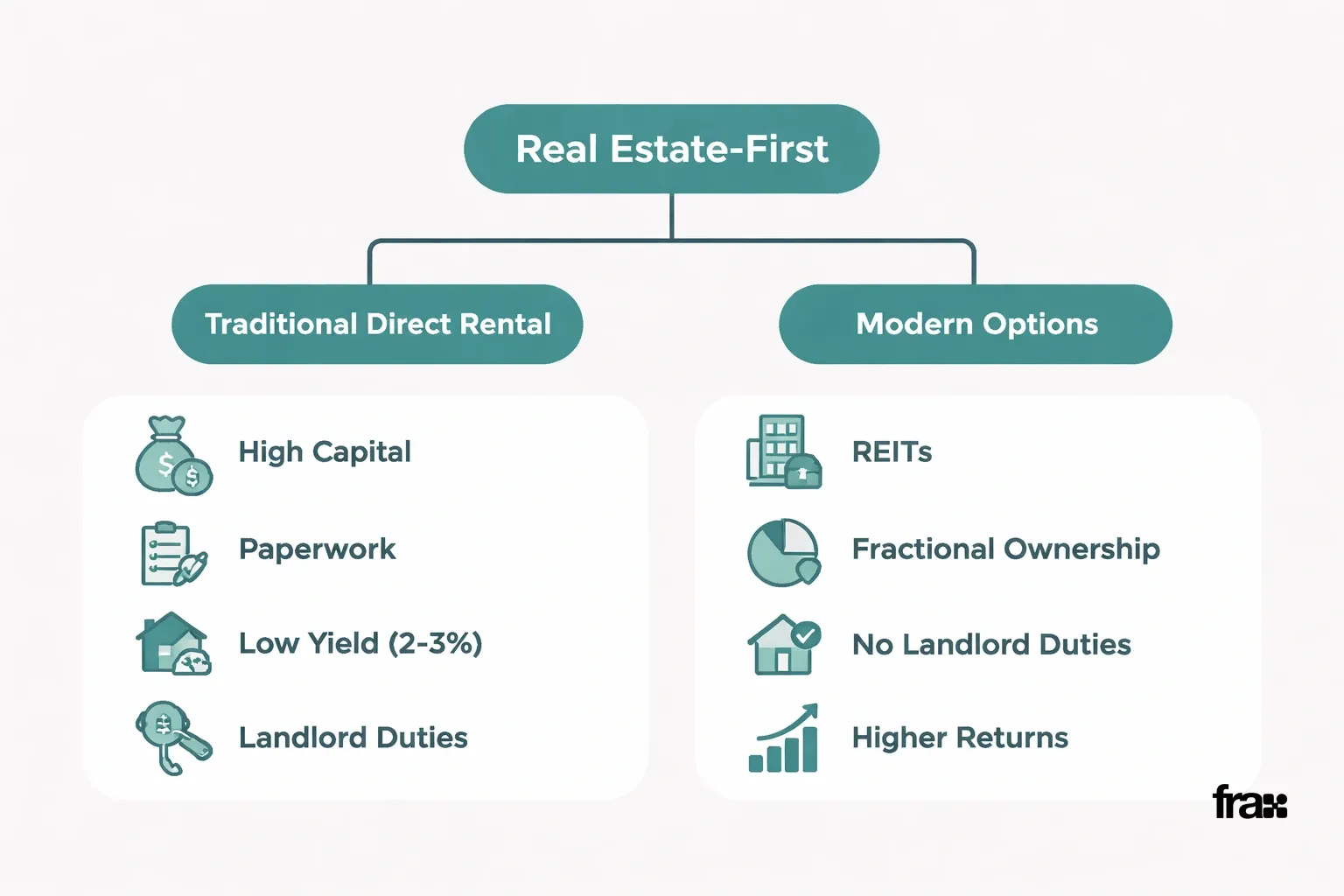
Real estate is a default wealth-building tool in India, but the traditional route demands crores, paperwork, and patience. Modern options like fractional ownership let you capture rental income without the landlord duties.
This content is for informational purposes only and does not constitute financial, legal, or investment advice.
Direct Rental Property: The Hard Way
This is the path everyone's uncle recommends. Buy a flat, rent it out, collect cheques. On paper, it looks great. In reality, you deal with tenant screening, maintenance calls, vacancy gaps, and society disputes.
Rental yields on Indian residential property hover between 2% and 3% annually. That is a low return for the capital locked in. You also need significant money upfront, which makes diversification impossible for most salaried buyers. If you want real estate exposure for passive income, this is usually the least efficient way to get it.
This content is for informational purposes only and does not constitute financial, legal, or investment advice.
REITs: Real Estate on the Stock Exchange
REITs let you buy units of income-generating commercial real estate through the stock market. You get exposure to office parks and malls without owning a single brick. Our REIT investment guide explains how distributions and unit pricing work.
REITs suit investors who want listed, trackable exposure to commercial property. They distribute a large share of rental income periodically, though payouts depend on occupancy and market conditions. Compare this with other routes in our piece on REITs, InvITs, and fractional real estate.
This content is for informational purposes only and does not constitute financial, legal, or investment advice.
Fractional Real Estate: Hands-Off Rental Income
This content is for informational purposes only and does not constitute financial, legal, or investment advice.
Fractional real estate lets multiple investors co-own a specific property through a dedicated legal structure, splitting costs and income. Investors hold direct beneficial partnership interests in dedicated LLP SPVs, not direct individual property titles. You invest a fixed amount, hold a beneficial interest, and receive your share of the returns. You do not handle tenant calls: a managing entity runs operations.
This is the idea behind FraX. Instead of saving for years to afford one property, you start with ₹10,000 and gain exposure to a curated portfolio. Our guide to fractional real estate ownership walks through the mechanics, including how LLP-based special purpose vehicles separate each property's ownership.
Here is what makes fractional ownership genuinely passive:
No tenant management, repairs, or society meetings to attend.
No large upfront capital requirement compared to buying outright.
Transparent legal documentation replaces informal broker deals.
A digital dashboard replaces manual rent collection.
For readers researching how to invest in real estate without being a landlord, this is the closest it gets to a "set it and review it" asset. Past performance and realized XIRR figures are historical and do not guarantee future property returns or rental yields. Read more about the returns in our breakdown of fractional real estate appreciation versus rental yield.
Start Building Real Estate Income from ₹10,000
Commercial Property Through Fractional Routes
Commercial real estate typically offers better rental yields than residential, often in the 6-9% range before any appreciation. Past performance and realized XIRR figures are historical and do not guarantee future property returns or rental yields. Office spaces and warehouses generate steadier cash flows because business tenants sign longer leases. Our overview of commercial real estate in India explains why institutional investors favor this segment.
The barrier was always access: a single Grade-A office floor costs crores. Fractional structures now let individual investors buy into these assets at a fraction of the ticket size. Investors hold direct beneficial partnership interests in dedicated LLP SPVs, not direct individual property titles. We cover this shift in our guide on fractional commercial property investment.
This content is for informational purposes only and does not constitute financial, legal, or investment advice.
Beyond Real Estate: Other Passive Income Streams
Non-real-estate passive income ideas still matter for diversification. Fixed deposits, bonds, dividend stocks, and P2P lending each serve a specific role, usually balancing stability against growth.
This content is for informational purposes only and does not constitute financial, legal, or investment advice.
Fixed Deposits and Debt Instruments
Fixed deposits are India's most familiar passive income tool, offering predictable interest with minimal effort. Banks currently offer roughly 6% to 7.5% per annum. Debt mutual funds and government bonds sit in a similar risk band, often with slightly better liquidity.
These instruments work well for emergency funds and short-term goals. They rarely beat inflation by a wide margin over long periods, which is why they should not anchor your entire wealth plan.
This content is for informational purposes only and does not constitute financial, legal, or investment advice.
Dividend Stocks and Mutual Funds
Dividend-paying stocks distribute a portion of company profits to shareholders, often quarterly or annually. Established companies in FMCG, utilities, and banking tend to pay steadier dividends. Dividend mutual funds pool such stocks to smooth out single-company risk.
Dividend yields in India typically range from 1% to 4%. The real upside comes from long-term price growth, not the dividend itself. This route demands almost no ongoing effort once the portfolio is built, though market volatility can drag down capital value.
This content is for informational purposes only and does not constitute financial, legal, or investment advice.
P2P Lending and Royalties
Peer-to-peer lending platforms let you lend directly to borrowers for interest income, often targeting 9% to 12%. The tradeoff is credit risk: borrower defaults can hurt returns. Royalties from books, music, or digital courses offer a different model, requiring high upfront effort for long-tail passive earnings.
Both can diversify a portfolio, but neither matches the simplicity of real estate-linked instruments for beginners.
This content is for informational purposes only and does not constitute financial, legal, or investment advice.
How to Invest in Real Estate for Passive Income Without Being a Landlord

This content is for informational purposes only and does not constitute financial, legal, or investment advice.
Investing for passive income without landlord duties starts with choosing structured, professionally managed routes like REITs or fractional ownership. These models separate ownership from operations. You earn property-linked returns while a managing entity handles the grind. Past performance and realized XIRR figures are historical and do not guarantee future property returns or rental yields.
The practical steps:
Decide your ticket size. You can start from ₹10,000 through fractional platforms.
Pick a city or asset class. Our best cities for real estate investment guide helps narrow it down.
Review the legal structure. Investments through platforms like FraX are held via dedicated LLP SPVs, one property per LLP. Investors hold direct beneficial partnership interests in dedicated LLP SPVs, not direct individual property titles.
Check fund security. Transactions route through an ICICI Bank escrow account overseen by Universal Trustees.
Track your holding digitally. No physical paperwork to manage.
Our step-by-step guide on your first fractional real estate investment covers this in more depth. You can also read how FraX safeguards investor money at every stage before committing capital.
Explore Fractional Properties on the FraX App
How to Choose the Right Passive Income Mix
Your mix depends on liquidity needs, risk appetite, and how much effort you can handle. A balanced approach usually blends a stable base like debt instruments with growth-oriented real estate exposure.
Younger professionals earning ₹15 to ₹20 lakh annually often have time on their side but no bandwidth for active management. That makes real estate-first passive income via REITs or fractional ownership a strong fit. Our piece on modern real estate investment routes explores how different goals map to different structures.
Before finalizing any allocation, weigh upside and risk honestly. Our guide on risk and reward in fractional real estate is a useful read for this exact decision.
This content is for informational purposes only and does not constitute financial, legal, or investment advice. Investors hold direct beneficial partnership interests in dedicated LLP SPVs, not direct individual property titles. Past performance and realized XIRR figures are historical and do not guarantee future property returns or rental yields.
Frequently Asked Questions
Q: What is the easiest passive income idea for beginners in India? A: Fixed deposits are the easiest to start minimal research, no management. But they offer modest returns compared to equity or real estate over the long term.
Q: How much money do I need to start passive investing in real estate? A: Fractional real estate platforms like FraX allow you to begin with ₹10,000. You do not need to save crores before entering premium real estate.
Q: Can I really earn real estate income without managing tenants? A: Yes. Through routes like REITs and fractional ownership, a managing entity handles tenant relationships, maintenance, and compliance on your behalf. You hold a beneficial interest and receive your share of outcomes.
Q: Is fractional real estate safer than buying property directly? A: Fractional structures add legal safeguards like dedicated LLP SPVs and escrow-managed transactions, which direct purchases often lack. Every real estate investment carries market and property-specific risk, and no return is guaranteed.
Q: How is fractional real estate different from REITs? A: REITs are pooled, exchange-traded vehicles covering multiple properties. Fractional ownership usually ties your investment to a specific property through its own SPV. Our comparison of REITs, InvITs, and fractional real estate explains this distinction.
Q: Which passive income idea has the best liquidity? A: Dividend stocks, mutual funds, and fixed deposits generally offer the highest liquidity. Real estate-linked instruments are less liquid than listed securities but more flexible than direct property ownership.
Learn more
Discover more from the latest posts.


